Mark B. Reyneker — Podiatrist, Foot and Gait Specialist



28 August 2026
By Mark Reyneker, BTech (Podiatry), MSc (Palaeontology), Registered Podiatrist, Foot & Gait Specialist | Founder & Clinical Director, Family Podiatry Centre
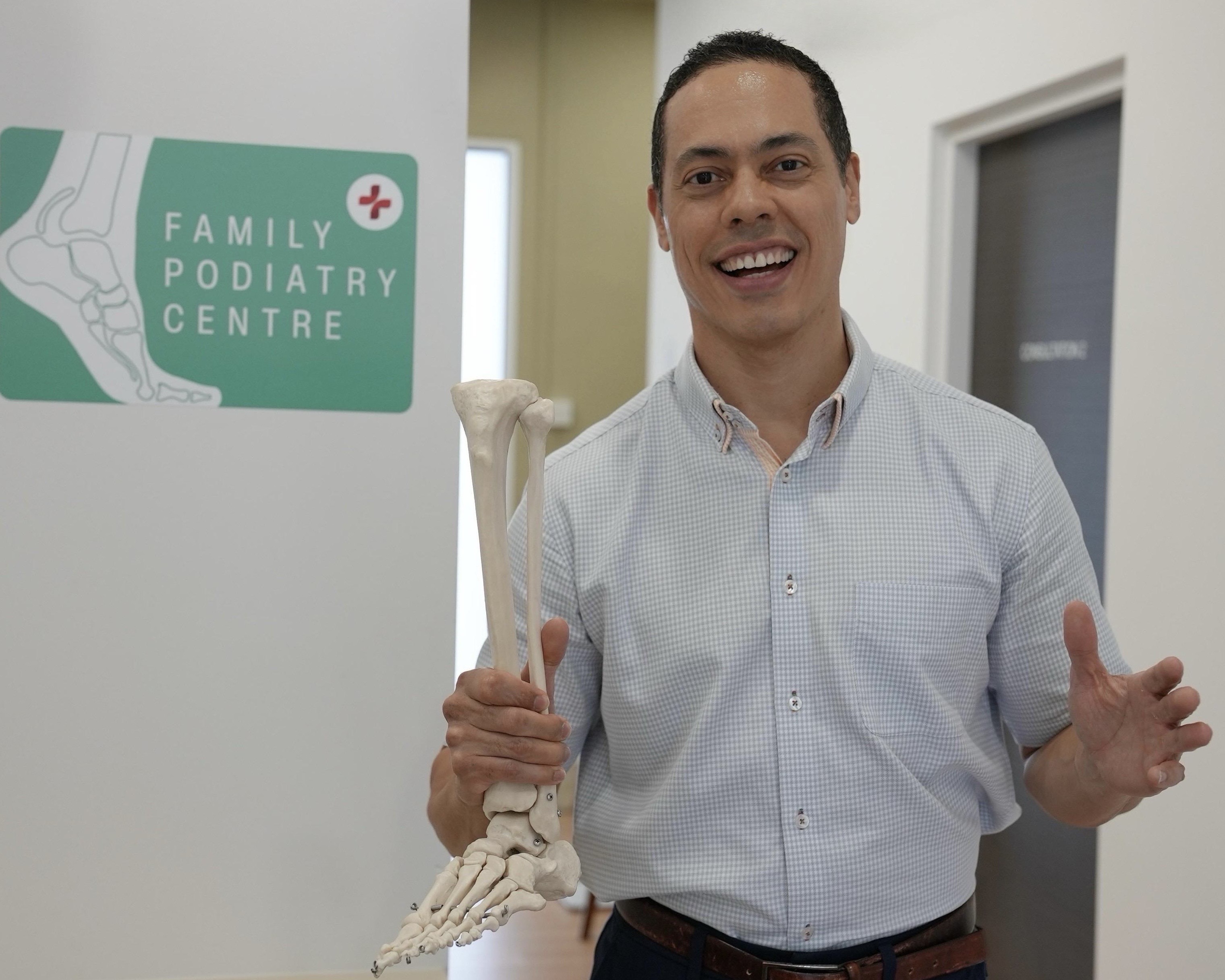
Mark B. Reyneker
Podiatrist | MSc Palaeontology | Podiatrist, Foot and Gait Specialist
More than 25 years in clinical podiatry
Book An Appointment
Mark B. Reyneker is a podiatrist and Founder & Clinical Director of Family Podiatry Centre, with more than 25 years of clinical experience across South Africa, Malaysia and Singapore.
Mark's professional work has centred on a question that has remained remarkably consistent throughout his clinical, academic and product-development career:
How does the human foot function during movement, why does that function sometimes become painful or impaired, and how can an understanding of foot biomechanics contribute to better clinical management?
This interest has taken his work beyond day-to-day clinical podiatry into human gait analysis, orthotic design, footwear, sports biomechanics, medical technology and palaeoanthropology.
His postgraduate research at the University of the Witwatersrand investigated human propulsion through the structural properties of the metatarsals. His clinical work has included orthotic technology, conservative management of musculoskeletal foot disorders, gait analysis, footwear and extensive patient and public education.
He is also the named inventor of A Foot Orthotic, an orthotic invention developed through an international patent family with national-phase protection pursued and maintained in Malaysia and Singapore.
Education & Qualifications
Baccalaureus Technologiae — Podiatry
Baccalaureus Technologiae
Field of Study: Podiatry
University of Johannesburg, South Africa
2001
The degree was completed in accordance with the curriculum of the former Technikon Witwatersrand.
After qualifying, Mark began his professional career in South Africa before relocating to Southeast Asia.
Master of Science — Palaeontology
He completed an:
MSc in Palaeontology
Faculty of Science
University of the Witwatersrand
Johannesburg, South Africa
His dissertation was entitled:
An Investigation into High Gear and Low Gear Propulsion in Human Gait and its Relation to Metatarsal Diaphyseal Geometric Cross-Sectional Properties
The research investigated the relationship between human propulsion and the structural properties of the metatarsal bones, bringing together clinical biomechanics, functional morphology and palaeoanthropology.
The research was supervised by Dr Bernhard Zipfel, with Professor Kristian J. Carlson as co-supervisor. The University of the Witwatersrand repository independently records the dissertation, degree, faculty and supervisors.
Academic reference
Reyneker, M.B. (2022). An Investigation into High Gear and Low Gear Propulsion in Human Gait and its Relation to Metatarsal Diaphyseal Geometric Cross-Sectional Properties. MSc dissertation, Faculty of Science, University of the Witwatersrand, Johannesburg, South Africa.
Read Mark Reyneker's MSc dissertation — University of the Witwatersrand
More Than 25 Years in Clinical Podiatry
South Africa · Malaysia · Singapore
After beginning his career in South Africa, he relocated to Southeast Asia, where he has spent more than two decades practising and developing podiatry services.
During his career, he has been involved in managing multiple podiatry clinics and in the training and professional development of other podiatrists. Historical Family Podiatry Centre records already described him in 2016 as having 16 years of clinical experience across South Africa, Malaysia and Singapore, as well as involvement in CAD/CAM orthotics, research and foot-related intellectual property.
He subsequently founded Family Podiatry Centre, where he remains Founder and Clinical Director while continuing to practise clinically.
His clinical interests include:
- Human gait and foot biomechanics
- Plantar heel pain and plantar fasciitis
- Hallux rigidus
- Hallux valgus and bunions
- Metatarsalgia
- Plantar plate disorders
- Sesamoid disorders
- First metatarsophalangeal joint function
- Flat feet and excessive pronation
- High-arched feet
- Orthotic therapy
- Running-related foot and lower-limb disorders
- Footwear biomechanics
- Paediatric gait concerns
- Ingrown toenails and nail disorders
- Plantar warts
- Age-related changes in foot function
Human Gait & Foot Biomechanics
The human foot performs seemingly competing mechanical roles.
During locomotion, it must provide sufficient adaptability to interact with the ground and accommodate variations in loading while also developing sufficient stiffness during propulsion to transmit forces effectively as the body moves forward.
Understanding how this transition occurs — and what happens when it is altered by anatomy, pathology, injury, footwear or activity — has shaped Mark's approach to foot biomechanics.
His particular interests include:
- Human propulsion
- Forefoot rigidity
- Metatarsal loading
- High-gear and low-gear propulsion
- First metatarsophalangeal joint mechanics
- Windlass function
- Foot stiffening during propulsion
- Plantar-pressure distribution
- Orthotic intervention
- Running biomechanics
- Footwear stiffness
- Interaction between footwear and human foot function
These clinical questions eventually contributed to his decision to investigate the human foot from an evolutionary and anthropological perspective.
Palaeoanthropology & Evolution of the Human Foot
A podiatrist can observe someone walking or running, examine joint movement, assess loading patterns and relate these observations to symptoms.
Palaeoanthropology presents a different challenge.
Researchers studying past populations may have skeletal remains but no direct observation of how an individual moved during life.
Bone, however, is biologically responsive to its mechanical environment. Its structure can therefore preserve information relating to the mechanical loading experienced during life.
Mark's MSc research explored this relationship within the human metatarsals.
His research investigated cross-sectional geometric properties of the metatarsals and their relationship to high-gear and low-gear propulsion in human gait.
This work contributed to his continuing interest in an important question in clinical biomechanics:
How much variation in human foot structure and function is normal?
The human foot demonstrates substantial anatomical and functional variation. Understanding that variation is relevant not only to palaeoanthropology, but also to how clinicians interpret contemporary gait and foot mechanics.
Read the original research at the University of the Witwatersrand
Connecting Evolutionary Biology with Clinical Podiatry
Modern humans, however, use that anatomy in environments substantially different from those experienced during much of human evolutionary history.
We walk predominantly on manufactured surfaces. We place our feet inside footwear. We participate in highly repetitive sports. Modern athletic shoes may incorporate highly compliant foams, rigid plates, rods and rocker geometries.
For Mark, this makes the relationship between anatomy, movement, loading, environment and footwear particularly interesting.
It does not mean that modern foot disorders can simply be explained as evolutionary mismatches.
Instead, evolutionary anatomy provides an additional framework through which human variation and foot function can be investigated.
This perspective connects Mark's work in clinical biomechanics, footwear, human gait research and medical education.
Orthotic Therapy & CAD/CAM Technology
His work has included the adoption and development of computer-aided design and manufacturing methods for custom foot orthoses, with Family Podiatry Centre developing an in-house CAD/CAM orthotics capability.
Mark does not regard a foot orthosis simply as an “arch support.”
Rather, an orthotic forms part of the mechanical interface between:
the foot → the shoe → the ground.
Depending on the clinical problem, an orthotic may be prescribed to redistribute plantar loading, accommodate structural variation, alter the mechanical environment experienced by symptomatic tissue or influence aspects of foot function.
His longstanding interest in the possibilities and limitations of orthotic design eventually led to the development of his own orthotic invention.
Inventor — A Foot Orthotic
The invention describes an orthotic incorporating a base structure together with a detachable medial component, providing a means of altering aspects of the configuration of a pre-moulded orthotic.
The concept addressed a practical issue in orthotic therapy: conventional prefabricated orthoses generally have predetermined geometry, while fully customised orthoses require individual prescription and manufacturing.
The invention explored an intermediate approach in which aspects of orthotic configuration could be modified using interchangeable components.
International Patent Family
Invention: A Foot Orthotic
International Application: PCT/MY2014/000213
International Publication: WO2015009139A1
Priority Date: 17 July 2013
Publication Date: 22 January 2015
The international patent publication continues to appear in subsequent patent literature and has, for example, been cited by a patent examiner in relation to later orthosis technology.
View the international patent record for A Foot Orthotic
Malaysia
Application: PI 2013701253
Patent Owner: Mark Brenden Reyneker
Invention: A Foot Orthotic
Date of Grant: 14 August 2018
The Malaysian patent has subsequently been maintained through renewal procedures.
Singapore
Based on: PCT/MY2014/000213
Applicant: Reyneker, Mark, Brenden
Invention: A Foot Orthotic
The invention also entered the Singapore national phase.
Patent correspondence relating to the Singapore member of the family records a 12th-year annuity falling due on 14 July 2025, demonstrating continued maintenance of the Singapore patent right at that time.
For accuracy, the Singapore filing is identified here by its Singapore application number rather than describing it as a granted patent until the corresponding public grant record and grant number are independently verified.
From Orthotics to Footwear
Clinical practice repeatedly presented a practical problem: patients requiring footwear capable of accommodating orthoses or particular foot characteristics frequently felt that suitable footwear looked unnecessarily medical or orthopaedic.
This contributed to Mark's involvement in footwear development and the creation of Solescape.
His continuing interests in footwear include:
- Shoe geometry
- Orthotic accommodation
- Forefoot stiffness
- Longitudinal bending stiffness
- Rocker geometry
- Toe-box geometry
- Footwear stability
- First MTP joint function
- Running footwear
- Hybrid-sport footwear
- Interaction between footwear technology and human propulsion
His intellectual-property activity has subsequently extended into additional footwear concepts, including PaleoGait.
Running, Sport & Performance Footwear
Modern performance footwear provides an increasingly interesting intersection between clinical biomechanics and sports technology.
Running and training shoes now incorporate technologies including carbon-fibre plates, composite rods, rocker geometries, highly compliant and resilient foams, altered longitudinal bending stiffness and specialised forefoot geometries.
These technologies can influence the behaviour of the combined foot-shoe system.
Mark's particular interest is in how footwear technology interacts with the mechanisms used by the human foot during propulsion, including first metatarsophalangeal joint movement, forefoot rigidity and foot stiffening.
Hallux Valgus & Conservative Bunion Management
An important part of his approach is distinguishing between the structural deformity itself and the symptoms occurring around it.
This distinction matters because reducing pain, swelling or inflammation does not necessarily mean that the underlying angular deformity has been corrected.
Mark's multimodal approach to conservative bunion management received coverage in Singapore's The Business Times.
The article discussed an approach incorporating interventions such as orthoses, splinting, footwear changes and management of gait-related factors. Mark also distinguished the treatment of symptomatic inflammation from correction of the underlying bunion angle.
That distinction — symptomatic improvement is not necessarily structural correction — remains an important principle in discussing conservative hallux valgus management.
Read the original Business Times article — “Intimate boost”
Medical Writing & Evidence-Based Patient Education
He writes extensively about foot health, gait, biomechanics, footwear and lower-limb disorders for patients and the general public.
His objective is to make complex medical and biomechanical concepts understandable without removing the scientific mechanisms necessary to understand them properly.
His medical writing covers subjects including:
- Plantar fasciitis and plantar heel pain
- Heel fat-pad disorders
- Hallux rigidus
- Hallux valgus
- Plantar plate injuries
- Metatarsalgia
- Orthotic therapy
- Footwear
- Minimalist and barefoot footwear
- Running biomechanics
- Plantar warts
- Ingrown toenails
- Paediatric gait
- Human gait
- Evolution of the human foot
Where appropriate, articles reference peer-reviewed scientific literature and authoritative medical sources.
An important editorial principle is the distinction between:
scientific evidence · biological plausibility · clinical interpretation · clinical experience
These can inform one another, but they are not interchangeable.
Where scientific evidence is uncertain, conflicting or incomplete, this should be made clear to the reader.
Selected Media & Expert Commentary
His documented media history extends back more than 15 years.
The Star — Barefoot Running & Biomechanics | 2010
The article considered the arguments surrounding barefoot running at a time when minimalist footwear was attracting considerable international attention.
Mark discussed the subject from a podiatric and biomechanical perspective and cautioned against overly generalised conclusions about barefoot running. The original article remains available in The Star's archive.
This provides a public record of Mark discussing running, footwear and biomechanics in 2010 — subjects that remain central to his clinical and research interests today.
Read the original 2010 article in The Star — “The experts explain”
Health & Beauty Magazine | 2012
“An afternoon with Dr. Mark Reyneker.”
The feature discussed the human foot and its role in standing, walking and running.
The historical publication and its June 2012 date remain recorded in Mark's professional publication history.
The Business Times — Bunions | 2016
The original article remains accessible through The Business Times website.
Read the original Business Times article
Television & Broadcast Media
These have included an interview with Channel 8 Singapore concerning his approach to conservative bunion management, alongside other historical broadcast appearances concerning foot health.
Awards & Professional Recognition
Britishpedia — Successful People in Malaysia and Singapore, 7th Edition | 2025
The published announcement states that he was recognised for contributions to podiatry in Singapore and Malaysia, highlighting innovation, patient care and advancement of the profession in the region. It also discusses his work in CAD/CAM orthotics, shockwave therapy, patented orthotic technology and postgraduate research.
The recognition was publicly announced on 7 May 2025 and subsequently appeared across multiple regional media and news platforms.
Read the published Britishpedia recognition announcement
The Finder — Expatpreneur Awards | 2017
The surviving professional record identifies The Finder Magazine, March 2017, and describes the recognition in connection with Mark's move to Singapore and development of Family Podiatry Centre.
The Finder recognition and later Britishpedia selection reflect different aspects of Mark's professional career — entrepreneurship and practice development, alongside his broader work in podiatry, innovation and clinical education.
A Longstanding Professional Interest in Human Foot Function
2001 — Awarded Baccalaureus Technologiae in Podiatry.
2010 — Featured by The Star discussing barefoot running and biomechanics.
2013–2015 — Development of A Foot Orthotic and entry into the international patent system.
2016 — The Business Times documents Mark's approach to conservative bunion management.
2017 — The Finder Expatpreneur recognition and continued footwear-development activity.
2018 — Malaysian patent MY-167252-A granted.
2022 — MSc research at the University of the Witwatersrand investigating human propulsion and metatarsal structural properties.
2025 — Selected for inclusion in Britishpedia's Successful People in Malaysia and Singapore, 7th Edition.
2025 — 12th-year annuity documented for the Singapore national-phase member of the A Foot Orthotic patent family.
Today — Continuing clinical practice, medical writing, research interests, footwear development and public education in foot health and biomechanics.
Together, these activities document a longstanding professional focus on understanding the human foot across clinical practice, biomechanics, technological innovation and evolutionary research.
Founder & Clinical Director — Family Podiatry Centre
The organisation provides podiatry services in Singapore and Malaysia.
During his career, Mark has been involved in managing multiple clinics and training podiatrists while continuing to practise clinically.
Family Podiatry Centre's clinical scope includes musculoskeletal podiatry, gait assessment, paediatric podiatry, sports-related foot problems, nail and skin disorders and custom foot orthotic manufacturing.
Mark continues to oversee the organisation's clinical direction while remaining involved in patient care, medical education, research interests and product development.
Family Podiatry Centre
Research & Professional Interests
- Human Locomotion
- Human gait · Evolution of bipedalism · Walking and running · Human gait variability · High- and low-gear propulsion
- Functional Morphology
- Metatarsal cross-sectional geometry · Skeletal adaptation to mechanical loading · Forefoot rigidity · Metatarsal functional morphology
- Clinical Biomechanics
- First metatarsophalangeal joint function · Hallux rigidus · Hallux valgus · Windlass mechanics · Plantar pressure · Orthotic therapy · Running biomechanics
- Palaeoanthropology
- Evolution of the human foot · Human skeletal variation · Behavioural reconstruction from skeletal morphology · Relationship between locomotion and skeletal structure
- Footwear
- Performance footwear · Longitudinal bending stiffness · Forefoot rigidity · Rocker geometry · Orthotic-footwear interaction · Footwear and human propulsion
Clinical Philosophy
It does not always explain why it developed in a particular person.
This distinction is central to Mark's clinical approach.
Foot and lower-limb disorders can result from complex interactions between:
anatomy → movement → loading → tissue capacity → activity → footwear → environment → disease
For musculoskeletal conditions, identifying the symptomatic structure may therefore represent only the beginning of the clinical investigation.
The mechanical environment in which that structure operates may also be relevant.
At the same time, biomechanics should not be used to explain every foot disorder.
The objective is not to identify as many biomechanical abnormalities as possible. It is to determine which findings are actually relevant to the patient's symptoms, function and goals.
This approach may combine clinical examination, gait assessment, plantar-pressure analysis, footwear evaluation, diagnostic investigations where appropriate and consideration of the patient's activities.
The purpose is ultimately straightforward:
to understand the problem sufficiently well to make its management more rational.
Qualifications & Professional Information
Full name in academic and intellectual-property records: Mark Brenden Reyneker
Professional qualification
Baccalaureus Technologiae — Podiatry
University of Johannesburg, South Africa
2001
Completed in accordance with the curriculum of the former Technikon Witwatersrand
Postgraduate qualification
Master of Science — Palaeontology
University of the Witwatersrand
Johannesburg, South Africa
2022
Professional role
Founder & Clinical Director
Family Podiatry Centre
Clinical experience
More than 25 years
Countries of clinical practice
South Africa · Malaysia · Singapore
Principal professional interests
Podiatry · Human gait · Foot biomechanics · Orthotic therapy · Footwear biomechanics · Palaeoanthropology · Human foot evolution · Metatarsal functional morphology
Selected Academic Work
Supervisor: Dr Bernhard Zipfel
Co-supervisor: Professor Kristian J. Carlson
Read the full MSc dissertation — University of the Witwatersrand
Selected Intellectual Property
A Foot Orthotic
International Application: PCT/MY2014/000213
International Publication: WO2015009139A1
Priority: 17 July 2013
View the international patent publication
Malaysia
Patent: MY-167252-A
Application: PI 2013701253
Patent Owner: Mark Brenden Reyneker
Granted: 14 August 2018
Singapore
Singapore Patent Application No.: 11201510031P
Based on: PCT/MY2014/000213
Applicant: Reyneker, Mark, Brenden
Invention: A Foot Orthotic
The Singapore member entered the national phase and was the subject of a 12th-year annuity due on 14 July 2025.
Editorial & Medical Content Standards
Where appropriate, articles reference peer-reviewed scientific research and authoritative medical sources.
Scientific evidence, clinical interpretation, biological plausibility and individual clinical experience are not treated as equivalent forms of evidence.
Where evidence is conflicting, emerging or incomplete, this should be acknowledged.
Articles should display their original publication date and the date on which they were most recently medically reviewed or substantially updated.
Educational information published on this website does not replace individual clinical assessment, diagnosis or treatment by an appropriately qualified healthcare professional.
A Singapore Court of Appeal Decision in Digital Advertising & Trademark Law
Selected Original & Independent Sources
University of the Witwatersrand — Mark B. Reyneker MSc dissertation
International intellectual property:
A Foot Orthotic — WO2015009139A1
Media — running biomechanics:
The Star — “The experts explain” (2010)
Media — bunion management:
The Business Times — “Intimate boost”
Professional recognition:
Britishpedia recognition announcement — 2025
Professional website:
Family Podiatry Centre
Book An Appointment
Frequently Asked Questions
Mark Reyneker (BTech Podiatry, MSc) is a registered podiatrist, foot and gait specialist, and the Founder and Clinical Director of Family Podiatry Centre, operating practices across Singapore and Malaysia
Mark holds a Bachelor of Technology in Podiatry and a Master of Science (MSc) degree. He is a registered podiatrist with over two decades of international clinical experience specializing in lower-limb biomechanics, advanced gait analysis, and non-surgical foot pathomechanics.
Mark Reyneker treats patients across Family Podiatry Centre’s clinics located in Singapore (Joo Chiat & Bukit Timah) and Kuala Lumpur, Malaysia (Taman Tun Dr Ismail / TTDI).
Mark specializes in complex foot and lower-limb conditions, including chronic heel pain (plantar fasciitis, heel fat pad atrophy), Achilles tendinopathy, bunions (Hallux Valgus), flat feet, pediatric foot conditions (Sever's disease, growing pains), and runner/sports biomechanics.
Mark’s clinical practice is rooted in evidence-based, non-surgical podiatry. Instead of masking symptoms with temporary injections or medication, he focuses on diagnosing and correcting the underlying biomechanical and structural root causes of lower-limb pain.
Mark focuses primarily on conservative, non-surgical management. He utilizes advanced diagnostic technology, custom biomechanical offloading, 3D gait analysis, and non-invasive therapies like Shockwave Therapy (ESWT) to help patients recover without needing surgery.
Under Mark Reyneker's clinical leadership, custom orthotics are engineered in-house using precise 3D gait and pressure modeling. They are custom-designed to correct specific joint angles, control excessive pronation, and offload damaged tissue rather than serving as soft gel cushions.
Yes. Mark frequently treats endurance runners, hybrid athletes (HYROX), and recreational sports players, using motion analysis and sports-specific orthotics to treat injuries and optimize running efficiency.
Yes. Mark has extensive experience in pediatric podiatry, diagnosing and managing conditions like pediatric flat feet, in-toeing ("pigeon-toed"), toe walking, and developmental heel pain like Sever’s disease.
Yes. Mark’s evidence-based research emphasizes that recurrent nighttime leg or foot pain in children is often caused by structural strain and flat foot mechanics rather than growth itself. He provides gentle orthotic correction to eliminate this strain.
Yes. He provides specialized diabetic foot assessments, nerve/circulation monitoring, calloused skin debridement, and custom offloading footwear to prevent diabetic ulcers and lower-limb complications.
Yes. Mark utilizes non-invasive Extracorporeal Shockwave Therapy (ESWT) as a primary non-surgical treatment for chronic soft-tissue and bone injuries, such as resistant plantar fasciitis, calcaneal periostitis, and Achilles tendinopathy.
During a gait analysis, Mark and his clinical team evaluate your dynamic walking/running pattern using specialized pressure sensors and motion capture to identify abnormal foot roll, joint asymmetry, and high-impact loading points.
Yes. Mark provides comprehensive non-surgical bunion management aimed at stabilizing overpronation, offloading the first metatarsal joint, halting deformity progression, and removing pain without bone surgery.
You can book a consultation directly through the official Family Podiatry Centre website or by contacting the Singapore (Joo Chiat / Bukit Timah) or Kuala Lumpur (TTDI) clinic reception lines via phone or WhatsApp.
In most cases, a doctor’s referral is not required to schedule a consultation with a podiatrist at Family Podiatry Centre, though certain insurance providers may request one for claim reimbursement.
Many international and local private health insurance plans cover podiatry consultations and custom orthotics. It is best to check with your specific insurance provider regarding podiatry benefits.
An initial consultation typically lasts 30 to 45 minutes, allowing time for a full medical history review, physical lower-limb examination, biomechanical assessment, and treatment plan discussion.
Mark and his multidisciplinary team at Family Podiatry Centre accommodate diverse local and international patients, offering consultations in English, Malay, and other regional languages across Singapore and Malaysia clinics.
Family Podiatry Centre is recognized for its transparent, patient-centered care. Patients choose Mark Reyneker for his deep biomechanical expertise, advanced clinical technology, in-house orthotic manufacturing, and commitment to long-term pain resolution without aggressive treatment packages.