Did the Human Big Toe Evolve for Walking or Running? The Evolution of Our Toes, Foot Arch and Plantar Fascia



24 September 2026
By Mark Reyneker, BTech (Podiatry), MSc (Palaeontology), Registered Podiatrist, Foot & Gait Specialist | Founder & Clinical Director, Family Podiatry Centre
Did the human big toe evolve for walking or running?
Running becomes particularly interesting when we consider our unusually short toes. Experimental research found little mechanical penalty from longer toes during walking, but substantially greater digital-flexor demands during running. This raises the possibility that toe shortening was favoured as our ancestors became increasingly capable endurance runners.
The modern human foot therefore probably does not represent a single adaptation. Its basic architecture was shaped by millions of years of bipedal walking, while some later features may have made walking—and especially running—more economical.
Did the Human Big Toe Evolve for Walking or Running?
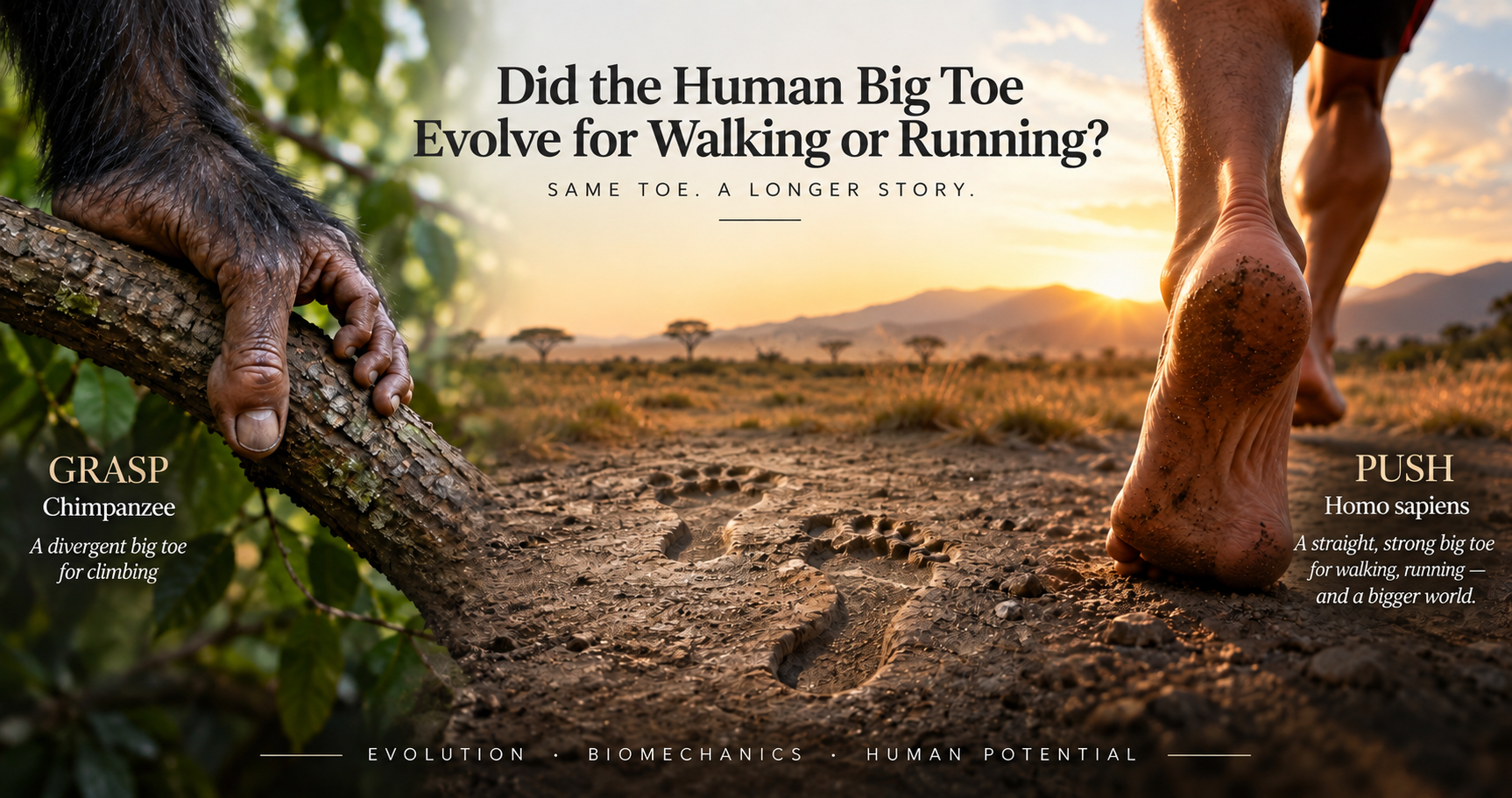
Now compare that with the foot of a chimpanzee. The difference is striking. The chimpanzee hallux diverges away from the other toes and is capable of participating in grasping. That is extremely useful when moving through trees.
Somewhere during our evolutionary history, however, the hominin foot began abandoning much of this grasping ability and became increasingly specialised for moving the body across the ground. The big toe moved into line. The toes became shorter. The foot developed increasingly human-like arches and stiffness. And eventually our lineage acquired a foot capable not only of remarkably efficient walking, but also sustained running.
This raises an intriguing question:
Did the human big toe evolve for walking or running?
By approximately 3.66 million years ago, however, the Laetoli footprints show substantially more human-like foot function, including an aligned hallux participating in terrestrial bipedal locomotion. This happened long before the appearance of the body proportions commonly associated with endurance running in later Homo. Running becomes particularly interesting when we consider another characteristic of the modern human foot: our toes are unusually short.
The modern human foot may therefore contain layers of evolutionary history. Its basic architecture reflects millions of years of bipedal walking. Some of its later specialisations may have made both walking and, particularly, running more economical.
Before we walked on two legs, our feet could grasp
In many living primates, the big toe diverges considerably from the other digits. Together with long, often curved toes, this allows the foot to wrap around branches and other objects. Chimpanzees provide a useful living comparison. Their feet are not simply inferior versions of human feet. They are specialised for a different locomotor repertoire. A divergent hallux is extremely useful when climbing.
But once a lineage becomes increasingly committed to terrestrial bipedalism, the mechanical requirements change.
- accepting body weight,
- supporting balance,
- transferring forces,
- becoming sufficiently stiff during propulsion,
- and interacting efficiently with the ground during repeated steps.
Ardipithecus: walking with a grasping big toe
And it tells us something extremely important: our ancestors began walking on two legs before they possessed a modern human big toe. That immediately challenges a common misconception about human evolution. We did not first evolve a modern foot and then start walking. Bipedalism began first. The foot continued changing afterwards.
Then something remarkable happened
Laetoli: the big toe joins the direction of travel
- upright bipedal walking,
- an adducted hallux,
- a functional longitudinal arch,
- lateral-to-medial transfer of loading,
- and propulsion involving the big toe.
By approximately 3.66 million years ago, the big toe had become substantially incorporated into terrestrial bipedal locomotion. And that date is crucial. It is far earlier than the appearance of the classic long-legged Homo body form usually discussed in relation to endurance running. This provides our first major clue. Running cannot easily explain the initial alignment of the human big toe. Walking came first.
Why would walking favour a straight big toe?
Instead of functioning primarily to wrap around something, the hallux can participate in supporting and transmitting forces beneath the medial forefoot. This becomes particularly important during late stance. But something else happens when the toes dorsiflex. They interact with the plantar fascia.
The big toe became connected to a mechanical windlass
The analogy is a windlass: a cable being wound around a drum. The hallux therefore does much more than simply provide a surface from which we “push off”. Its movement interacts mechanically with structures extending all the way back toward the heel.
Modern research has shown that the foot is considerably more complicated than a purely passive windlass. Muscles, ligaments, joint geometry and both the longitudinal and transverse arches contribute to foot stiffness. Nevertheless, the principle remains important. The big toe became incorporated into an increasingly integrated propulsive system.
But walking does not explain everything
Did running help make our toes shorter?
The researchers wanted to know whether that additional mechanical demand mattered equally during walking and running. It did not. During walking, longer toes produced relatively little additional digital-flexor demand. During running, the effect was dramatically greater.
Their modelling suggested that increasing relative toe length by only 20% could approximately double peak digital-flexor impulse and mechanical work during running. That is an extraordinary difference. It suggests that simply becoming a habitual walker may not fully explain why modern human toes became so short. Running provides another possible selective pressure.
Long toes become expensive when you run
This does not prove that humans evolved short toes because our ancestors ran. Evolutionary hypotheses rarely permit such simple conclusions. But it does demonstrate something important: short toes provide a much more obvious mechanical advantage during running than during ordinary walking. That makes running an extremely plausible part of the evolutionary story.
Then Homo appears
These included changes involving:
- relatively long legs,
- shorter toes,
- enlarged lower-limb joint surfaces,
- improved trunk stabilisation,
- enlarged gluteus maximus,
- the nuchal ligament,
- elastic tendons,
- and spring-like structures within the foot.
Many of these features become particularly evident with Homo, beginning roughly around 2 million years ago. Humans are not particularly impressive sprinters compared with many quadrupedal mammals. But we possess another unusual ability. We can run for a surprisingly long time.
Why would our ancestors need to run?
Running may also have been useful for reaching animal carcasses before competitors or scavengers. But we need to distinguish an attractive evolutionary narrative from what the fossil record can actually demonstrate. We cannot watch a two-million-year-old hominin running. Nor can we determine precisely how frequently different species ran.
What we can examine is anatomy. And later Homo increasingly possessed anatomical characteristics that would have made endurance running more economical than it was for earlier hominins. The exact selective pressures responsible remain open to scientific debate.
The chronology gives us an important answer
Ardipithecus ramidus:
Laetoli:
~3.66 million years ago
Human-like aspects of bipedal foot function and a substantially adducted hallux.
Later Homo:
Increasing evidence of body proportions and anatomical characteristics compatible with efficient endurance running. This sequence matters. It tells us that the evolution of the human foot probably occurred in stages.
Stage 1 — climbing plus early bipedalism
Early hominins retained considerable arboreal capability. The foot still needed to grasp.
The plantar fascia adds another twist
Sichting and colleagues (2020) examined plantar aponeurosis anatomy across primates. Their work indicates that the basic anatomical configuration of the human plantar aponeurosis has much deeper evolutionary origins. Chimpanzees possess a broadly comparable arrangement. So our ancestors probably did not suddenly “invent” a plantar fascia when they became terrestrial bipeds. Instead, evolution appears to have modified and repurposed an existing structure. This is common in evolution. Old anatomy acquires new functions.
The plantar fascia becomes part of a spring
Ker and colleagues demonstrated this elastic behaviour of the human arch in classic experimental work in the 1980s. But later research revealed something particularly interesting about running.
What happens if we stop the arch from working normally?
An anatomical system already useful during walking becomes particularly advantageous when humans start running. And the big toe is connected to this spring. This is why the evolution of the big toe cannot really be separated from the evolution of the rest of the foot.
The plantar fascia extends towards the toes. The hallux interacts with it as the first metatarsophalangeal joint dorsiflexes. Behind the hallux sits the first metatarsal. Beneath that sit the sesamoids. Behind them are the midfoot and arches.The intrinsic foot muscles help regulate stiffness. The Achilles tendon and calf muscles contribute enormous forces from above.The entire system interacts. Evolution was therefore not simply changing a toe. It was changing a locomotor system.
Why the sesamoids matter
Their position tells us something about the mechanical specialisation of the human first ray. The modern hallux is not simply aligned with the other toes. It sits at the end of a remarkably reinforced mechanical pathway. That becomes clinically obvious when something goes wrong with the sesamoids. Despite being tiny, sesamoid injuries can dramatically affect walking and running.
Was the big toe really the star of this evolutionary story?
The modern human foot is therefore better understood as an integrated mechanical structure than as a collection of individual bones.
My own research made this particularly interesting
Essentially, I was interested in how humans distribute forces across the forefoot and whether habitual loading might leave structural signatures within the metatarsals themselves. This work reinforced something I think is important both clinically and evolutionarily. There is no reason to assume that every human uses the forefoot in precisely the same way.
The evolution of an aligned hallux created the anatomical capacity for powerful medial forefoot propulsion. But humans retain considerable variation in how forces travel across the foot. Different environments, activities, anatomy and locomotor strategies may all influence forefoot loading. The big toe is important. But it functions as part of a five-ray forefoot. That distinction becomes important whenever evolutionary anatomy is translated into modern clinical advice.
Evolution does not prescribe how you should run today
Understanding how our ancestors evolved tells us why certain structures exist. It does not necessarily tell us what every modern person should do.
A modern runner may be:
- 20 or 70 years old,
- highly trained or completely sedentary,
- accustomed to shoes or accustomed to barefoot activity,
- running on trails or concrete,
- carrying more body mass,
- recovering from injury,
- living with arthritis,
- or possessing very different foot morphology from another runner.
Evolution provides context. It is not a universal treatment prescription. This distinction is particularly important when discussing barefoot and minimalist footwear.
Evolution also does not create perfect anatomy
Those changes provided enormous advantages. But the same mechanically specialised structures can also develop problems. Hallux valgus. Hallux rigidus. Sesamoid injuries. Plantar fascia disorders. Metatarsal stress injuries. Modern pathology does not mean that evolution “failed”. It reflects the reality that biological structures operate under competing demands, considerable individual variation and environments that can be very different from those in which they evolved.
Walking probably started the story
Did the human big toe evolve for walking or running?
Running may have helped finish the transformation
The Rolian experiments provide a particularly intriguing clue. Longer toes appear relatively inexpensive during walking. During running, however, they become substantially more mechanically demanding. That makes toe shortening much easier to understand if running formed part of the selective environment affecting later hominins.
Likewise, experimental restriction of arch compression appears to make running measurably more metabolically expensive. These findings do not prove that running created the modern human foot. But they make it increasingly difficult to explain every aspect of our foot using walking alone.
A 4.4-million-year experiment beneath your feet
The answer is not walking versus running
Walking began the transformation.
Running may then have refined it.
We did not evolve a walking foot or a running foot.
We inherited a grasping primate foot, transformed it into a walking foot, and then continued modifying it until it became remarkably good at running too.
Book An Appointment
Disclaimer: The word "treatment" in this article refers to the care and management of a patient’s health to prevent, cure, or improve a condition. Treatment results vary and do not necessarily indicate a cure. This article is for informational and educational purposes only and does not constitute medical advice.
About the Author
Mark B. Reyneker, BTech (Podiatry), MSc (Palaeontology) is a podiatrist and Founder & Clinical Director of Family Podiatry Centre, with more than 25 years of clinical experience across South Africa, Malaysia and Singapore. His clinical interests include foot and lower-limb pain, gait and biomechanics, sports-related foot conditions, orthotic therapy and footwear.
Alongside his clinical practice, Mark conducts research into human gait and foot biomechanics. His MSc research at the University of the Witwatersrand investigated human propulsion and the structural properties of the metatarsals. He is also the inventor of A Foot Orthotic, an orthotic technology developed through an international patent family.
References
- Bramble, D.M. and Lieberman, D.E. (2004) ‘Endurance running and the evolution of Homo’, Nature, 432, pp. 345–352.
Available at: https://doi.org/10.1038/nature03052 - Crompton, R.H., Pataky, T.C., Savage, R., D’Août, K., Bennett, M.R., Day, M.H., Bates, K., Morse, S. and Sellers, W.I. (2012) ‘Human-like external function of the foot, and fully upright gait, confirmed in the 3.66 million year old Laetoli hominin footprints by topographic statistics, experimental footprint-formation and computer simulation’, Journal of the Royal Society Interface, 9(69), pp. 707–719.
Available at: https://doi.org/10.1098/rsif. - Hicks, J.H. (1954) ‘The mechanics of the foot. II. The plantar aponeurosis and the arch’, Journal of Anatomy, 88(1), pp. 25–30.
Available at: https://pmc.ncbi.nlm.nih.gov/articles/PMC1244640/ - Holowka, N.B. and Lieberman, D.E. (2018) ‘Rethinking the evolution of the human foot: insights from experimental research’, Journal of Experimental Biology, 221(17), jeb174425.
Available at: https://doi.org/10.1242/jeb.174425 - Ker, R.F., Bennett, M.B., Bibby, S.R., Kester, R.C. and Alexander, R.McN. (1987) ‘The spring in the arch of the human foot’, Nature, 325, pp. 147–149. Available at: https://doi.org/10.1038/325147a0
- Lovejoy, C.O., Latimer, B., Suwa, G., Asfaw, B. and White, T.D. (2009) ‘Combining prehension and propulsion: the foot of Ardipithecus ramidus’, Science, 326(5949), pp. 72e1–72e8.
Available at: https://pubmed.ncbi.nlm.nih.gov/19810198/ - Reyneker, M.B. (2022) An Investigation into High Gear and Low Gear Propulsion in Human Gait and its Relation to Metatarsal Diaphyseal Geometric Cross-Sectional Properties. MSc dissertation. Johannesburg: University of the Witwatersrand.
Available at: https://wiredspace.wits.ac.za/bitstreams/77c0af20-51ed-4347-b71f-6474d01d8a44/download - Rolian, C., Lieberman, D.E., Hamill, J., Scott, J.W. and Werbel, W. (2009) ‘Walking, running and the evolution of short toes in humans’, Journal of Experimental Biology, 212, pp. 713–721.
Available at: https://doi.org/10.1242/jeb.019885 - Sichting, F., Holowka, N.B., Ebrecht, F. and Lieberman, D.E. (2020) ‘Evolutionary anatomy of the plantar aponeurosis in primates, including humans’, Journal of Anatomy, 237(1), pp. 85–104.
Available at: https://doi.org/10.1111/joa.13173 - Stearne, S.M., McDonald, K.A., Alderson, J.A., North, I., Oxnard, C.E. and Rubenson, J. (2016) ‘The foot’s arch and the energetics of human locomotion’, Scientific Reports, 6, 19403.
Available at: https://doi.org/10.1038/srep19403 - Venkadesan, M. et al. (2020) ‘Stiffness of the human foot and evolution of the transverse arch’, Nature, 579, pp. 97–100.
Available at: https://doi.org/10.1038/s41586-020-2053-y
Frequently Asked Questions
Humans possess several anatomical characteristics that make sustained running possible, including relatively long legs, short toes, elastic tendons, an arched foot and effective thermoregulation. However, this does not mean every feature of the human body evolved specifically for running. Bipedal walking appeared millions of years earlier (Bramble and Lieberman, 2004).
We cannot determine an exact date from fossils. Bramble and Lieberman (2004) argued that a suite of characteristics associated with endurance running becomes particularly apparent with the genus Homo, roughly around 2 million years ago. This remains an evolutionary hypothesis rather than evidence for a precise moment when endurance running began.
Shorter toes reduce the external lever acting around the metatarsophalangeal joints. Rolian et al. (2009) found that longer toes imposed relatively little additional digital-flexor demand during walking but substantially greater demands during running, suggesting that running may have contributed to selection for shorter toes.
A divergent hallux is useful for grasping during climbing. As hominins became increasingly committed to terrestrial bipedalism, the big toe became aligned with the other digits and increasingly incorporated into weight bearing and propulsion.
The approximately 3.66-million-year-old Laetoli footprints preserve direct evidence of early hominin foot-ground interaction. Detailed analysis indicates human-like aspects of bipedal foot function, including an adducted hallux and medial forefoot propulsion (Crompton et al., 2012).
Possibly, but fossils cannot establish how often or how effectively Australopithecus ran. Evidence for habitual bipedal walking is much stronger. The more extensive anatomical suite associated with endurance running becomes particularly apparent later in Homo.
Not exclusively. The arches contribute to foot mechanics during both walking and running. However, Stearne et al. (2016) found that restricting normal arch compression increased the energetic cost of running by approximately 6%, suggesting that elastic arch behaviour is particularly valuable during running.
Probably not from scratch. Comparative anatomy indicates that the basic configuration of the plantar aponeurosis predates the modern human foot. Existing primate anatomy appears to have been modified and incorporated into the increasingly specialised hominin foot (Sichting et al., 2020).
The hallux is important in both. During walking it participates in late-stance forefoot loading and propulsion. Running increases the magnitude and rate of loading and places greater demands upon the toes and elastic structures of the foot. Its modern anatomy probably reflects multiple locomotor pressures rather than a single behaviour.
Humans evolved before modern footwear, but that does not mean every modern person should run barefoot. Evolutionary history explains anatomy; it does not automatically prescribe modern footwear or treatment. Conditioning, anatomy, surface, training history, age and pathology all matter.