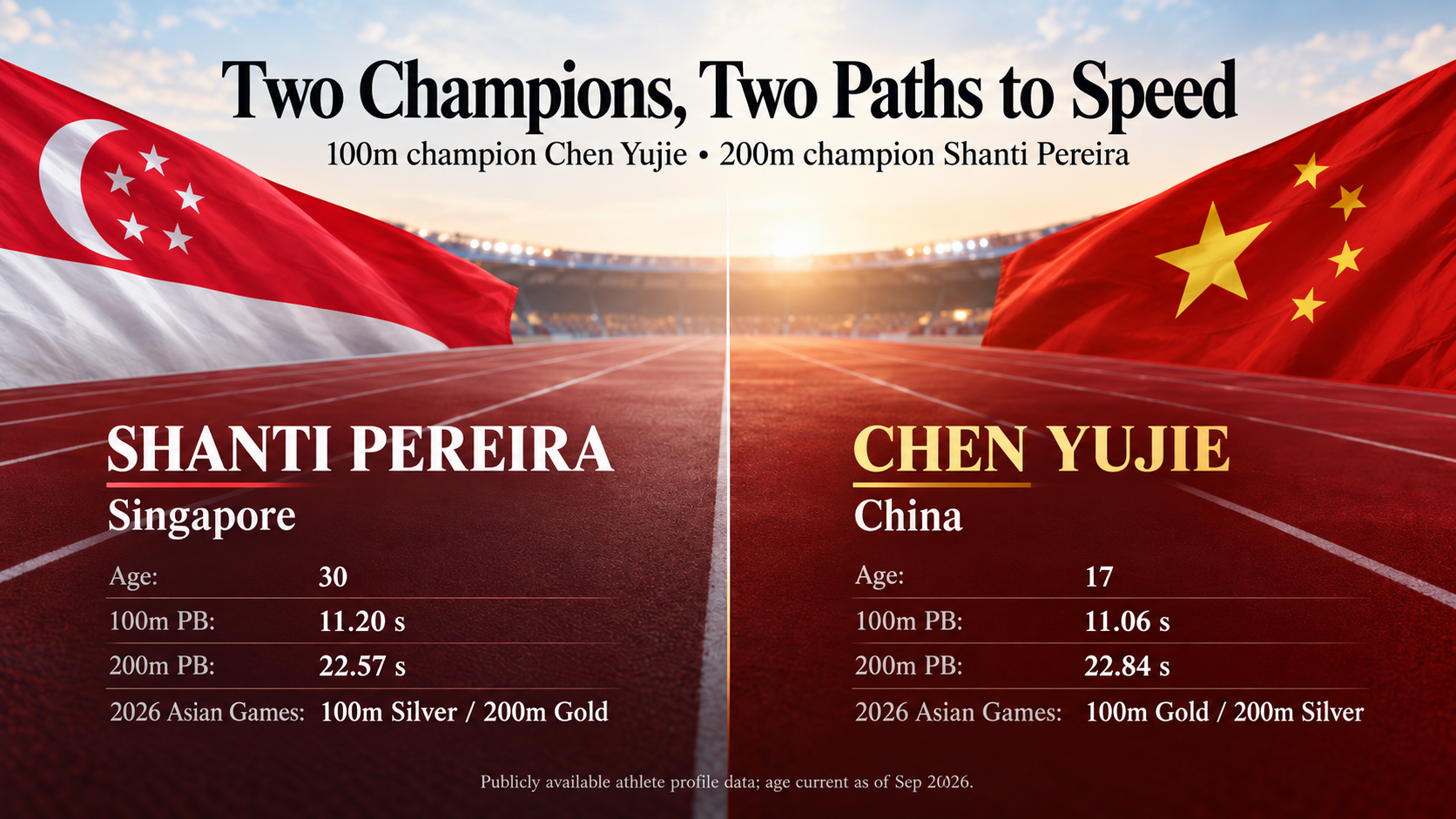
Two Champions, Two Paths to Speed: Chen Yujie and Shanti Pereira



27 September 2026
By Mark Reyneker, BTech (Podiatry), MSc (Palaeontology), Registered Podiatrist, Foot & Gait Specialist | Founder & Clinical Director, Family Podiatry Centre
Published: 27 September 2026 | Last reviewed: 27 September 2026
The women's sprint events at the 2026 Asian Games in Nagoya produced a fascinating contest between two athletes at very different stages of their careers.
The women's sprint events at the 2026 Asian Games in Nagoya produced a fascinating contest between two athletes at very different stages of their careers.
On 25 September, China's 17-year-old Chen Yujie won the women's 100 metres in 11.06 seconds, setting an Asian Games record and improving her own Asian under-20 record. Singapore's Shanti Pereira, aged 30, finished second in a season-best 11.21 seconds.
Two days later, the positions were reversed.
Pereira successfully defended her Asian Games 200 m title, winning in a season-best 22.78 seconds, while Chen took silver in 22.93 seconds. Pereira also became the first woman in Asian Games history to win the 200 m title twice.
Both women are exceptional sprinters. What is particularly interesting, however, is that they have arrived at this level in very different ways.
Chen Yujie: exceptional speed at only 17
Chen was born on 29 December 2008, making her only 17 years old. She has already run 11.06 for 100 m and 22.84 for 200 m, extraordinary performances for an athlete who is still technically and physically developing.
Her progress over the past few years has been rapid. In 2023 she ran 11.56 seconds to win the 100 m at the World School Sport Games. By November 2025 she had reduced this to 11.10, and less than a year later she ran 11.06 in Nagoya.
Perhaps the most interesting part of Chen's development is that her training is not simply about becoming stronger.
Reports from her training describe considerable attention being paid to coordination, arm action and connecting individual movements into one smooth running sequence. Chen herself has explained that learning an individual movement can be relatively easy, but maintaining it and integrating it into the complete sprint action is much harder.
She has also reportedly performed hundreds of arm-swing drills while combining technical training with speed, endurance and strength work.
Watching Chen therefore provides a useful reminder that sprinting ability cannot simply be judged by how muscular an athlete appears. Sprinting is about how rapidly and efficiently the nervous and muscular systems can produce and transmit force.
Shanti Pereira: speed refined through experience
Pereira's story is quite different.
At 30, she has spent more than a decade competing at senior level. Yet some of the biggest improvements of her career actually came relatively late.
Her 100 m personal best remained at 11.58 seconds between 2019 and 2022. After working closely with coach Luis Cunha, however, considerable attention was placed on the small biomechanical details of her sprinting.
One important change involved her starting blocks. Her rear foot was moved farther backwards to improve the position of her hips and knees and allow her to produce force more effectively.
Her first step was also changed. Previously, her foot followed a slightly higher cycling movement as she came out of the blocks. This could cause the foot to land in a position that created unnecessary braking. Training was therefore directed towards keeping the initial movement lower and directing more force forwards.
Through further work on her mechanics, Pereira's maximum stride length during the fastest part of the 100 m increased from approximately 2.06 m to 2.27 m.
This is an important aspect of her story. An experienced athlete does not necessarily become faster by simply becoming stronger. Sometimes the improvement comes from applying existing strength more efficiently.
Pereira's progression demonstrates what years of technical refinement can achieve.
Where does the calf fit into sprinting?
When we think of sprinters, attention often goes immediately to the gluteal muscles, quadriceps and hamstrings.
They are certainly important, but the calf complex deserves considerably more attention.
Research using musculoskeletal modelling during maximal sprint acceleration has shown that the ankle plantarflexors — particularly the soleus and gastrocnemius — play major roles.
The soleus contributes substantially to the vertical force that supports the body during each extremely brief ground contact. The gastrocnemius contributes both to supporting the body and to the propulsive impulse that drives the athlete forwards. The hamstrings also make an important contribution to forward acceleration. This helps explain why sprinting is not simply an action generated at the hip.
Force ultimately has to travel through the lower leg, ankle and foot into the track. At elite sprinting speeds this happens incredibly quickly. The athlete needs to generate a large amount of force while the foot is in contact with the ground for only a fraction of a second. The calf is therefore not merely moving the ankle. It forms an important part of the system responsible for transmitting force into the ground.
Seventeen versus thirty: what does the age difference mean?
Perhaps the most remarkable aspect of the rivalry is the 13-year age difference.
Chen is 17.
Pereira turned 30 this month.
That places the two athletes at almost opposite stages of an elite sprinting career. Chen may still have considerable physical and technical development ahead of her. Strength, coordination, technique and the ability to manage major competitions can continue developing as a young athlete matures.
Pereira, on the other hand, brings something that cannot be accelerated in a gym: experience. She has spent years learning how her body responds to training, how to execute different phases of a sprint, how to manage international competition and how to make increasingly small technical changes when the obvious improvements have already been made. Interestingly, 30 should not automatically be considered "old" for an elite female sprinter.
Research examining thousands of competitive sprinters found an average peak-performance age of approximately 25.8 years for women's 100 m and 27.4 years for women's 200 m, although there is considerable variation between individual athletes. Broader research involving world-ranked track and field athletes has similarly placed average peak performance in many events at around 25–27 years.
Pereira's victory at 30 therefore makes her performance particularly impressive: she remains capable of producing some of the fastest running of her career at an age beyond the average statistical peak reported in sprint research.
Chen represents what may still be developing.
Pereira represents what years of refinement can produce.
Two different examples of sprinting excellence
There is probably no need to choose which athlete represents the "better" type of sprinter. Nagoya provided a much more interesting answer.
Over 100 metres, Chen's explosive speed carried her to a Games record of 11.06.
Over 200 metres, Pereira's combination of speed, technique and speed endurance carried her to a historic second consecutive Asian Games title. One is 17 and at the beginning of what could be a long international career. The other is 30 and demonstrating that a mature athlete can continue refining her performance at the highest level.
Their races also illustrate something that is easy to miss when watching someone cover 100 metres in approximately 11 seconds.
Elite sprinting is not simply about having large muscles or trying harder.
It is a remarkably precise interaction between muscle strength, tendon function, neural control, coordination, technique and the ability to apply force into the ground in exactly the right direction at exactly the right time.
Chen Yujie and Shanti Pereira have taken very different paths to that point.
This week in Nagoya, both showed just how effective those paths can be.
Disclaimer: This article is for informational and educational purposes only and does not constitute medical advice.
About the Author
Mark B. Reyneker, BTech (Podiatry), MSc (Palaeontology) is a podiatrist and Founder & Clinical Director of Family Podiatry Centre, with more than 25 years of clinical experience across South Africa, Malaysia and Singapore. His clinical interests include foot and lower-limb pain, gait and biomechanics, sports-related foot conditions, orthotic therapy and footwear.
Alongside his clinical practice, Mark conducts research into human gait and foot biomechanics. His MSc research at the University of the Witwatersrand investigated human propulsion and the structural properties of the metatarsals. He is also the inventor of A Foot Orthotic, an orthotic technology developed through an international patent family.
Disclaimer: This article is for informational and educational purposes only and does not constitute medical advice.
About the Author
Mark B. Reyneker, BTech (Podiatry), MSc (Palaeontology) is a podiatrist and Founder & Clinical Director of Family Podiatry Centre, with more than 25 years of clinical experience across South Africa, Malaysia and Singapore. His clinical interests include foot and lower-limb pain, gait and biomechanics, sports-related foot conditions, orthotic therapy and footwear.
Alongside his clinical practice, Mark conducts research into human gait and foot biomechanics. His MSc research at the University of the Witwatersrand investigated human propulsion and the structural properties of the metatarsals. He is also the inventor of A Foot Orthotic, an orthotic technology developed through an international patent family.