Does Laser Treatment Work for Toenail Fungus? What the Scientific Evidence Actually Shows



9 October 2026
By Mark Reyneker, BTech (Podiatry), MSc (Palaeontology), Registered Podiatrist, Foot & Gait Specialist | Founder & Clinical Director, Family Podiatry Centre
Published: 09 October 2026 | Last reviewed: 19 October 2026
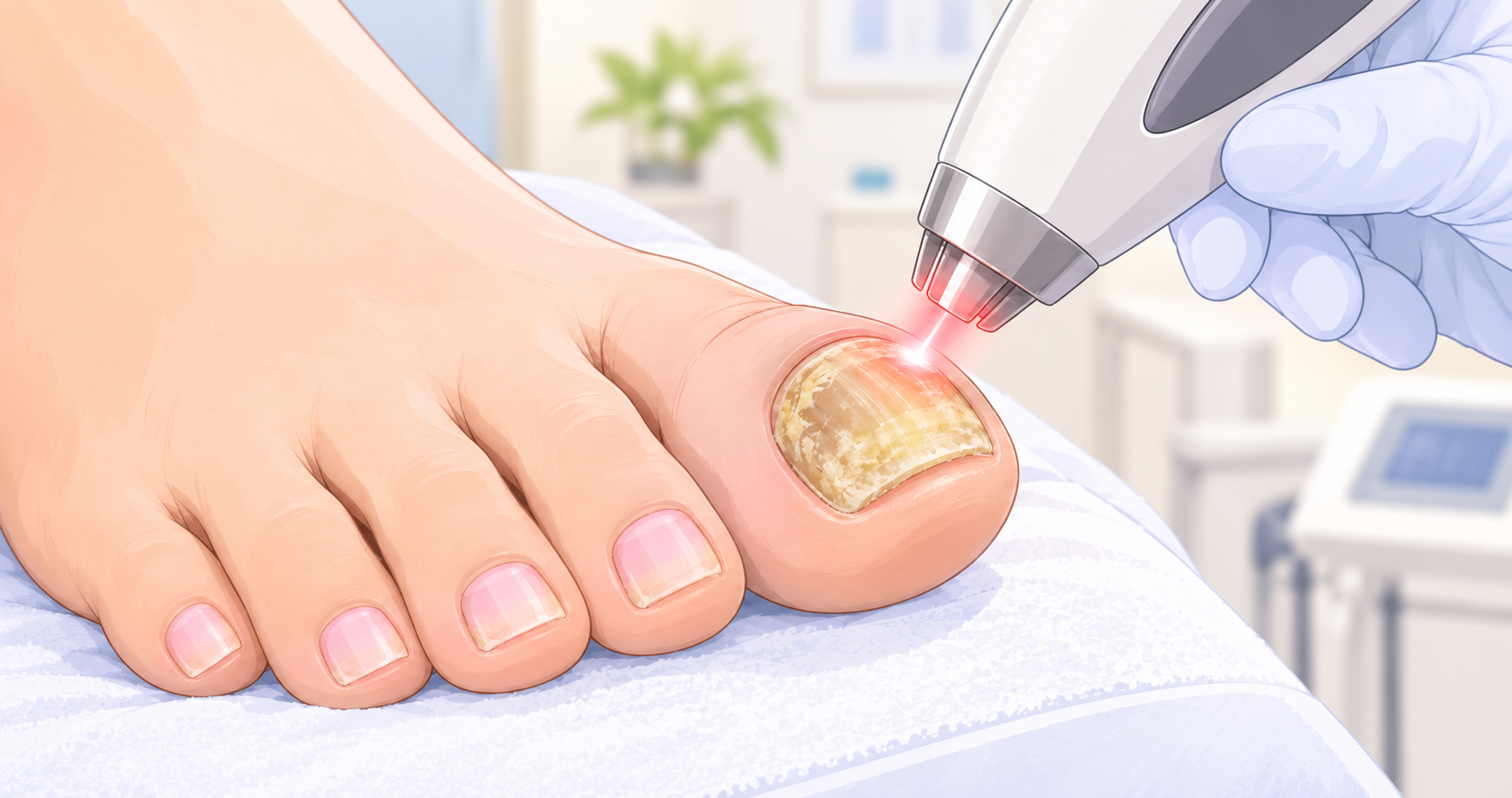
Laser treatment for fungal toenails sounds almost ideal. There are no tablets to remember, no medication applied to the nail every day for months, and no concern about systemic drug interactions. A laser is simply passed across the affected nail, theoretically damaging or killing the fungus while leaving the surrounding tissues intact. It is therefore easy to understand why laser treatment for onychomycosis has become popular.
But there is an important question: Does laser treatment actually cure fungal nail infection?
The answer depends very heavily on what we mean by the word “works.” A fungal nail can become clearer without the fungal infection necessarily being eradicated. A fungal culture can become negative without the nail becoming completely normal. And a treatment that produces some cosmetic improvement is not necessarily equivalent to one that produces a durable cure. When the better-quality scientific studies are examined, the evidence for laser treatment becomes much more complicated.
What exactly is onychomycosis?
Onychomycosis is a fungal infection involving the nail unit. Dermatophytes such as Trichophyton rubrum are common causes, although yeasts and non-dermatophyte moulds may also be responsible. Typical changes include: thickening of the nail, yellow or white discoloration, separation of the nail from the nail bed, subungual debris and gradual distortion of the nail plate.
However, appearance alone is not always enough to diagnose fungal infection. Traumatic nail dystrophy, psoriasis and several other nail disorders can resemble onychomycosis. Modern reviews and guidelines therefore recommend confirming suspected infection using microscopy, culture, histology and/or molecular testing where appropriate before committing a patient to treatment.
This becomes particularly important when evaluating laser studies. If a study treats abnormal-looking nails without establishing that fungus is actually present, improvement or failure becomes difficult to interpret.
What is laser treatment supposed to do to the fungus?
The most commonly studied system is the 1064-nm Nd laser, although diode, CO₂, Q-switched and other laser technologies have also been investigated. One proposed mechanism is photothermal injury. Laser energy passes through the nail and generates heat. The theory is that sufficient heating could damage fungal structures without permanently injuring the nail matrix, nail bed or surrounding skin. That sounds biologically plausible.
But achieving selective fungal destruction inside a human nail is more difficult than simply demonstrating that fungi can be killed by heat. Laboratory experiments have shown that some fungal organisms require temperatures around 50°C maintained for several minutes before reliable fungicidal effects occur. In one experimental study, Trichophyton rubrum required approximately 50°C for 15 minutes to demonstrate a fungicidal effect.
Importantly, laser exposure itself did not reproduce the same effect in fungal colonies, and the investigators found no clinical cure when the laser was subsequently tested in vivo. Another laboratory investigation similarly found no inhibition of T. rubrum after several commonly studied Nd laser regimens. Other experiments have demonstrated growth inhibition at sufficiently high laser energies, so the biological effect is not necessarily imaginary.
The difficulty is translating laboratory fungal heating into a treatment that is simultaneously: effective enough to destroy fungus, capable of penetrating an irregular and sometimes very thick nail, tolerable for the patient, and safe for the nail bed and surrounding tissues.
That may partly explain why laboratory plausibility has not consistently translated into high cure rates in clinical trials.
Importantly, laser exposure itself did not reproduce the same effect in fungal colonies, and the investigators found no clinical cure when the laser was subsequently tested in vivo. Another laboratory investigation similarly found no inhibition of T. rubrum after several commonly studied Nd laser regimens. Other experiments have demonstrated growth inhibition at sufficiently high laser energies, so the biological effect is not necessarily imaginary.
The difficulty is translating laboratory fungal heating into a treatment that is simultaneously: effective enough to destroy fungus, capable of penetrating an irregular and sometimes very thick nail, tolerable for the patient, and safe for the nail bed and surrounding tissues.
That may partly explain why laboratory plausibility has not consistently translated into high cure rates in clinical trials.
The most important distinction: clearer nail does not necessarily mean cured fungus
This is probably the single most important concept when reading laser advertisements or research papers. Researchers may report several different outcomes.
- Clinical improvement means the nail looks better.
- Clinical cure usually means that the nail appears normal or almost normal, although definitions vary between studies.
- Mycological cure means laboratory testing no longer detects the fungus.
- Complete cure generally requires both a clinically normal nail and negative mycological testing.
These are very different outcomes. A treatment might therefore produce visibly clearer nail growth while viable fungus remains elsewhere within the nail unit. This distinction is reflected in the regulatory position in the United States.
The FDA device classification for lasers used for onychomycosis describes their indication as: “temporary increase of clear nail in patients with onychomycosis.” That is quite different from an indication claiming eradication or cure of the fungal infection. The wording matters.
What happens when laser is compared with placebo?
This is where the evidence becomes particularly interesting.
A treatment can appear impressive in an uncontrolled study because toenails grow slowly, diseased portions are gradually trimmed away, patients improve their foot hygiene, associated tinea pedis may be treated and some nails naturally fluctuate in appearance. A randomized sham-controlled study therefore provides considerably stronger evidence.
The 52-week randomized double-blind trial
A particularly important study randomized 51 patients with toenail onychomycosis to either three treatments with a short-pulsed 1064-nm Nd laser or sham laser treatment. The investigators waited 52 weeks, which is important because toenails grow slowly. The primary endpoint was complete cure of the target great toenail. The result was striking.
Laser complete cure: 0%
Placebo complete cure: 7.7%
Only 33% of patients in the laser group had negative cultures, compared with 50% in the placebo group. None of the study's major secondary efficacy endpoints were achieved. The authors concluded that this laser regimen was not effective for treating onychomycosis.
Other controlled trials have produced similar concerns
An earlier randomized controlled trial involving 27 patients and 125 affected nails compared 1064-nm Nd treatment with an untreated control group. At three months, negative fungal cultures occurred in 33% of laser-treated patients versus 20% of controls, but the difference was not statistically significant.
By 12 months there was also no significant difference in nail clearance. The investigators concluded that there was no significant clinical or mycological benefit from laser treatment. Another prospective randomized trial followed patients for 12 months after four short-pulsed Nd treatments. Mycological remission was achieved in neither treatment group. There was also no significant improvement in Onychomycosis Severity Index scores compared with controls.
By 12 months there was also no significant difference in nail clearance. The investigators concluded that there was no significant clinical or mycological benefit from laser treatment. Another prospective randomized trial followed patients for 12 months after four short-pulsed Nd treatments. Mycological remission was achieved in neither treatment group. There was also no significant improvement in Onychomycosis Severity Index scores compared with controls.
What about patients with diabetes?
Laser treatment might seem particularly attractive when clinicians wish to avoid systemic medication. However, one of the strongest studies in this area specifically investigated patients with diabetes who were at increased risk of diabetic foot complications. This was a randomized, quadruple-blind, sham-controlled trial involving 64 patients.
Participants received four sessions of 1064-nm Nd laser or sham treatment. After one year there was no difference in clinical and microbiological cure between laser and sham treatment. The investigators concluded that they could find no evidence of an effect from the laser treatment in this patient population. Laser appeared relatively safe, but safety and efficacy are two separate questions.
What do systematic reviews tell us?
Individual studies can produce unusual results, so systematic reviews are particularly useful.
The conclusions, however, depend enormously on which studies are included and how their results are pooled.
The conclusions, however, depend enormously on which studies are included and how their results are pooled.
The Cochrane evidence
A Cochrane systematic review examined topical and device-based treatments for fungal toenail infection. Three studies involving 112 participants compared 1064-nm Nd laser with sham treatment or no treatment. At 52 weeks, the authors found that laser may produce little or no difference in mycological cure.
The relative risk was: RR 1.04, 95% CI 0.59–1.85. The evidence was rated as low quality. In other words, the best available controlled evidence could not demonstrate a meaningful advantage for laser. A revealing figure: complete cure around 7%.
Another systematic review and meta-analysis examined 22 prospective laser trials involving 755 participants. When patients rather than individual nails were used as the unit of analysis, the pooled estimates were:
The relative risk was: RR 1.04, 95% CI 0.59–1.85. The evidence was rated as low quality. In other words, the best available controlled evidence could not demonstrate a meaningful advantage for laser. A revealing figure: complete cure around 7%.
Another systematic review and meta-analysis examined 22 prospective laser trials involving 755 participants. When patients rather than individual nails were used as the unit of analysis, the pooled estimates were:
Mycological cure: 70.4%
Clinical improvement: 67.2%
Clinical improvement: 67.2%
but
Complete cure: only 7.2%.
There was also substantial statistical heterogeneity between studies. The authors therefore concluded that the true efficacy of laser remained difficult to determine and that better randomized controlled trials were required. That enormous difference between “mycological cure,” “clinical improvement” and complete cure illustrates why percentages quoted for laser treatment must be interpreted cautiously.
Why can some laser studies report 60–70% success?
A 2019 meta-analysis of 35 studies involving 1,723 patients reported an overall pooled mycological cure rate of approximately 63%. At first glance this sounds impressive. But pooling uncontrolled observational studies with controlled trials can generate an apparently high response rate without demonstrating that the laser itself caused the improvement.
Study methodology has varied enormously. Some investigators count individual nails rather than individual patients. A patient with ten affected nails can therefore contribute ten observations to the study. Definitions of “cure” vary. Treatment parameters differ. Follow-up periods vary.
Some studies use laser alone while others combine laser with topical antifungal medication, debridement or other interventions. Severe disease may be excluded. Some studies have no placebo group at all. And shorter studies may detect temporary clearing before recurrence becomes apparent. These methodological problems have been repeatedly highlighted in systematic reviews of laser therapy. This is why a 70% “response rate” in an uncontrolled study cannot automatically be interpreted as a 70% probability that laser will cure someone's fungal nail infection.
More recent research has not completely closed the case
It would nevertheless be incorrect to say that every newer study has found laser ineffective. A prospective 2024 study treated 31 patients representing 213 infected nails with multiple sessions of long-pulsed 1064-nm Nd laser. Most patients had relatively severe disease.
Three months after treatment, mycological cure occurred in 12.9% of patients. Visible improvement occurred in 32.3%, although only 9.7% showed moderate-to-significant visual improvement. The treatment was generally well tolerated. This again suggests that laser can influence some fungal nails — but the response is far from universal.
And then came a positive randomized trial
More recent evidence illustrates why the question remains scientifically interesting. A randomized controlled trial published in 2026 compared: itraconazole pulse therapy, 1064-nm Q-switched Nd laser, and the combination of the two.
Ninety laboratory-confirmed patients were randomized and followed for nine months. Clinical cure was reported in approximately 74% of both the itraconazole and laser groups and 80% of the combination group, with no significant differences between groups. Mycological testing also showed no significant intergroup differences.
The authors concluded that laser treatment appeared comparable with itraconazole in their study. That is important evidence and should not be ignored. But one positive single-blind study does not erase several sham-controlled trials that failed to demonstrate benefit. Instead, it tells us that the effectiveness of laser may depend heavily upon the type of laser, wavelength, pulse characteristics, energy delivered, frequency of treatment, disease severity and patient selection. It also means that this field is not scientifically settled.
Laser may make more sense as an adjunct than as a stand-alone cure
This may ultimately prove to be the most important role for laser therapy. A 2022 systematic review and meta-analysis examined 12 randomized studies involving 869 patients in which laser treatment was combined with topical antifungal medication. Compared with topical treatment alone, combination treatment produced improvements in complete cure, mycological cure and clinical response.
The reported relative risk for complete cure favoured combination therapy substantially, although the confidence interval was wide and the authors emphasized the need for better-designed large trials. There are plausible reasons for this. Some laser systems — particularly ablative or fractional lasers — may alter the nail plate and potentially increase drug penetration.
Laser could also reduce fungal burden without necessarily eliminating every viable organism. The antifungal medication could then address organisms that survive the laser exposure. This is fundamentally different from claiming that laser alone reliably kills the fungus.
A 2025 study reinforces the combination-treatment idea
A randomized study published in 2025 compared 1064-nm Nd laser, urea occlusion and a combination of both. All groups also received topical miconazole. At 24 weeks, mycological cure rates were approximately:
26.5% with the laser-based group
53.3% with urea occlusion
56.5% with laser plus urea occlusion.
The combination produced the greatest increase in temporarily clear nail. Again, the study supports the possibility that laser can contribute to a broader treatment strategy, but it does not demonstrate that laser monotherapy is necessarily the best treatment.
Why treating the nail alone may not solve the problem
Onychomycosis should not necessarily be viewed as an isolated patch of fungus sitting inside the visible yellow portion of the nail. The fungus can involve several parts of the nail unit. There may simultaneously be fungal infection of the surrounding skin or interdigital spaces. Thick subungual material can reduce penetration of treatments.
A dermatophytoma may create a particularly concentrated fungal reservoir. Shoes and socks can contribute to reinfection. And some patients have anatomical or mechanical factors that repeatedly traumatize the same nail. Simply directing energy through the visible nail plate therefore does not necessarily address every factor responsible for persistence or recurrence.
Another problem: not every thick yellow nail is fungal
This deserves repeating because it has enormous clinical importance. A large 2022–2023 laboratory dataset involving more than 96,000 submitted nail specimens demonstrated how difficult clinical diagnosis can be. Laboratory confirmation is therefore important when the diagnosis is uncertain.
A traumatically damaged nail subjected to repeated pressure inside a shoe can become thick, yellow and partially detached. It can look remarkably fungal. Laser treatment cannot eradicate a fungal infection that was never present. And antifungal medication cannot correct mechanical nail trauma. Good treatment therefore starts with establishing what is actually wrong with the nail.
So does laser work for onychomycosis?
The most scientifically defensible answer in 2026 is: Sometimes — but not as reliably as the word “laser cure” might imply. Laser treatment can produce clearer-looking nail growth in some patients. Some studies demonstrate mycological improvement. Several studies suggest benefit when laser is combined with topical or systemic antifungal treatment.
Newer randomized research continues to produce encouraging results. However, multiple randomized and sham-controlled trials have failed to demonstrate a meaningful advantage for laser monotherapy, and high-quality systematic reviews have concluded that the evidence remains uncertain.
Most importantly, improvement in nail appearance is not synonymous with eradication of fungal infection. This is why the FDA classification of these devices refers specifically to a temporary increase in clear nail, rather than fungal cure.
Where might laser still have a role?
Laser treatment should probably not be considered simply as a technological replacement for established antifungal treatment. Its more rational role may eventually prove to be as an adjunctive treatment in carefully selected cases. That could include patients in whom systemic medication is unsuitable, patients who strongly prefer to avoid oral medication, situations where additional improvement in nail appearance is desirable or treatment protocols where laser is combined with methods intended to improve penetration or reduce fungal burden.
But patient selection matters. The type and severity of infection matter. The organism matters. The laser parameters matter. And, perhaps most importantly, the diagnosis needs to be correct before treatment begins.
What is still the evidence-based approach to fungal nails?
Current reviews and guidelines continue to regard antifungal medication as the foundation of treatment. Topical therapy is generally considered for less extensive disease, while oral antifungal treatment is normally considered when infection is more extensive or involves deeper portions of the nail unit.
Oral terbinafine remains one of the best-supported treatments for dermatophyte toenail onychomycosis. That does not mean every patient requires tablets. It means treatment should be selected according to the diagnosis, organism, severity, number of nails involved, medical history and likelihood of recurrence rather than simply according to which technology sounds most sophisticated.
The bottom line
Laser technology for fungal toenails is scientifically interesting, biologically plausible and generally associated with relatively few systemic adverse effects. But the current evidence does not justify presenting laser monotherapy as a consistently proven cure for onychomycosis. The strongest placebo-controlled studies have frequently produced disappointing results.
At the same time, newer controlled studies and combination-treatment trials suggest that laser may have a useful role in certain patients or as part of a broader treatment strategy. So the question should perhaps no longer be: “Does laser kill toenail fungus?”.
A better clinical question is: “In which type of onychomycosis, using which laser parameters, and combined with which other treatments does laser meaningfully increase the probability of a durable cure?” That question has not yet been completely answered. And that is very different from saying that every fungal toenail simply needs a laser.
A better clinical question is: “In which type of onychomycosis, using which laser parameters, and combined with which other treatments does laser meaningfully increase the probability of a durable cure?” That question has not yet been completely answered. And that is very different from saying that every fungal toenail simply needs a laser.
Book An Appointment
Disclaimer: The word "treatment" in this article refers to the care and management of a patient’s health to prevent, cure, or improve a condition. Treatment results vary and do not necessarily indicate a cure. This article is for informational and educational purposes only and does not constitute medical advice.
About the Author
Mark B. Reyneker, BTech (Podiatry), MSc (Palaeontology) is a podiatrist and Founder & Clinical Director of Family Podiatry Centre, with more than 25 years of clinical experience across South Africa, Malaysia and Singapore. His clinical interests include foot and lower-limb pain, gait and biomechanics, sports-related foot conditions, orthotic therapy and footwear.
Alongside his clinical practice, Mark conducts research into human gait and foot biomechanics. His MSc research at the University of the Witwatersrand investigated human propulsion and the structural properties of the metatarsals. He is also the inventor of A Foot Orthotic, an orthotic technology developed through an international patent family.
Disclaimer: The word "treatment" in this article refers to the care and management of a patient’s health to prevent, cure, or improve a condition. Treatment results vary and do not necessarily indicate a cure. This article is for informational and educational purposes only and does not constitute medical advice.
About the Author
Mark B. Reyneker, BTech (Podiatry), MSc (Palaeontology) is a podiatrist and Founder & Clinical Director of Family Podiatry Centre, with more than 25 years of clinical experience across South Africa, Malaysia and Singapore. His clinical interests include foot and lower-limb pain, gait and biomechanics, sports-related foot conditions, orthotic therapy and footwear.
Alongside his clinical practice, Mark conducts research into human gait and foot biomechanics. His MSc research at the University of the Witwatersrand investigated human propulsion and the structural properties of the metatarsals. He is also the inventor of A Foot Orthotic, an orthotic technology developed through an international patent family.
References
- Bristow, I.R. et al. (2014). The effectiveness of lasers in the treatment of onychomycosis: a systematic review. Journal of Foot and Ankle Research.
Available article: https://pubmed.ncbi.nlm.nih.gov/40287882/ - Cai, Q. et al. (2025). A randomised comparative study of 1064 nm Nd laser and urea occlusion therapy with topical miconazole for the treatment of onychomycosis. Lasers in Medical Science, 40, 213. DOI: 10.1007/s10103-025-04468-x.
Available article: https://www.researchgate.net/publication/391214001_A_randomised_comparative_study_of_1064_nm_NdYAG_laser_and_ - Dash, S. et al. (2026). Efficacy of Itraconazole Pulse Therapy Versus Q-Switched Nd-YAG Laser Versus Combination of Both in the Treatment of Onychomycosis—A Single-Blind Randomized Control Trial. Journal of Cutaneous Medicine and Surgery, 30(3), 227–232. DOI: 10.1177/12034754251392072.
Available article: https://pubmed.ncbi.nlm.nih.gov/41243308/ - Falotico, J.M. & Lipner, S.R. (2022). Updated Perspectives on the Diagnosis and Management of Onychomycosis. Clinical, Cosmetic and Investigational Dermatology, 15, 1933–1957. DOI: 10.2147/CCID.S362635.
Available article: https://pmc.ncbi.nlm.nih.gov/articles/PMC9484770/ - Gupta, A.K. et al. (2017). A critical review of improvement rates for laser therapy used to treat toenail onychomycosis. Journal of the European Academy of Dermatology and Venereology.
Available article: https://www.ovid.com/journals/jeadv/abstract/10.1111/jdv.14212~a-critical-review-of-improvement-rates-for-laser-therapy - Karsai, S. et al. (2017). Treating onychomycosis with the short-pulsed 1064-nm-Nd laser: results of a prospective randomized controlled trial. Journal of the European Academy of Dermatology and Venereology.
Available article: https://pubmed.ncbi.nlm.nih.gov/27521028/ - Ma, W. et al. (2019). Laser treatment for onychomycosis: A systematic review and meta-analysis. Medicine, 98(48), e17948. DOI: 10.1097/MD.0000000000017948.
Available article: https://pmc.ncbi.nlm.nih.gov/articles/PMC6890331/ - Ortiz, A.E. et al. (2014). Lack of efficacy with 1064-nm neodymium laser for the treatment of onychomycosis: a randomized, controlled trial. Journal of the American Academy of Dermatology.
Available article: https://www.sciencedirect.com/science/article/abs/pii/S0190962214009876 - Ramzy, B. et al. (2024). Nd 1064 nm laser treatment for onychomycosis – is it really effective? A prospective assessment for efficiency and factors contributing to response. Mycoses, 67(1), e13657. DOI: 10.1111/myc.13657.
Available article: https://onlinelibrary.wiley.com/doi/full/10.1111/myc.13657 - Zhang, J. et al. (2022). Efficacy of laser therapy combined with topical antifungal agents for onychomycosis: a systematic review and meta-analysis of randomised controlled trials. Lasers in Medical Science.
Available article: https://europepmc.org/article/med/35484440