Toe Spreaders for Foot Pain and Crooked Toes: Do They Help?



1 October 2026
By Mark Reyneker, BTech (Podiatry), MSc (Palaeontology), Registered Podiatrist, Foot & Gait Specialist | Founder & Clinical Director, Family Podiatry Centre
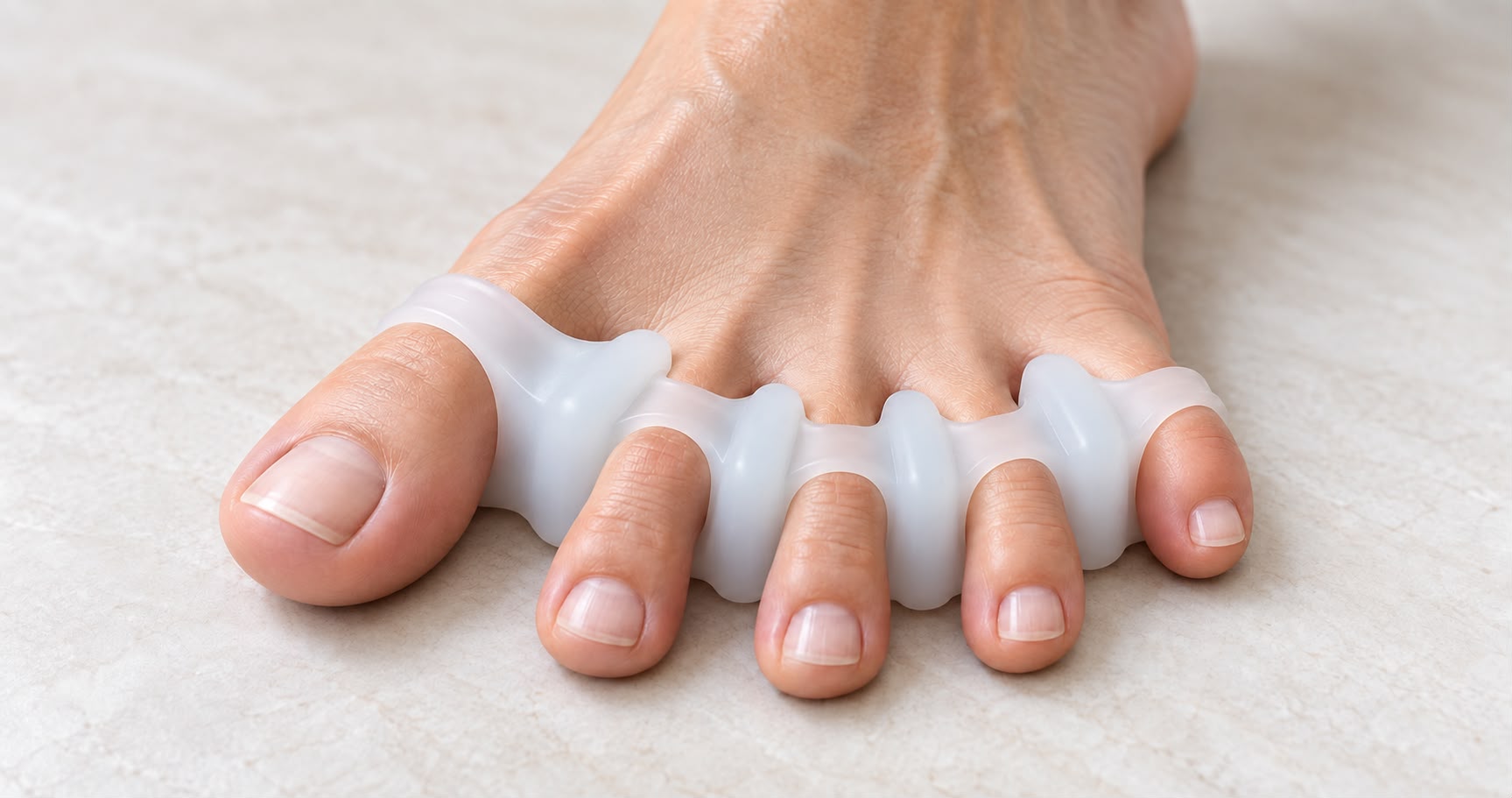
Are toe spreaders suitable for foot pain?
Where separation is appropriate, target the affected space with an individually fitted separator; custom shaping may be useful. Some research supports separators for selected bunion patients. Those results should not be taken as proof that a generic five-toe spreader treats every type of forefoot pain (Chadchavalpanichaya et al., 2018).
What is metatarsalgia?
Possible causes include overuse, joint problems, nerve irritation, fractures and painful skin lesions. The appropriate treatment depends on which problem is present (Chelsea and Westminster Hospital NHS Foundation Trust, n.d.). The label “metatarsalgia” therefore does not tell you that your toes need spreading. Two people with this label may need very different care.
Do toe spreaders help metatarsalgia or toe-joint pain?
For example, forefoot treatment may involve cushioning, footwear changes or an insole intended to reduce pressure and improve function. These are selected according to the cause, rather than simply because the forefoot hurts (Royal Orthopaedic Hospital, n.d.).
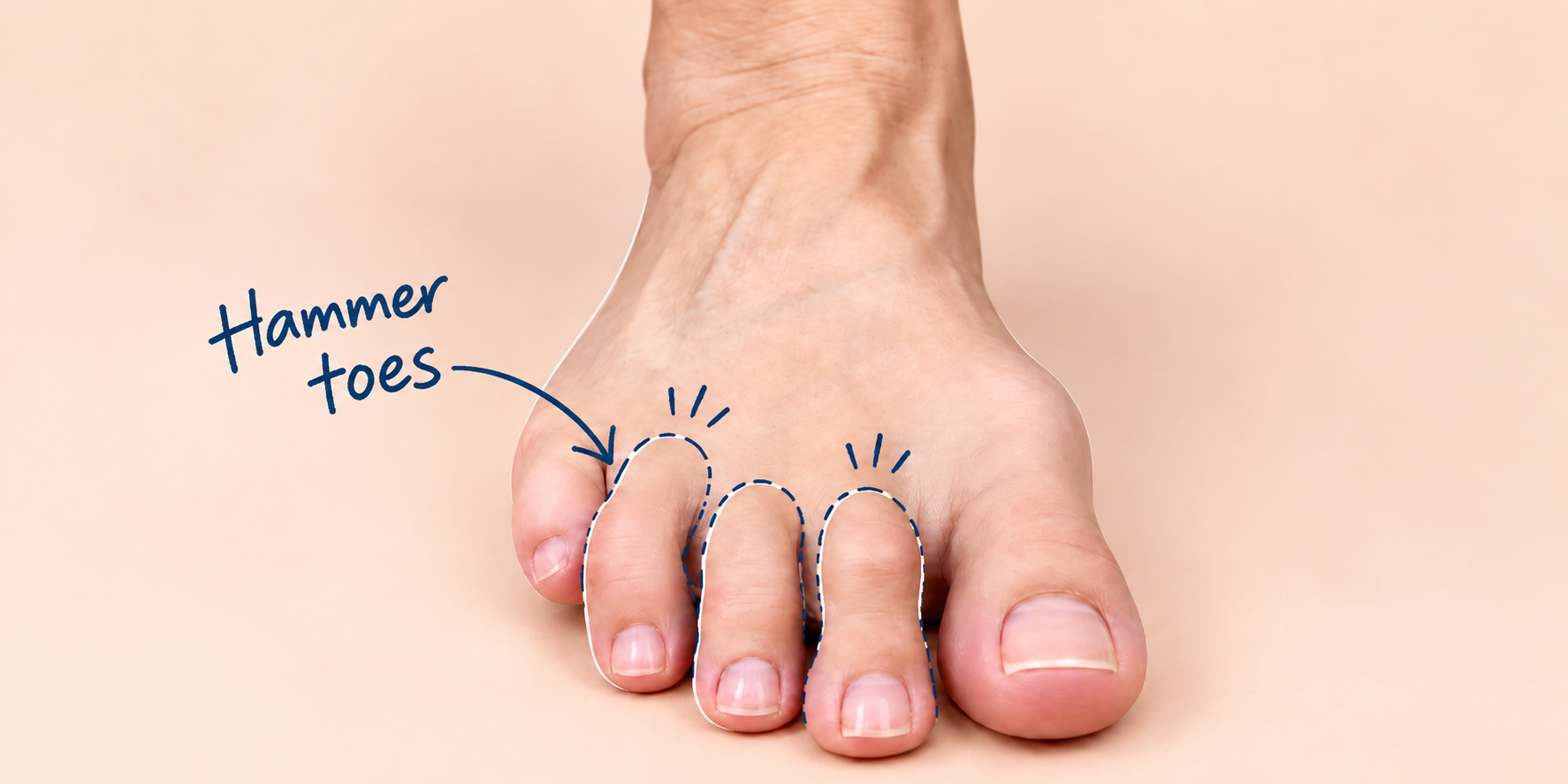
What if my toes are going crooked?
Changes at the joint where the toe meets the foot can contribute to pain beneath the ball of the foot (Royal National Orthopaedic Hospital, n.d.). Holding the toes apart does not show that those joint changes have been corrected.
Why spreading all the toes can be the wrong approach
From a clinical fitting perspective, a device that is too wide or applies pressure in an unsuitable direction may hold a toe in an unwanted position relative to its joint. This is a mechanical concern, not a finding that every multi-toe product inevitably damages or misaligns every foot.
Target the specific toe space
There is no need to assume that every gap must be widened. Clinical silicone devices are designed to reduce or redistribute pressure. Correct positioning and sufficient room in footwear are central to their use (RDaSH, 2025).
When might a custom-made toe separator help?
A separator may be only one part of treatment
Assessment may lead to footwear advice, cushioning, an insole, exercises or further investigation (Royal Orthopaedic Hospital, n.d.). This is why a toe spacer and a foot orthosis should not be treated as interchangeable products.
What does the bunion research actually show?
That supports a specific intervention in a selected patient group. It does not prove that full-foot spreaders treat unexplained pain beneath the lesser-toe joints.Bunion pain, metatarsalgia and a crooked lesser toe can coexist, but they should not be assumed to have the same cause.
Can I walk or sleep wearing toe spreaders?
More hours do not automatically mean more benefit. Stop if the device causes pain, persistent redness, tenderness or skin irritation, and arrange a review (Herefordshire and Worcestershire Health and Care NHS Trust, n.d.).
What if the spreader feels good?
When should I seek advice?
What should I do before buying toe spreaders?
Book An Appointment
Disclaimer: The word "treatment" in this article refers to the care and management of a patient’s health to prevent, cure, or improve a condition. Treatment results vary and do not necessarily indicate a cure. This article is for informational and educational purposes only and does not constitute medical advice.
About the Author
Mark B. Reyneker, BTech (Podiatry), MSc (Palaeontology) is a podiatrist and Founder & Clinical Director of Family Podiatry Centre, with more than 25 years of clinical experience across South Africa, Malaysia and Singapore. His clinical interests include foot and lower-limb pain, gait and biomechanics, sports-related foot conditions, orthotic therapy and footwear.
Alongside his clinical practice, Mark conducts research into human gait and foot biomechanics. His MSc research at the University of the Witwatersrand investigated human propulsion and the structural properties of the metatarsals. He is also the inventor of A Foot Orthotic, an orthotic technology developed through an international patent family.
References
- Chadchavalpanichaya, N., Prakotmongkol, V., Polhan, N., Rayothee, P. and Seng-Iad, S. (2018) ‘Effectiveness of the custom-mold room temperature vulcanizing silicone toe separator on hallux valgus: a prospective, randomized single-blinded controlled trial’, Prosthetics and Orthotics International, 42(2), pp. 163–170.
Available at: https://doi.org/10.1177/0309364617698518. - Chelsea and Westminster Hospital NHS Foundation Trust (n.d.) Metatarsalgia and dislocated toe deformities.
Available at: https://www.chelwest.nhs.uk/your-visit/patient-leaflets/surgery-services/metatarsalgia-and-dislocated-toe-deformities (Accessed: 1 October 2026). - Herefordshire and Worcestershire Health and Care NHS Trust (n.d.) Silicone.
Available at: https://www.hacw.nhs.uk/silicone/ (Accessed: 1 October 2026). - Kandang, C., Tanvijit, P., Harnphadungkit, K. and Chadchavalpanichaya, N. (2020) ‘Effectiveness of prefabricated silicone toe separator on hallux valgus’, ASEAN Journal of Rehabilitation Medicine, 30(3), pp. 97–102.
Available at: https://he01.tci-thaijo.org/index.php/aseanjrm/article/view/243960. - Rotherham Doncaster and South Humber NHS Foundation Trust (RDaSH) (2025) Silicone toe devices.
Available at: https://www.rdash.nhs.uk/services/podiatry-foot-protection/general-foot-care/silicone-toe-devices/ (Accessed: 1 October 2026). - Royal National Orthopaedic Hospital (n.d.) A patient’s guide to bunion (hallux valgus) and lesser toe deformities.
Available at: https://www.rnoh.nhs.uk/patients-and-visitors/patient-information-guides/bunion-hallux-valgus-and-lesser-toe-deformities (Accessed: 1 October 2026). - Royal Orthopaedic Hospital (n.d.) Metatarsalgia forefoot pain.
Available at: https://roh.nhs.uk/services-information/foot-and-ankle/metatarsalgia-forefoot-pain (Accessed: 1 October 2026).
Frequently Asked Questions
Generic five-toe spreaders are not established as a routine treatment for metatarsalgia. The term means ball-of-foot pain and covers different causes. A separator may be appropriate for a specific problem, but treatment should follow an assessment of why the foot hurts (Chelsea and Westminster Hospital NHS Foundation Trust, n.d.).
Sometimes a selected separator can help—for example, research has reported pain relief in bunion patients. That does not establish that spreading every toe treats all painful toe joints. Joint pain may need a different approach depending on its cause (Chadchavalpanichaya et al., 2018).
They may temporarily change toe position or reduce contact, but that does not prove lasting correction. Toe deformities differ in the joints involved and their flexibility. A drifting or overlapping toe should be assessed rather than automatically spread away from its neighbours (Royal National Orthopaedic Hospital, n.d.).
Only separate spaces where there is an identified treatment need. One troublesome space does not mean every gap needs widening. A multi-toe product may position otherwise unaffected toes unnecessarily; fit and direction of correction should be assessed individually.
A device that is too wide or pushes in an unsuitable direction may hold a toe in an unwanted position at its base joint. This is a clinical fitting concern, not proof that every spreader causes damage. Wider toe gaps do not automatically demonstrate better joint alignment.
Custom shaping can be useful when a standard product does not fit the required space or positioning goal. It is not necessary for everyone: a properly selected ready-made separator can also be appropriate. There is no general proof that every custom product is superior to every prefabricated one (Kandang et al., 2020).
An insole may be selected to redistribute pressure beneath the foot or improve function. A toe spacer mainly changes local toe contact or position. If your pain comes from forefoot loading, a spacer alone may not address it (Royal Orthopaedic Hospital, n.d.).
Follow the plan for the particular device. Some prescribed devices are worn during the day and removed at night, while a custom bunion-separator trial used nighttime wear. These instructions should not be copied indiscriminately to a different product (RDaSH, 2025; Chadchavalpanichaya et al., 2018).
Not automatically. Similar symptoms can have different causes, and feet differ in shape and alignment. A friend’s relief does not establish that the same device suits your joint or pressure problem. Persistent pain warrants assessment before relying on a generic corrective product.
Seek an assessment rather than relying on repeated purchases as your only treatment. Bring the device to the appointment. Remove it if it causes pain, skin irritation or persistent redness, and arrange a review (Herefordshire and Worcestershire Health and Care NHS Trust, n.d.).