Custom Orthotics in Singapore: Who Actually Designs and Makes Your Orthotics?



17 September 2026
By Mark Reyneker, BTech (Podiatry), MSc (Palaeontology), Registered Podiatrist, Foot & Gait Specialist | Founder & Clinical Director, Family Podiatry Centre
Explainer Video
A truly custom foot orthotic is not simply an insole made from a 3D scan of your foot. The scan provides the starting shape, but a clinician must decide how that shape should be modified according to your examination, diagnosis, biomechanics, symptoms and footwear. The crucial step is who converts that clinical prescription into the actual three-dimensional orthotic design.
Where Are Your Custom Orthotics Actually Made? Why Prescription Integrity Matters
After more than two decades working with foot orthoses, I believe this question is at least as important as asking what material the orthotic is made from or what type of scanner was used. Because a custom orthotic is not simply the shape of your foot. It is a prescription translated into a three-dimensional medical device. And every step between the examination and the finished orthotic matters.
Why does the orthotic laboratory matter?
The experience that changed the way I thought about orthotics
However, I discovered that at least some devices were being made by selecting an existing prefabricated shell that approximately matched the required size and then adding the requested pads and modifications to it. From the outside, the finished orthotic looked convincing. It had the expected shape. It had the requested additions. It looked like a custom orthotic. But the underlying shell had not necessarily been individually manufactured from the patient's prescription in the way I had assumed.
rather than: available material → altered prescription.
A custom orthotic is not simply a scan of your foot
Consider a patient with heel pain, first metatarsophalangeal joint pathology, forefoot overload, asymmetrical pronation or a structural difference between the two feet. The scan tells us what the foot looks like. It does not automatically tell us what the orthotic should look like. The clinician must decide how the orthotic geometry should differ from the patient's natural foot shape in order to achieve a particular therapeutic objective.
- shell thickness and stiffness
- heel-cup depth
- arch contour
- rearfoot correction
- forefoot correction
- intrinsic or extrinsic posting
- heel skives
- first-ray or plantar fascial accommodations
- metatarsal modifications
- localised offloading
- shell width and length
- material selection
- cover thickness and density.
The overlooked person in the process: who actually creates the CAD design?
Our podiatrists do the CAD themselves
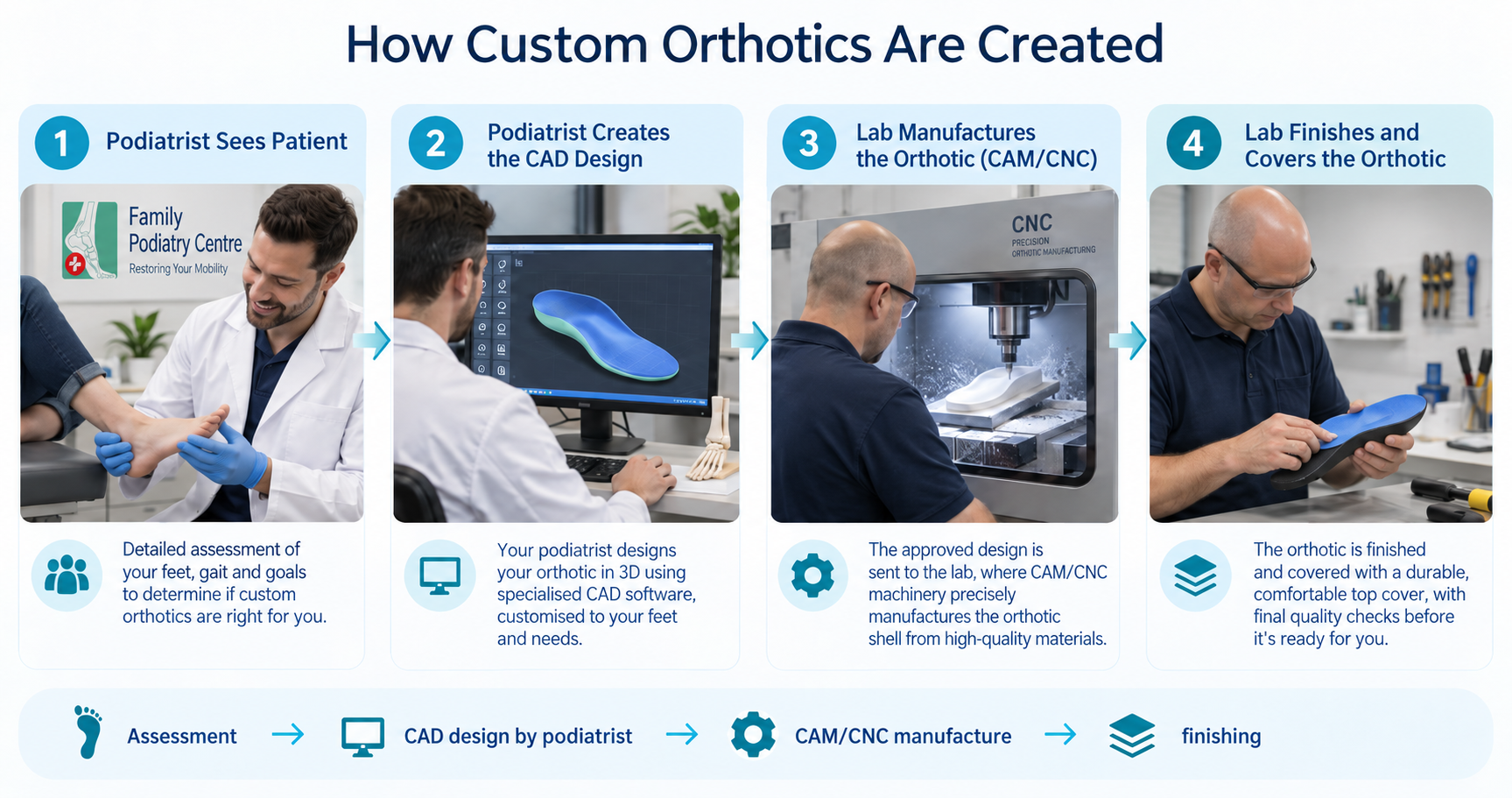
Only after that design has been completed is the protected CAD file passed into the manufacturing stage. The laboratory then performs CAM and the finishing processes—manufacturing the shell and completing elements such as covers and finishing.
In simplified form:
↓
Clinical diagnosis
↓
Orthotic prescription
↓
CAD design by the treating podiatrist
↓
Protected digital design
↓
CAM manufacturing
↓
Finishing and cover
↓
Patient fitting and review
Why removing one communication step matters
One clinician memorably described how apparently identical angular instructions could mean slightly different things to different people. Participants reported that establishing a good working relationship with manufacturers reduced the need for subsequent modifications. This is exactly the type of problem our system is designed to avoid.
The laboratory can still make a mistake—but it cannot redesign the prescription
Once our podiatrist has completed and protected the CAD geometry, the laboratory is not being asked to decide what the clinical prescription means.
- Prescription integrity
- The clinician decides what the patient requires.
- Design integrity
- The clinician personally translates that prescription into digital geometry.
- Manufacturing fidelity
- The laboratory must reproduce that approved geometry accurately.
Keeping those three concepts separate is important.
Why you cannot simply inspect an orthotic afterwards and know whether the prescription was followed
There is no routine clinical equivalent of a lensmeter for custom orthotics
But that is not the same thing as placing the orthotic into a simple machine and having it display:
- rearfoot correction: X°
- forefoot correction: Y°
- heel skive: Z mm
- arch fill: X mm
Digital design changes that equation
Has podiatry education changed?
Leach, Cowley and Bowen's 2024 study found lack of confidence in custom orthosis design and manufacture among the themes raised by specialist podiatrists. Participants specifically called for greater education at registration level so that newly qualified podiatrists have greater knowledge of custom orthotic design and manufacture. I therefore would not argue that modern podiatrists are universally poorly trained in orthotics. That would be unfair. But I do think something valuable can be lost when manufacture becomes completely separated from clinical education.
Outsourcing and education may have evolved together
In clinical practice, it has become increasingly easy to: scan a foot → complete an order form → send the data away → receive an orthotic. And once that becomes the dominant workflow, there is naturally less practical need for every clinician to maintain a traditional manufacturing laboratory. The danger is that the efficiency of outsourcing can eventually separate the clinician from an important body of knowledge.
A 2016 UK qualitative study found that orthotic practice varied considerably between clinicians and was shaped by a complex combination of undergraduate education, subsequent clinical experience, local working environment and trial-and-error learning (Williams et al., 2016). A 2018 international survey involving 264 podiatrists also demonstrated significant differences in orthotic prescribing behaviour between countries. UK respondents prescribed more prefabricated devices than customised devices, whereas Australian respondents prescribed proportionally more custom orthoses.
The authors cautioned that healthcare setting and other factors could contribute to these differences; they did not attribute them simply to education. (Chapman et al., 2018). The picture is therefore complicated. But there is enough evidence to say that orthotic practice and training are variable—and that experienced podiatrists themselves have called for greater education in custom orthotic design and manufacture.
I believe you should understand how to make an orthotic even if you never make one yourself
In fact, modern CAD gives us an extraordinary opportunity. Instead of removing the podiatrist from manufacturing, we can use technology to bring the podiatrist back into the design process. That is exactly what we have chosen to do.
Clinician-controlled CAD: combining old knowledge with modern technology
Research shows why the clinician–fabricator feedback loop matters
Local manufacture also shortens the physical feedback loop
Does outsourcing automatically mean poor quality?
- local = good
- overseas = bad
- 3D scanned
- 3D printed
- AI-designed
- computer-generated
- anatomy
- pathology
- biomechanics
- tissue loading
- footwear
- materials
- orthotic design
- patient tolerance
- treatment objectives.
Why “custom” deserves closer scrutiny
The three questions I think patients should ask
- Who designs my orthotic?
- Not simply who scans the foot.
- Who actually creates the three-dimensional orthotic geometry?
- Who manufactures it?
- Is it made locally, within the clinic, by an external domestic laboratory or overseas?
- Can my podiatrist see and control the design?
How we approach custom orthotics at Family Podiatry Centre
This is why our laboratory has always mattered to me
Over the years the manufacturing technology has changed enormously. Plaster has increasingly given way to scanning. Manual model modification has moved into CAD. Manufacturing has become increasingly computer controlled. But my underlying philosophy has not changed. The clinician should remain as close as possible to the prescription. If anything, modern digital technology now allows us to achieve that more effectively than before.
What does the research actually prove?
The real question is not “local or overseas?”
Book An Appointment
Disclaimer: The word "treatment" in this article refers to the care and management of a patient’s health to prevent, cure, or improve a condition. Treatment results vary and do not necessarily indicate a cure. This article is for informational and educational purposes only and does not constitute medical advice.
About the Author
Mark B. Reyneker, BTech (Podiatry), MSc (Palaeontology) is a podiatrist and Founder & Clinical Director of Family Podiatry Centre, with more than 25 years of clinical experience across South Africa, Malaysia and Singapore. His clinical interests include foot and lower-limb pain, gait and biomechanics, sports-related foot conditions, orthotic therapy and footwear.
Alongside his clinical practice, Mark conducts research into human gait and foot biomechanics. His MSc research at the University of the Witwatersrand investigated human propulsion and the structural properties of the metatarsals. He is also the inventor of A Foot Orthotic, an orthotic technology developed through an international patent family.
References
- 1. Barr, L., Richards, J. and Chapman, G.J. (2025). ‘The use of computer-aided design and manufacture for foot orthoses: A cross-sectional study of orthotic services in the UK’. Journal of Foot and Ankle Research, 18(1), e70031.
Original artical: PubMed record - Chapman, L.S., Redmond, A.C., Landorf, K.B. et al. (2018). ‘A survey of foot orthoses prescription habits amongst podiatrists in the UK, Australia and New Zealand’. Journal of Foot and Ankle Research, 11, 64.
Original artical: Full article - Health and Care Professions Council (2023). Standards of proficiency: Chiropodists/podiatrists. Effective 1 September 2023.
Original artical: HCPC standards - Leach, E., Cowley, E. and Bowen, C. (2024). ‘The experiences of podiatrists prescribing custom foot orthoses and patients using custom foot orthoses for foot pain management in the United Kingdom: A focus group study’. Journal of Foot and Ankle Research, 17(3), e12047.
Original artical: Open-access full article - Menz, H.B., Allan, J.J., Bonanno, D.R., Landorf, K.B. and Murley, G.S. (2017). ‘Custom-made foot orthoses: an analysis of prescription characteristics from an Australian commercial orthotic laboratory’. Journal of Foot and Ankle Research, 10, 23.
Original artical: Full article - 6. Qaiser, Z., Faraz, A. and Johnson, S. (2020). ‘Feasibility Study of a Rapid Evaluate and Adjust Device (READ) for Custom Foot Orthoses Prescription’. IEEE Transactions on Neural Systems and Rehabilitation Engineering, 28(8), pp. 1760–1770.
Original artical: PubMed record - Sengkang General Hospital/SingHealth (2025). ‘3D-Printed Custom Insoles: Advancing Diabetic Foot Care at Sengkang General Hospital’, 8 July 2025.
Original artical: SingHealth article - Telfer, S., Gibson, K.S., Hennessy, K., Steultjens, M.P. and Woodburn, J. (2012). ‘Computer-aided design of customized foot orthoses: reproducibility and effect of method used to obtain foot shape’. Archives of Physical Medicine and Rehabilitation, 93(5), pp. 863–870.
Original artical: PubMed record - University of Brighton (2026). Podiatry BSc(Hons). Current programme information including orthotics manufacturing facilities and practical manufacture of orthotics and insoles.
Original artical: University programme - 9. Williams, A.E., Martinez-Santos, A., McAdam, J. and Nester, C.J. (2016). ‘“Trial and error…”, “…happy patients” and “…an old toy in the cupboard”: a qualitative investigation of factors that influence practitioners in their prescription of foot orthoses’. Journal of Foot and Ankle Research, 9, 11.
Original artical: Open-access full article
Frequently Asked Questions
Ask how the device is designed and manufactured. A genuinely customised orthotic should be based on information specific to you, such as your foot morphology, clinical examination, diagnosis and the clinician's prescription. However, a 3D scan alone does not necessarily make an orthotic custom. The important question is what happens after the scan. Ask: Who creates the actual orthotic design? Some systems send the scan and written prescription to an external laboratory, where another person creates the CAD model. In other systems, the treating clinician performs the digital design themselves. Research analysing 1,000 custom orthotic prescriptions found considerable variation in the corrections, shell modifications, materials and other characteristics prescribed for individual patients, demonstrating that custom orthoses involve considerably more than simply reproducing the shape of the foot (Menz et al., 2017).
No. A 3D scan records the shape of your foot. It does not independently diagnose your condition or determine what treatment you need. The clinician still has to decide how the orthotic should differ from your natural foot shape. This might involve changes to arch contour, heel geometry, shell stiffness, forefoot or rearfoot correction, accommodations, offloading and other modifications. The scan is therefore data.The orthotic design is the clinical interpretation of that data.
This depends on the manufacturing system being used. In many outsourced systems, the clinician submits a scan or impression together with a prescription, and laboratory personnel subsequently create or modify the CAD model. A UK study examining CAD/CAM orthotic services found that technicians carried out digital modelling or rectification in the majority of responding services using CAD/CAM. This demonstrates how the person examining the patient and the person creating the final orthotic geometry can become separated within modern manufacturing systems (Barr, Richards and Chapman, 2025). At Family Podiatry Centre, the treating podiatrist performs the CAD design before the file reaches the manufacturing stage.
Because CAD is where the written clinical prescription becomes a physical three-dimensional shape. CAD stands for computer-aided design. CAM stands for computer-aided manufacturing. They are not the same thing. The CAD operator determines the geometry that will subsequently be manufactured. Research has demonstrated that variation can occur during CAD design and that operator experience affects reproducibility (Telfer et al., 2012). This means that CAD should not simply be regarded as an automated computer process. Someone is making decisions about the orthotic.
Not completely. An experienced clinician can visually identify many features of an orthotic, such as the approximate location of a metatarsal pad, heel-cup depth, cut-outs, covers and obvious posting. However, many custom orthotic modifications involve only a few millimetres or degrees. The finished three-dimensional shell can also represent several interacting modifications. Unlike prescription spectacles, there is no routine clinical equivalent of a lensmeter that can simply read the finished orthotic and display the original complete prescription. Sophisticated 3D measurement systems can analyse orthotic geometry, but visual inspection alone cannot necessarily reconstruct every modification made during the design process. This is why retaining the original CAD design is so valuable.
No. There are excellent orthotic laboratories in many countries. The location of a laboratory does not by itself determine whether the orthotic is good or bad. The more important issues are: who designs the orthotic, how accurately the prescription is communicated, whether the manufacturing process follows the approved design, how quality control is performed, how easily changes can be made, how closely the clinician remains involved. Research involving specialist podiatrists has identified communication with manufacturers and variability between custom orthotic devices as important concerns in real-world practice (Leach, Cowley and Bowen, 2024). The argument for local or closely controlled manufacture is therefore about visibility, communication and control, rather than geography alone.
Outsourcing can introduce additional stages between prescription, manufacture, delivery and subsequent modification. If an orthotic needs changing, the device or manufacturing instructions may have to travel back through the same system. A Singapore public-hospital programme reported in 2025 that specialised pressure-relieving insoles manufactured overseas could take up to two months to reach patients and that adjustments could create additional shipping delays. Moving the process to a local digital manufacturing pathway reportedly reduced delivery to approximately one week. This example concerned diabetic pressure-relieving insoles rather than all types of functional custom orthotics, but it demonstrates how manufacturing distance can affect turnaround time.
Because understanding manufacture helps the clinician understand what a prescription actually does. A podiatrist who understands shell materials, stiffness, posting, arch geometry, accommodations and manufacturing limitations is better able to understand how changes to a prescription may affect the finished device. Modern technology means that podiatrists do not necessarily have to manufacture every orthotic manually. However, recent UK research involving specialist podiatrists identified lack of confidence in custom orthosis design and manufacture as an issue and called for greater education in this area at registration level (Leach, Cowley and Bowen, 2024). My view is that a podiatrist should understand how an orthotic is made even if they ultimately choose not to manufacture it personally.
CAD — computer-aided design — determines the shape of the orthotic. CAM — computer-aided manufacturing — produces the physical device from that design. This distinction is important. The CAD stage is where clinical decisions become geometry. The CAM stage should faithfully reproduce that approved geometry. At Family Podiatry Centre, the treating podiatrist performs the CAD portion of the process. The completed digital design is then protected and passed to the laboratory for CAM manufacturing and finishing. This means the laboratory does not need to reinterpret the clinician's biomechanical prescription before creating the shell.
The central difference is that the podiatrist who examines you remains responsible for the orthotic through the design stage. Our process is: Clinical examination, diagnosis, orthotic prescription, CAD design by the treating podiatrist, approved digital design, CAM manufacture, finishing, fitting and review. We refer to this principle as prescription integrity. The person who examined your foot, assessed your movement, identified the painful structures and decided what the orthotic should achieve is also the person who converts those decisions into the digital orthotic design. Our laboratory then manufactures that design. In simple terms: The laboratory manufactures the prescription. It does not decide the prescription.That distinction has been central to the way we have approached custom orthotics since Family Podiatry Centre was established.