Podiatry Insurance in Singapore: 2026 Plan Comparison

25 September 2026

By Mark Reyneker, BTech (Podiatry), MSc (Palaeontology), Registered Podiatrist, Foot & Gait Specialist | Founder & Clinical Director, Family Podiatry Centre

Published: 25 September 2026 | Last reviewed: 25 September 2026  

A guide for Singapore Citizens, Permanent Residents and expatriates considering treatment by a podiatrist.

You can have excellent health insurance and still discover that a visit to a podiatrist is not covered. The mistake often starts with a plausible assumption: if a policy pays for outpatient consultations or medical specialists, surely it will pay for foot care too. Policy wording can classify podiatry separately, sometimes under complementary treatment, alternative therapy or footcare.

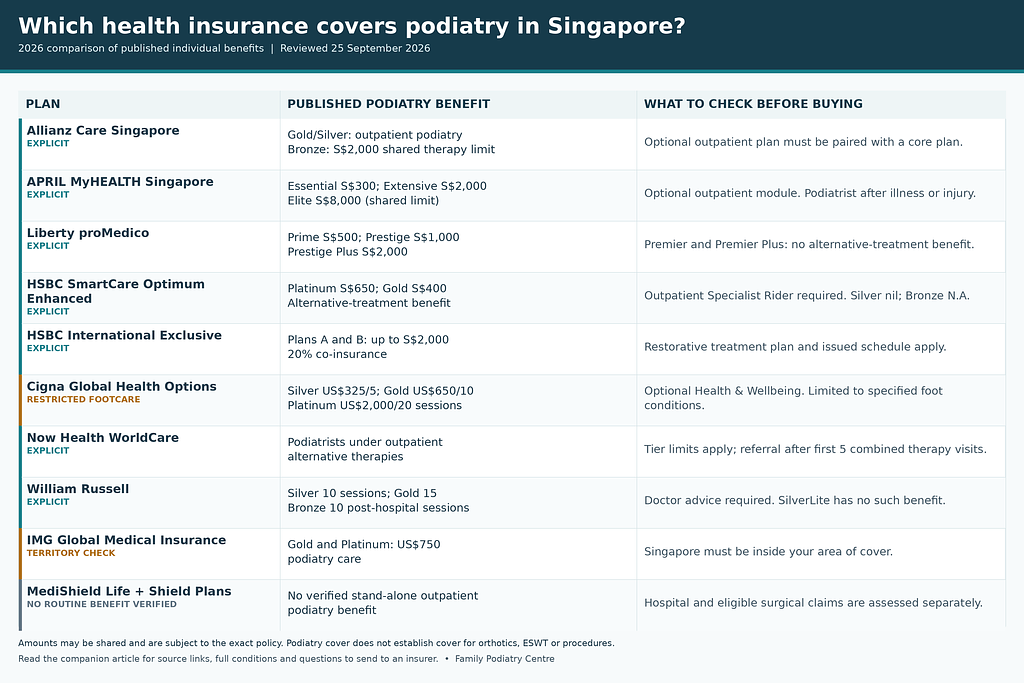
The portrait comparison graphic below identifies plans whose published documents expressly name podiatry or podiatrists. The detailed notes beneath it explain the crucial tier and module conditions and link directly to the source documents. This is a shortlist for comparing benefits, not a recommendation to buy any one plan. Premiums, hospital cover, underwriting and the insurer's response about your intended treatment matter too.

Podiatry insurance comparison: the quick view

Portrait comparison of nine Singapore and international health insurance options with published podiatry benefits, showing the eligible tiers, limits and modules, plus a caution about routine podiatry under Integrated Shield Plans.

The image is a quick screen. A published limit is not a guaranteed claim payment. Several amounts are shared with other therapies. The precise condition, treatment, policy tier and issued schedule decide whether a claim is eligible. These are the details behind each entry:

Allianz Care Singapore International Healthcare Plans
Allianz's 2026 benefit schedule explicitly lists podiatry with other therapies in its optional outpatient plans. Gold and Silver show cover within the outpatient plan terms; Bronze lists S$2,000 for the shared therapy category. The outpatient plan must accompany a core plan. Check whether your particular treatment, procedure or device falls within the covered category.

APRIL MyHEALTH Singapore
The benefits schedule includes podiatrist consultation following illness or injury in Complementary Medicine. The combined category limits are S$300 Essential, S$2,000 Extensive and S$8,000 Elite. You need the optional outpatient module. The schedule says a podiatrist following illness or injury does not require a referral, but the allowance is shared with other complementary and traditional Chinese medicine benefits.

Liberty proMedico
Liberty's plan comparison names registered podiatrists under Outpatient Alternative Treatment: S$500 Prime, S$1,000 Prestige and S$2,000 Prestige Plus. Premier and Premier Plus show N.A. for that benefit. The amounts are shared with other named practitioners; ask separately about orthotics, tests and procedures.

HSBC Life SmartCare Optimum Enhanced
The current policy wording defines alternative practitioners to include podiatry. Its Outpatient Specialist Rider lists an Alternative Treatment benefit of S$650 Platinum or S$400 Gold, with Silver nil and Bronze N.A. The HSBC product page also names podiatrists. Have the insurer confirm the benefit in the rider and schedule actually issued to you: older public materials have displayed different figures.

HSBC Life International Exclusive
The policy wording expressly includes podiatrists under Alternative and Wellbeing Medicine for Plans A and B, with a published limit of up to S$2,000 and 20% co-insurance. The treatment must meet the policy's restorative treatment-plan requirement. Check your plan level and obtain confirmation for the condition and course of care.

Cigna Global Health Options Singapore
The 2026 product summary includes “Footcare by a Chiropodist or Podiatrist” in its optional International Health & Wellbeing module. Limits are US$325 and five sessions on Silver, US$650 and ten on Gold, US$2,000 and twenty on Platinum. This is a narrow footcare benefit: the published wording describes medically necessary restorative treatment of bunions, calluses, corns and fungal infection, and excludes massage and sports medicine. It does not establish cover for heel pain, Achilles problems, biomechanics or orthotics.

Now Health WorldCare Singapore
The 2026 Singapore handbook extends the applicable outpatient alternative-therapies benefit to chiropodists and podiatrists. Check the exact WorldCare tier and its monetary and session limits. The first five combined therapy sessions may be accessed without referral; later sessions require a medical practitioner or specialist referral. Confirm the eligible provider setting as well.

William Russell international health insurance
Its 2026 plan information includes complementary treatment by a podiatrist on a doctor's advice. Silver lists ten complementary-treatment sessions and Gold fifteen. Bronze lists ten post-hospital sessions, while SilverLite shows no complementary-treatment cover. Confirm that your selected territory includes Singapore and whether hospitalisation must precede the treatment on your tier.

IMG Global Medical Insurance
The published schedule lists US$750 Podiatry Care on Gold and Platinum; Bronze and Silver show N.A. A published geographical option excludes Singapore, so check that the issued area of cover includes Singapore for ordinary outpatient claims and that the product can be issued for your residence.
MediShield Life and Integrated Shield Plans

No routine outpatient podiatry benefit was verified for this category. These plans primarily protect against hospital and major medical costs, with selected costly outpatient benefits. The Ministry of Health's comparison lists the seven Integrated Shield insurers. One clear example is the AIA HealthShield Gold Max sample contract, which expressly excludes podiatric treatment among complementary treatments. For an ordinary clinic visit, request a separate, expressly worded benefit rather than relying on an Integrated Shield Plan alone. Eligible hospital or surgery claims are assessed differently.

Why an Integrated Shield Plan alone usually misses this need
MediShield Life covers Singapore Citizens and Permanent Residents against large hospital bills and selected costly outpatient treatments. Integrated Shield Plans add private-insurer coverage, generally for higher ward classes or private hospitals. Singapore's seven Integrated Shield insurers are AIA, Great Eastern, HSBC Life, Income, Prudential, Raffles Health Insurance and Singlife. These products have an important role, but their standard hospital-focused benefits should not be mistaken for an allowance for a podiatrist visit at an independent clinic. MOH explains the purpose of the plans and lists the current policies and sample contracts.

This is not a claim that an Integrated Shield policy can never pay for care relating to a foot condition. An eligible hospital admission, day surgery or related pre- and post-hospital treatment must be assessed under its own terms. For ordinary, stand-alone outpatient podiatry, request the clause that expressly covers it. Do not infer it from the words “specialist” or “outpatient.”

Match the benefit to the foot care you actually expect

“Podiatry covered” can mean very different things. Before comparing premiums, write down the services you are likely to need:|

Consultation and follow-ups
Ask about the diagnosis, referral rule, number of visits, provider network and any shared annual cap.

Nail, corn, callus and fungal treatment
Check how the contract distinguishes medically necessary treatment from routine or preventive care. Cigna's stated footcare benefit, for example, is tied to specified conditions.

Heel pain, Achilles and sports-related care
A footcare benefit confined to skin and nail problems or bunions may not cover these diagnoses. Sports medicine can be expressly excluded.

Gait or biomechanical assessment
A consultation benefit does not automatically pay for a separately charged assessment. Ask how the insurer classifies it and whether it requires a referral.

Custom orthotics, insoles, splints and footwear
Devices may fall under medical appliances, have a separate limit or be excluded. Obtain written confirmation for the device and its fitting.

Shockwave therapy, imaging and minor procedures
ESWT, scans and procedures may each fall under different treatment or diagnostic categories, with medical-necessity and pre-authorisation rules.

At Family Podiatry Centre, we see patients with heel pain, forefoot pain, nail problems, sports injuries and children’s foot concerns. The insurer's decision turns on the patient's actual contract and the clinical service billed, not the fact that a clinic has previously dealt with that insurer. Panel status and direct billing describe how claims are administered; they do not establish a benefit for every member.

For employer plans, ask for the benefit schedule

Many expatriates and Singapore residents receive insurance through work. A group policy can have a benefit design negotiated for that employer. The brand on the card cannot tell you whether podiatry is included: two employees insured by the same company under different employer schemes can have different limits or exclusions.

Ask HR or the benefits administrator for your own schedule of benefits and policy wording, then obtain a written answer from the insurer or administrator using your membership or scheme details. Ask whether your chosen clinic is on the relevant network and whether a referral or guarantee of payment is required. If the company benefit stops when employment ends, consider how a future individual policy would underwrite any condition that has already arisen.

Existing symptoms and new policies

A new policy is not necessarily a way to reimburse an existing complaint. Symptoms, previous treatment and diagnoses may be considered during underwriting, even when the product includes podiatry. Rules differ between products and underwriting routes. Describe the condition accurately when applying and request the insurer's written treatment of it before relying on future claims. APRIL, for example, describes different underwriting approaches for its MyHEALTH Singapore product.

The eight-question checklist

  1. Does this exact plan, tier and selected module or rider name podiatry or treatment by a podiatrist in Singapore?
  2. Is the specific condition covered, including heel pain or a sports injury if those are your concern?
  3. What are the annual amount, per-visit cap and session limit, and which other treatments share them?
  4. Must a doctor refer you, and do later visits require a new referral or pre-authorisation?
  5. Does the policy pay at your chosen clinic, and how do panel status, reimbursement and direct billing differ?
  6. What are the deductible, co-insurance and reasonable-and-customary fee rules?
  7. Are gait assessment, orthotics, ESWT, scans and minor procedures covered under separate clauses?
  8. How are your existing symptoms or prior diagnoses treated under the issued policy?

Copy this to your insurer or broker:
Please confirm in writing whether the proposed plan, including its chosen tier and optional benefits, covers medically necessary outpatient consultation and treatment by a podiatrist in Singapore for [condition]. Please identify the clause, annual and session limits, shared benefit pool, referral and pre-authorisation rules, network restrictions, deductible and co-insurance. Please answer separately for gait or biomechanical assessment, custom orthotics, ESWT, imaging and minor procedures, and explain any exclusion applying to my declared history.

The practical rule: Choose a plan whose issued documents cover the care you expect to use. A named podiatry benefit is a useful first screen. The exact condition, service and policy configuration decide whether that benefit is useful to you.

Research method and disclosure: Family Podiatry Centre reviewed insurer product pages, benefit schedules and policy wording available on 25 September 2026. The graphic and plan notes cover documented individual options and the Integrated Shield category; it cannot enumerate every employer scheme or international contract. It does not compare premiums or rank insurers and is not a promise that a claim will be paid. Figures and availability may change. Confirm the current issued policy with the insurer or a licensed adviser before purchasing or claiming. Family Podiatry Centre provides podiatry services and may treat members insured by the companies name

Book An Appointment

Disclaimer: The word "treatment" in this article refers to the care and management of a patient’s health to prevent, cure, or improve a condition. Treatment results vary and do not necessarily indicate a cure. This article is for informational and educational purposes only and does not constitute medical advice.

About the Author

Mark B. Reyneker, BTech (Podiatry), MSc (Palaeontology) is a podiatrist and Founder & Clinical Director of Family Podiatry Centre, with more than 25 years of clinical experience across South Africa, Malaysia and Singapore. His clinical interests include foot and lower-limb pain, gait and biomechanics, sports-related foot conditions, orthotic therapy and footwear.

Alongside his clinical practice, Mark conducts research into human gait and foot biomechanics. His MSc research at the University of the Witwatersrand investigated human propulsion and the structural properties of the metatarsals. He is also the inventor of A Foot Orthotic, an orthotic technology developed through an international patent family.
Frequently Asked Questions

Some policies do, but the insurer's name alone cannot answer this. Check your exact tier, outpatient module or rider, and issued benefit schedule. Podiatry may appear under footcare, complementary medicine or alternative treatment, with its own conditions and limits. The Allianz, APRIL and Liberty schedules illustrate how differently this benefit can be structured.

The published individual documents reviewed for this guide expressly name podiatry or podiatrists in certain configurations of Allianz Care Singapore, APRIL MyHEALTH Singapore, Liberty proMedico, HSBC Life SmartCare Optimum Enhanced, HSBC Life International Exclusive, Cigna Global Health Options Singapore, Now Health WorldCare, William Russell and IMG Global Medical Insurance. Their qualifying tiers, modules, treatment definitions and limits are described above; some options exclude Singapore geographically or cover only a narrow type of footcare. This list is not a catalogue of every employer policy.

Do not assume it covers an ordinary outpatient visit. Integrated Shield Plans primarily add protection for higher ward classes and private-hospital bills; they are not designed as a general podiatry allowance. The Ministry of Health explains their scope, and the AIA HealthShield Gold Max sample contract expressly excludes podiatric treatment among complementary therapies. An eligible hospital or surgical claim involving a foot condition is a separate question under the relevant contract.

An ordinary standalone private podiatry consultation is not automatically MediSave claimable. MediSave pays for specified inpatient, day-surgery and outpatient services under defined schemes and at eligible institutions; it is not a general fund for every outpatient bill. If your care forms part of an approved chronic-disease service, scan or procedure, ask the treating institution to check the exact claimable item and eligibility before treatment. See MOH's outpatient MediSave guide and CPF's payment guidance.

You can generally book a private podiatry appointment directly, but claiming it may require a referral. APRIL's Singapore schedule says no referral is required for the stated podiatrist benefit following illness or injury. Now Health's Singapore handbook allows the first five combined therapy sessions without referral and requires one for later sessions. Check your own insurer's rule before attending.

Not necessarily. A consultation benefit may reimburse the podiatrist's fee without reimbursing a prescribed device. Ask your insurer whether custom orthotics, their assessment and fitting are covered under the same clause, a separate medical-appliance benefit, or neither. Also ask for any per-device limit, prescription requirement and replacement interval; a general statement that “podiatry is covered” does not settle those questions.

These services need a condition-specific and treatment-specific answer. For example, Cigna's published footcare definition identifies bunions, calluses, corns and fungal infection and excludes sports medicine; it does not establish cover for plantar heel pain or Achilles treatment. ESWT may have a separate rule even when consultations are eligible. Send the diagnosis and proposed treatment to the insurer for written confirmation.

It depends on which Cigna policy and benefit you have. The 2026 Cigna Global Health Options Singapore summary names podiatrists in a restricted footcare benefit within the optional International Health & Wellbeing module, with tiered monetary and session limits. A corporate Cigna plan may have a different schedule. Ask whether your particular diagnosis and treatment fall within your contract.

The Allianz Care Singapore 2026 benefits table expressly lists podiatry in its optional outpatient plans. The outpatient plan must be bought with a core plan, and the Bronze tier has a S$2,000 shared therapy limit. This does not establish that every Allianz-branded policy, employer scheme or podiatry service is covered.

It may, depending on the specific policy. Bupa Global says that its plan benefits can include footcare, while benefits vary by plan. “Footcare” on a general product page is not enough to establish that an individual policy pays for your podiatrist's assessment, treatment or orthotics. Request the exact benefit clause and confirmation for care in Singapore.

Possibly. Employer plans can have benefits negotiated for a specific company, so the insurer on your membership card cannot answer the question. Ask HR for your scheme's outpatient schedule and ask the insurer or benefits administrator to confirm podiatry, your proposed services, annual limits, referral rules and whether your chosen clinic is eligible.

Panel membership or direct billing is not proof of personal coverage. Your policy may still exclude podiatry, limit the condition or require a referral. Panel status determines which providers can use particular claims arrangements; your issued benefit schedule and the insurer's claim decision determine payment. Ask whether the clinic can bill directly, whether you must pay first and claim later, and whether any pre-authorisation is needed.

You can apply for a policy, but a newly selected podiatry benefit does not automatically cover symptoms or diagnoses that already existed. The insurer may assess your medical history and issue exclusions or other terms. Disclose symptoms and prior care accurately, then obtain its written underwriting decision for that particular condition before counting on reimbursement. APRIL's Singapore product information describes several underwriting approaches.

All rights reserved | Blog