Interdigital Corns (Heloma Molle): Why Painful Soft Corns Form Between the Toes



6 October 2026
By Mark Reyneker, BTech (Podiatry), MSc (Palaeontology), Registered Podiatrist, Foot & Gait Specialist | Founder & Clinical Director, Family Podiatry Centre
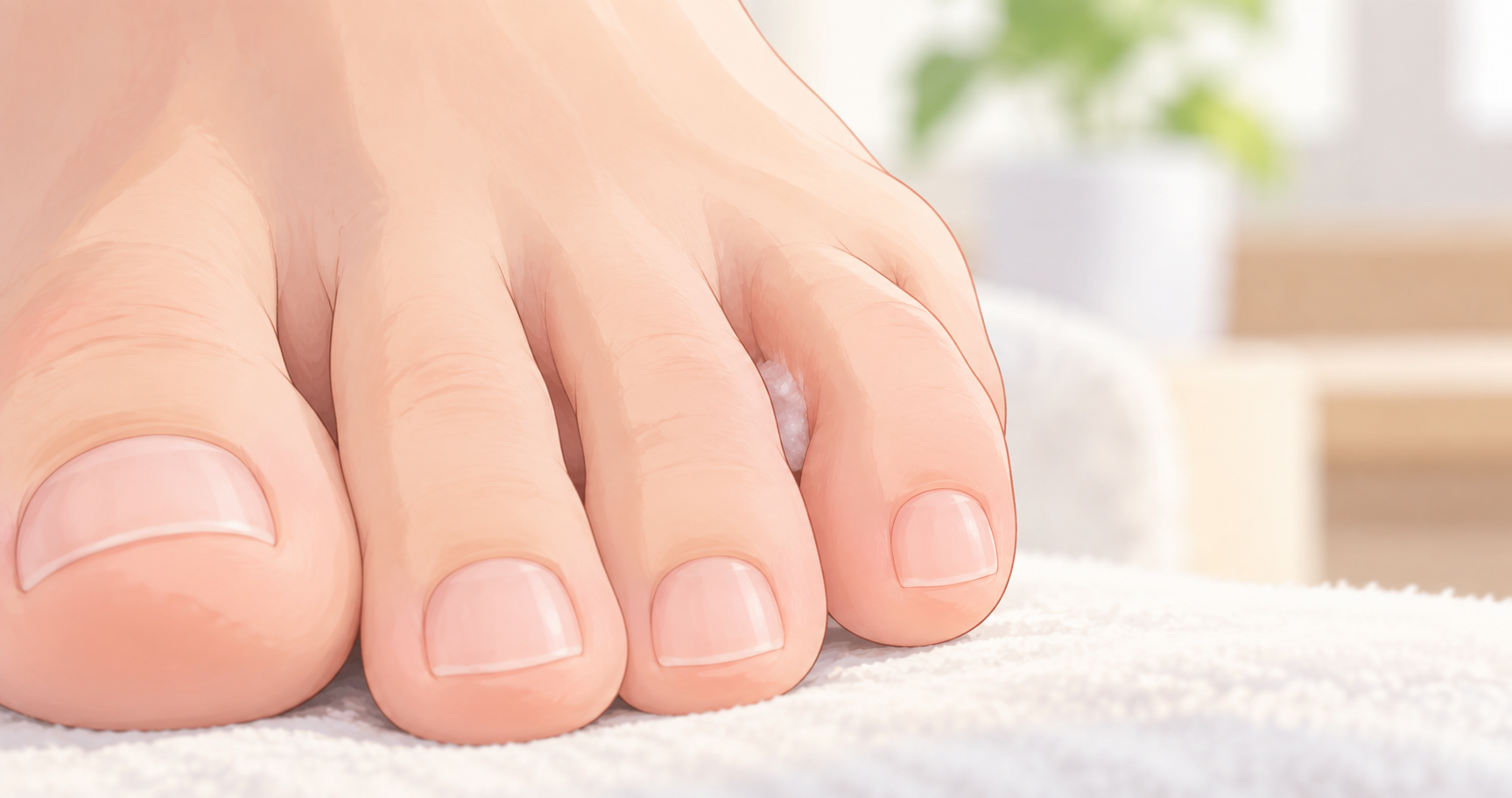
A painful spot between the toes can be surprisingly uncomfortable. It may feel as though there is a small stone, sharp piece of skin or foreign object trapped between the toes, yet when you look at the area there may be little more than a small white patch of thickened skin.
The important point is that a heloma molle is therefore not simply a superficial skin problem. In many cases, there is a mechanical reason why that particular piece of skin is repeatedly being compressed.
Understanding that mechanism helps explain why interdigital corns can become extremely painful — and why some return repeatedly after the visible corn has disappeared.
What is a heloma molle?
- Heloma durum — the hard corn, generally dry and firm.
- Heloma molle — the soft or interdigital corn.
Interdigital corns consist of localised hyperkeratotic tissue developing between opposing surfaces of adjacent toes. They are particularly associated with the fourth interdigital space between the fourth and fifth toes, although they can occur elsewhere (Day, Reyzelman and Harkless, 1996; Martí-Martínez et al., 2019).
Why does an interdigital corn form?
1. The toes are pushed against one another
2. Repetitive pressure stimulates the epidermis
3. The corn becomes increasingly concentrated
This helps explain the disproportionate pain. A lesion only a few millimetres across can hurt considerably because every step, shoe compression or movement of the neighbouring toe can repeatedly drive pressure through a very small area. Helomas have been described histologically and clinically as circumscribed hyperkeratotic lesions arising through epidermal hyperplasia following excessive pressure and friction (Martí-Martínez et al., 2019).
4. Moisture transforms the lesion into a “soft” corn
- limited air circulation,
- close skin-to-skin contact,
- perspiration,
- increased local humidity,
- and frequently prolonged enclosure inside footwear.
- white,
- grey-white,
- pale,
- rubbery,
- soft,
- moist,
- or slightly peeling.
Peer-reviewed descriptions of interdigital helomas specifically identify this absorption of perspiration as the reason for their characteristic macerated appearance (Martí-Martínez et al., 2019). This gives us a useful way of understanding the pathology: Pressure produces the hyperkeratosis. Moisture produces the maceration. Both processes are occurring at the same location.
Why are interdigital corns so painful?
The first is pressure concentration.
A broad callus distributes load over a comparatively large area. A corn concentrates force into a considerably smaller region.
An interdigital corn may effectively become trapped between two firm neighbouring structures. Every time the shoe compresses the toes, the lesion is squeezed again.
If repeated mechanical loading persists, the tissues beneath and around the corn can become inflamed. With sufficient ongoing pressure, skin breakdown or ulceration can occur (Martí-Martínez et al., 2019).
- a sharp focal pain,
- burning,
- tenderness when wearing closed shoes,
- pain when the neighbouring toes press together,
- or the sensation that something is stuck between the toes.
Removing the shoe can make the discomfort settle surprisingly quickly because the external compressive force decreases.
Why do they occur so often between the fourth and fifth toes?
More recent literature continues to identify the fourth interspace as the most frequent location for interdigital helomas (Martí-Martínez et al., 2019). One reason is the anatomy of the outer toes. Depending on toe length, rotation and alignment, a prominence from one phalanx can lie directly opposite a prominence from the neighbouring phalanx. The skin is then repeatedly compressed between them. The fifth toe is particularly variable in its position and may rotate, curl or move beneath or against the fourth toe.
Shoes matter — but they may not be the whole explanation
Is an interdigital corn contagious?
What else can look like an interdigital corn?
Fungal infection
Bacterial toe-web infection
Verruca
In one study, corns characteristically demonstrated a translucent central core, whereas plantar warts showed vascular red or black dots and interruption of normal dermatoglyphics (Patil et al., 2023).
Interdigital skin breakdown
Other dermatological lesions
Why does the same corn keep coming back?
The scientific literature on interdigital corns has long emphasised the importance of identifying the underlying predisposing anatomy and mechanical forces rather than viewing the lesion in isolation (Day, Reyzelman and Harkless, 1996; Gillet, 1979). A recurrent interdigital corn is therefore clinically useful information. Its recurrence suggests that the mechanical environment at that location has probably not changed sufficiently.
How is an interdigital corn assessed?
- the precise location of the lesion,
- which two surfaces of the toes oppose one another,
- the alignment and rotation of the lesser toes,
- the prominence of the underlying joints or phalanges,
- the shape and fit of footwear,
- whether the lesion changes during weightbearing,
- the condition of the surrounding interdigital skin,
- and whether infection, ulceration or another diagnosis is present.
For recurrent lesions, the relationship between the underlying bones may also become clinically relevant. The objective is therefore not merely to identify a “corn”. It is to understand the mechanical architecture surrounding the corn.
How are interdigital corns treated?
Why simply removing the thick skin may not be enough
- the position of the toes,
- the underlying bony prominences,
- the width of the shoe,
- or the compressive forces acting between the digits.
Instead of asking: “How do I remove this corn?” it may be more useful to ask: “Why does my skin keep producing a corn in exactly this location?”. That question leads back to the underlying mechanics.
Should you cut an interdigital corn yourself?
When should an interdigital corn be examined?
- the corn is painful,
- it repeatedly returns,
- you are uncertain whether it is actually a corn,
- the skin is breaking down,
- there is redness, swelling, discharge or increasing warmth,
- the area appears infected,
- changing footwear has not resolved the problem,
- the toes appear significantly rotated or deformed,
- or you have diabetes, neuropathy or circulation problems.
A recurrent lesion between exactly the same two toes usually deserves investigation of why those surfaces continue contacting one another.
Interdigital corns are small lesions with a mechanical story
Disclaimer: The word "treatment" in this article refers to the care and management of a patient’s health to prevent, cure, or improve a condition. Treatment results vary and do not necessarily indicate a cure. This article is for informational and educational purposes only and does not constitute medical advice.
About the Author
Mark B. Reyneker, BTech (Podiatry), MSc (Palaeontology) is a podiatrist and Founder & Clinical Director of Family Podiatry Centre, with more than 25 years of clinical experience across South Africa, Malaysia and Singapore. His clinical interests include foot and lower-limb pain, gait and biomechanics, sports-related foot conditions, orthotic therapy and footwear.
Alongside his clinical practice, Mark conducts research into human gait and foot biomechanics. His MSc research at the University of the Witwatersrand investigated human propulsion and the structural properties of the metatarsals. He is also the inventor of A Foot Orthotic, an orthotic technology developed through an international patent family.
Reference
- Bus, S.A. et al. (2024) ‘Guidelines on the prevention of foot ulcers in persons with diabetes (IWGDF 2023 update)’, Diabetes/Metabolism Research and Reviews, 40(3), e3651. DOI: 10.1002/dmrr.3651. DOI / PubMed
Available article: https://pure.plymouth.ac.uk/ws/portalfiles/portal/39290726/Diabetes/Metabolism Research and Reviews.pdf - Day, R.D., Reyzelman, A.M. and Harkless, L.B. (1996) ‘Evaluation and management of the interdigital corn: a literature review’, Clinics in Podiatric Medicine and Surgery, 13(2), pp. 201–206.
Available article: https://www.sciencedirect.com/science/article/abs/pii/S0891842223007954 - Freeman, D.B. (2002) ‘Corns and calluses resulting from mechanical hyperkeratosis’, American Family Physician, 65(11), pp. 2277–2280.
Available article: https://www.aafp.org/afp/2002/0601/p2277 - Gillet, H.G. (1979) ‘Interdigital clavus: predisposition is the key factor of soft corns’, Clinical Orthopaedics and Related Research, 142, pp. 103–109.
Available article: https://www.ovid.com/jnls/clinorthop/abstract/00003086-197907000-00017~interdigital-clavus-predisposition-is-the-key-factor-of-soft - Martí-Martínez, L.M. et al. (2019) ‘Description of the surgical technique for condylectomy with minimally invasive surgery to treat interdigital helomas on the lesser toes: a Delphi study’, Journal of Foot and Ankle Research, 12, 13. DOI: 10.1186/s13047-019-0322-5.
Available article: https://onlinelibrary.wiley.com/doi/full/10.1186/s13047-019-0322-5 - Martí-Martínez, L.M. et al. (2021) ‘Efficacy and safety of condylectomy with minimally invasive surgery in the treatment of interdigital corns of the lesser toes compared to conservative treatment’, Journal of Foot and Ankle Research, 14, 20. DOI: 10.1186/s13047-021-00460-0.
Available article: https://www.scienceopen.com/document/read?vid=30ccfd11-e123-432d-9e22-5cb002ee7109 - Menz, H.B., Zammit, G.V. and Munteanu, S.E. (2007) ‘Plantar pressures are higher under callused regions of the foot in older people’, Clinical and Experimental Dermatology, 32(4), pp. 375–380. DOI: 10.1111/j.1365-2230.2007.02421.x.
Available article: https://academic.oup.com/ced/article-abstract/32/4/375/6625728 - Patil, S. et al. (2023) ‘Dermoscopic findings in clinically diagnosed cases of plantar warts, corns, and calluses: a cross-sectional study’, Cureus, 15(4), e38093. DOI: 10.7759/cureus.38093.
Available article: https://assets.cureus.com/uploads/original_article/pdf/151471/20230425-17572-17jzjil.pdf?utm_source=consensus - Schaper, N.C. et al. (2024) ‘Practical guidelines on the prevention and management of diabetes-related foot disease (IWGDF 2023 update)’, Diabetes/Metabolism Research and Reviews, 40(3), e3657. DOI: 10.1002/dmrr.3657.
Available article: https://onlinelibrary.wiley.com/doi/full/10.1002/dmrr.3657
Frequently Asked Questions
A heloma molle is a painful soft corn that develops between adjacent toes. It forms because of repetitive pressure or friction and becomes soft and white because the thickened keratin absorbs moisture within the interdigital space.
The fourth interdigital space is the most frequently reported location for soft corns. The shape, position or rotation of the fourth and fifth toes can cause neighbouring bony prominences to oppose each other, while footwear may further compress the toes.
No. A heloma molle is a mechanically induced hyperkeratotic lesion. However, the moist skin surrounding an interdigital corn can also develop fungal or bacterial infection, and the conditions may coexist.
A corn concentrates pressure into a very small area. When it lies between two opposing toes, every episode of shoe compression or toe movement can repeatedly load the same sensitive tissue.
If the underlying pressure between the toes remains, the skin continues receiving the mechanical stimulus that originally caused the hyperkeratosis. Recurrence may therefore indicate that the causative pressure has not been sufficiently altered.
Yes. Persistent maceration and skin breakdown can occasionally allow secondary fungal or bacterial infection to develop.
The thickened keratin absorbs moisture from perspiration. Because evaporation between closely opposed toes is limited, the skin becomes macerated and develops its characteristic white, soft appearance.
Self-treatment with chemical preparations requires particular caution because the healthy skin surrounding an interdigital corn is often thin and moist. People with diabetes, neuropathy or impaired circulation should have corns professionally assessed rather than attempting chemical or sharp self-treatment.
A corn concentrates pressure into a very small area. When it lies between two opposing toes, every episode of shoe compression or toe movement can repeatedly load the same sensitive tissue.
An assessment is advisable when the lesion is painful, repeatedly returns, appears infected or ulcerated, or when you are unsure whether it is actually a corn. Earlier professional assessment is particularly important for people with diabetes, neuropathy or impaired circulation.