Haglund’s Deformity. Why Is There a Painful Bump at the Back of My Heel?


12 November 2026
By Mark Reyneker, BTech (Podiatry), MSc (Palaeontology), Registered Podiatrist, Foot & Gait Specialist | Founder & Clinical Director, Family Podiatry Centre
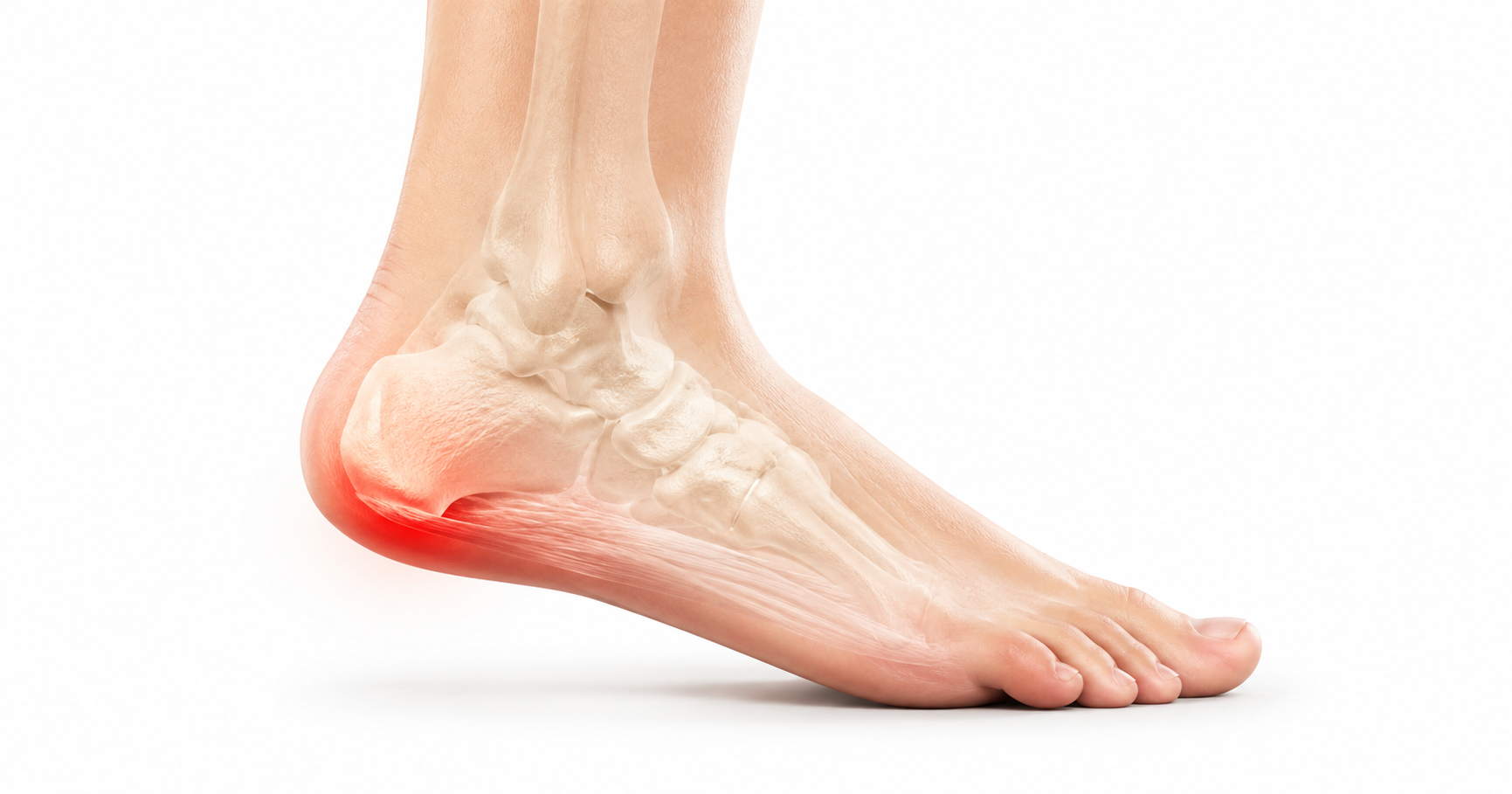
Haglund’s deformity is a bony prominence at the upper back of the heel. It can be painless, rub against the back of a shoe, or occur alongside irritation of the nearby Achilles tendon and a small cushioning sac called a bursa. If the bump hurts, where and when you feel the pain can help identify what needs attention.
What exactly is Haglund’s deformity?
Haglund’s deformity
A bony prominence at the upper back of the heel.
Retrocalcaneal bursitis
Irritation of the small sac deep between the Achilles tendon and the heel bone.
Insertional Achilles tendinopathy
A painful problem where the Achilles tendon attaches to the heel. “Insertional” means at the attachment.
Haglund’s syndrome
A term often used when the bony prominence occurs with symptoms and irritation of surrounding tissues, such as the bursa or tendon.
Why can a bump that’s been there for years suddenly hurt?
Does a bigger bump mean more pain?
What happens at a podiatry assessment?
What can be done about it?
Surgery is considered in selected cases when symptoms persist despite appropriate non-surgical care. If the pain started suddenly with a pop or snap and you’re struggling to push off or stand on tiptoe, seek urgent medical assessment. Those symptoms can occur with an Achilles tendon rupture.
When should you book an assessment?
Book An Appointment
Disclaimer: The word "treatment" in this article refers to the care and management of a patient’s health to prevent, cure, or improve a condition. Treatment results vary and do not necessarily indicate a cure. This article is for informational and educational purposes only and does not constitute medical advice.
About the Author
Mark B. Reyneker, BTech (Podiatry), MSc (Palaeontology) is a podiatrist and Founder & Clinical Director of Family Podiatry Centre, with more than 25 years of clinical experience across South Africa, Malaysia and Singapore. His clinical interests include foot and lower-limb pain, gait and biomechanics, sports-related foot conditions, orthotic therapy and footwear.
Alongside his clinical practice, Mark conducts research into human gait and foot biomechanics. His MSc research at the University of the Witwatersrand investigated human propulsion and the structural properties of the metatarsals. He is also the inventor of A Foot Orthotic, an orthotic technology developed through an international patent family.
References
- Pavlov H, Heneghan MA, Hersh A, Goldman AB, Vigorita V. The Haglund syndrome: initial and differential diagnosis. Radiology. 1982;144(1):83–88. DOI
Available article: https://pubs.rsna.org/doi/10.1148/radiology.144.1.7089270 - Glossary of terms for musculoskeletal radiology. Skeletal Radiology. 2020. DOI
Available article: https://link.springer.com/article/10.1007/s00256-020-03465-1 - van Dijk CN, van Sterkenburg MN, Wiegerinck JI, Karlsson J, Maffulli N. Terminology for Achilles tendon related disorders. Knee Surgery, Sports Traumatology, Arthroscopy. 2011;19(5):835–841. DOI
Available article: https://esskajournals.onlinelibrary.wiley.com/doi/10.1007/s00167-010-1374-z - Sofka CM, Adler RS, Positano R, Pavlov H, Luchs JS. Haglund’s syndrome: diagnosis and treatment using sonography. HSS Journal. 2006;2(1):27–29. DOI
Available article: https://d1wqtxts1xzle7.cloudfront.net/44820070/Haglunds_syndrome_Diagnosis_and_treatme20160417-4000-1g224ta-libre.pdf?1460901269=&response-content-disposition=inline%3B+filename%3DHaglunds_Syndrome_Diagnosis_and_Treatmen.pdf - Chimenti RL, Cychosz CC, Hall MM, Phisitkul P. Current concepts review update: insertional Achilles tendinopathy. Foot & Ankle International. 2017;38(10):1160–1169. DOI
Available article: https://journals.sagepub.com/doi/10.1177/1071100717723127 - Kang S, Thordarson DB, Charlton TP. Insertional Achilles tendinitis and Haglund’s deformity. Foot & Ankle International. 2012;33(6):487–491. DOI
Available article: https://pubmed.ncbi.nlm.nih.gov/22735321/ - Correlations between insertional Achilles tendinopathy and Haglund’s deformity: MRI and radiographic findings. Journal of Orthopaedic Surgery and Research. 2025;20:666. DOI
Available article: https://link.springer.com/article/10.1186/s13018-025-06036-z - de Vos RJ, van der Vlist AC, Zwerver J, et al. Dutch multidisciplinary guideline on Achilles tendinopathy. British Journal of Sports Medicine. 2021;55(20):1125–1134. DOI
Available article: https://nt-e.nl/assets/blogfiles/Dutch-multidisciplinary-guideline-on-achilles-tendinopathy.-De-Vos-et-al.-2021.pdf - Pringels L, et al. Effectiveness of reducing tendon compression in the rehabilitation of insertional Achilles tendinopathy: a randomised clinical trial. British Journal of Sports Medicine. 2025. DOI
Available article: https://www.proquest.com/openview/8064983244a1d78294a0a020487d2c5d/1?pq-origsite=gscholar&cbl=2041038 - Current concepts and management of insertional Achilles tendinopathy and calcific insertional Achilles tendinopathy. British Medical Bulletin. 2026;159(1):ldag031. DOI
Available article: https://academic.oup.com/bmb/article-abstract/159/1/ldag031/8789723 - British Orthopaedic Foot & Ankle Society. Achilles tendon acute rupture. BOFAS Hyperbook. Clinical reference
Frequently Asked Questions
It often feels like a hard bump at the upper back of the heel. When the tissues around it are irritated, the area may feel tender or appear swollen.
Yes. A prominent heel bone can be present without symptoms. An incidental finding on an X-ray is interpreted in the context of your symptoms and examination.
A Haglund prominence is the shape of the upper back of the heel bone. An insertional Achilles spur projects from the area where the tendon attaches. Both can be present in the same heel.
Haglund-related symptoms are felt at the back of the heel. Plantar fasciitis typically causes pain underneath the heel. Showing exactly where it hurts helps guide the examination.
Yes. A stiff or closely fitting shoe back can press on the area and irritate the tissues over the bump. If one pair consistently causes trouble, bring it to your assessment.
These activities load the Achilles tendon and can increase compression near its attachment as the ankle bends. Pain during these movements is a clue that the tendon may be involved.
Yes. The bony prominence can be present on both heels, and you may feel more irritation on one side.
Some cases can be assessed clinically. When imaging would help, an X-ray can show the shape of the bone, while ultrasound can help assess the tendon and bursa.
Yes. Symptoms can improve when pressure or irritation in the surrounding tissues settles. The bony contour can remain visible.
Care usually starts with non-surgical measures tailored to the tissue involved. Surgery is an option for selected cases with persistent symptoms after appropriate care.