Curved Toenail Pain: Involuted & Pincer Nails Explained



31 August 2026
By Mark Reyneker, BTech (Podiatry), MSc (Palaeontology), Registered Podiatrist, Foot & Gait Specialist | Founder & Clinical Director, Family Podiatry Centre
An ingrown nail usually involves the nail edge traumatising or penetrating the surrounding skin, whereas an involuted nail may hurt simply because the nail is too curved for the available space. Treatment depends on severity and may include reducing shoe pressure, clearing painful hard skin, reducing nail thickness, nail bracing or, when symptoms are recurrent or severe, partial nail surgery.
Why some toenails become excessively curved, why the sides become painful, and what can be done about it
the nail itself is simply too curved for the space underneath it.
What is an involuted toenail?
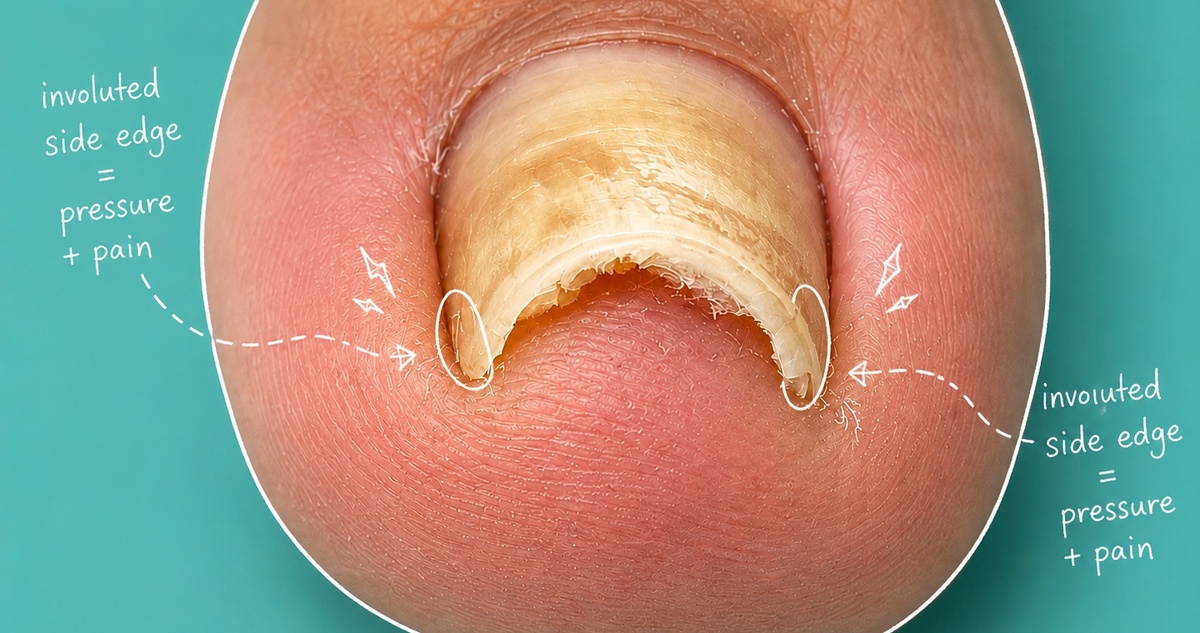
The problem is not necessarily that the nail is too wide. It is that the nail is too curved.
Why does an involuted nail hurt?
- There is no obvious infection
- There is no pus
- There is no granulation tissue
- The nail has not obviously pierced the skin
A shoe that compresses the toes from the sides or presses down over the nail increases the force acting on an already sensitive nail groove.
“It hurts down the sides of my nail, especially in shoes.”
Involuted nail vs ingrown toenail
Importantly, these conditions can overlap. An excessively curved nail may eventually produce enough pressure or trauma to behave like an ingrown toenail.
This is one reason patients with involuted nails may experience repeated episodes of “ingrown toenails” even after repeatedly cutting away the painful corner. The corner may not be the fundamental problem.
Why do toenails become so curved?
Reported associations include genetic predisposition, repeated trauma, changes in the nail bed, fungal nail disease, abnormalities around the distal phalanx and altered mechanical forces acting on the toe. Some people appear to have naturally more curved nails.
Acquired cases, however, can develop later in life. The relationship between the nail, nail bed and underlying bone is particularly important.
The nail is not simply growing on top of the toe
It would be misleading to tell every patient with an involuted nail that the condition has one simple cause.
Could the way we load our toes influence nail shape?
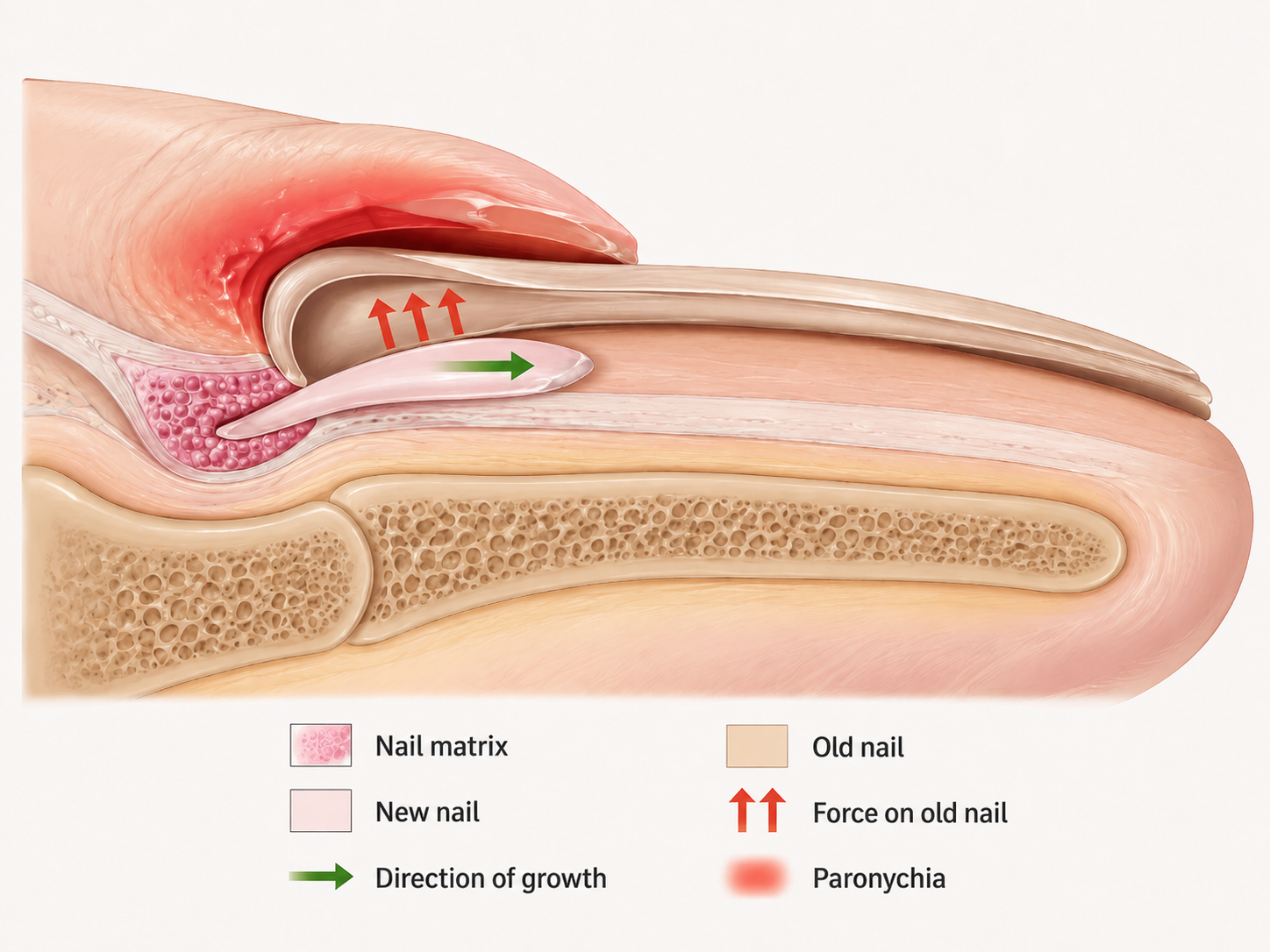
When the toe contacts the ground, the plantar soft tissues experience upward force while the nail plate provides resistance above.
This led the authors to propose that insufficient mechanical stimulation beneath the toe may contribute to excessive nail curvature. This is an intriguing hypothesis rather than definitive proof. The study was small, involving 12 people with bilateral pincer nails and 12 controls, so it cannot establish that reduced hallux loading causes involuted nails.
Nevertheless, it raises an important biomechanical possibility:
Nail shape may partly reflect how the toe is being used.
Shoes can affect the problem in more than one way
- Reducing direct compression around the nail
- Considering how the shoe affects loading of the big toe during walking
Why cutting down the sides can make matters worse
So the person cuts the corner away.
But the nail continues growing. Eventually the shortened edge reaches the nail groove again. It may now have a sharp corner or nail spicule.
Over time, the nail becomes progressively narrower while the underlying curvature has not necessarily changed.
Hard skin can develop down the side of the nail
Now there are two structures competing for the same limited space:
the curved nail edge and the hardened skin.
Book An Appointment
Can fungal infection cause an involuted nail?
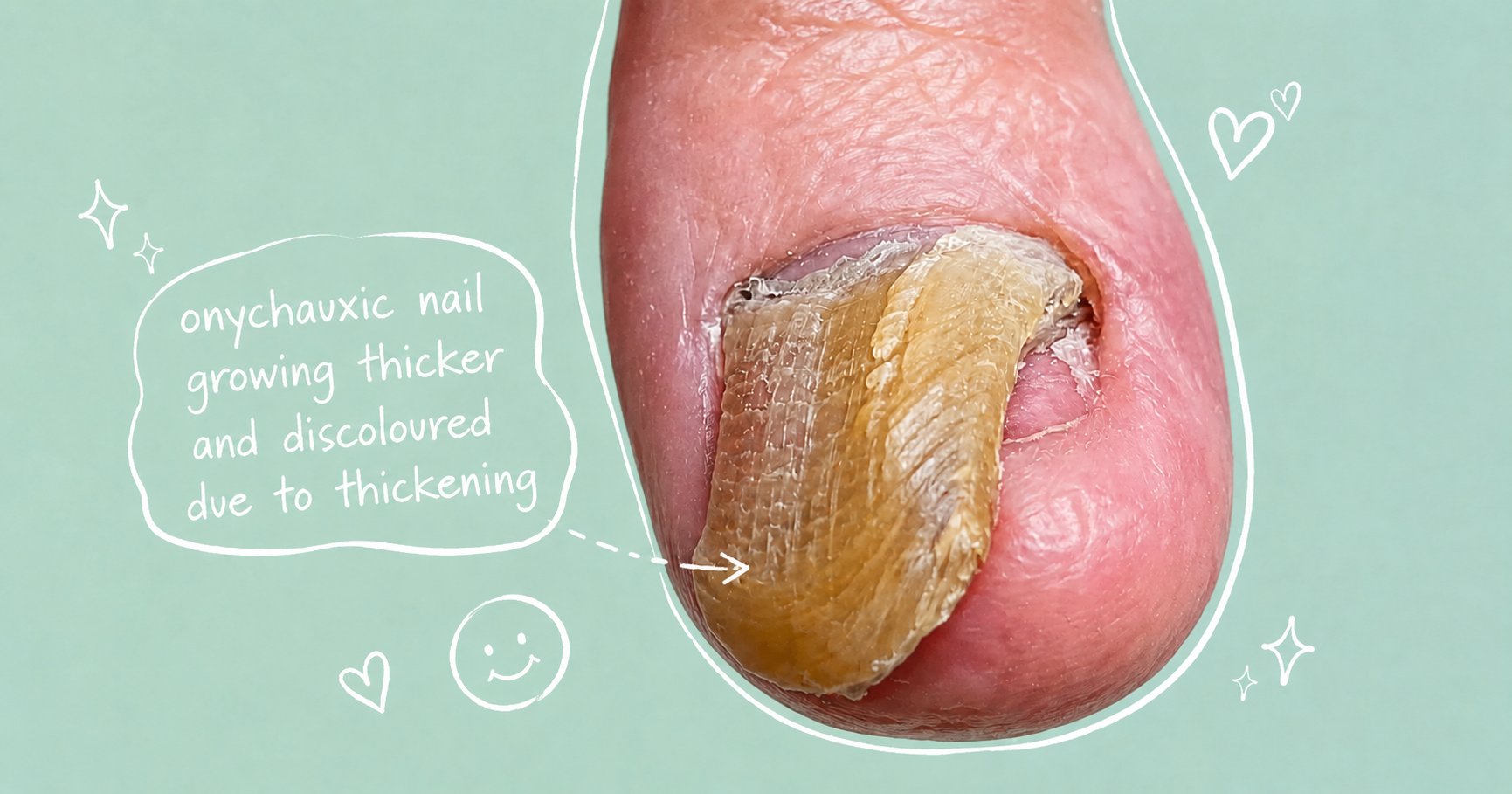
However, not every thick or curved nail is fungal.
How should an involuted toenail be assessed?
A clinical assessment may consider:
- Nail curvature
How severely is the nail curved? - Location of pain
Is pressure occurring on one side or both sides? - Skin condition
Is there inflammation, infection, granulation tissue or onychophosis? - Nail thickness
A thick nail occupies more space and can increase shoe pressure. - Nail integrity
Is there a sharp spicule or fractured edge? - Possible fungal infection
Is the nail thickened, discoloured or friable? - Footwear
Is the toe box compressing the nail? - Toe and foot mechanics
Where clinically appropriate, gait and plantar loading may also be considered, particularly when there appears to be abnormal hallux function. Not every patient requires every investigation. The objective is to determine whether we are dealing primarily with a curvature problem, an ingrown nail, a skin problem, an infection—or a combination of these.
Treatment: the least invasive effective option
A useful approach is therefore to progress from conservative management towards more definitive procedures when necessary. This is broadly consistent with modern management principles and the recent German S1 guidance addressing ingrown and pincer nails.
1. Reduce pressure around the nail
This can include:
- Wider footwear
- Sufficient depth over the toes
- Avoiding shoes that squeeze the big toe against the second toe
- Avoiding repeated aggressive cutting into the nail grooves
- Appropriate professional reduction of painful nail or callused tissue
2. Reduce nail thickness where appropriate
3. Clear painful nail grooves
4. Nail bracing: changing the curvature rather than simply cutting the nail
The attraction of orthonyxia is straightforward:
5. When does an involuted nail require surgery?
Surgery may be considered when there is:
- Severe curvature
- Persistent pain despite conservative treatment
- Repeated ingrowing or inflammation
- Recurrent nail spicules
- Significant soft-tissue compression
- Failure of bracing or inability to use a brace
- Substantial interference with footwear, walking or daily activities
This is another reason why distinguishing an involuted nail from an ingrown toenail matters.
Partial nail surgery
“remove the nail.”
What about removing the entire toenail?
More extensive procedures are generally reserved for severe deformities or situations where less invasive treatment has failed.
Can an involuted toenail be permanently fixed?
deformity.
Nail bracing attempts to remodel the curvature while retaining the nail, although recurrence can occur. A partial matricectomy can permanently prevent a problematic portion of the nail from regrowing, but this permanently makes the nail narrower.
More extensive reconstructive procedures can alter the anatomy of severe pincer nails but are correspondingly more invasive.
When should you see a podiatrist?
- The sides of the nail repeatedly hurt
- You have to keep cutting down the corners
- The nail appears increasingly curved
- Hard skin repeatedly develops in the nail grooves
- Shoes cause significant nail pain
- The skin becomes red, swollen or produces discharge
- The problem keeps returning
- You are unsure whether you have an involuted nail, ingrown toenail or fungal nail infection
The important point: look at the shape of the nail
If the nail is markedly curved and both sides are turning downward into the nail grooves, the nail's geometry itself may be contributing to the pain.
That changes the clinical question.
“How do we remove the painful corner?”
- Sometimes the answer is inflammation.
- Sometimes it is a nail spicule.
- Sometimes it is hard skin.
- Sometimes it is footwear.
- And sometimes the nail is simply too curved.
Key points
- An involuted toenail has excessive transverse curvature, causing the sides of the nail to turn downwards.
- A pincer nail represents a more pronounced form of transverse nail overcurvature.
- An involuted nail can be painful without actually penetrating the skin.
- The pain may result from mechanical compression of the lateral nail grooves.
- Involuted nails and ingrown toenails can occur together, but they are not synonymous.
- Repeatedly cutting down the sides may provide temporary relief without correcting the underlying curvature.
- Hard skin called onychophosis may develop in the nail groove and further increase pressure.
- Treatment can range from footwear modification and professional nail care to nail bracing and, when necessary, nail surgery.
- Nail bracing is particularly interesting because it attempts to change nail curvature while preserving the nail.
- Severe or recurrent cases require assessment of the nail shape, surrounding tissue and underlying cause rather than simply repeated removal of the painful corner.
Book An Appointment
Disclaimer: The word "treatment" in this article refers to the care and management of a patient’s health to prevent, cure, or improve a condition. Treatment results vary and do not necessarily indicate a cure. This article is for informational and educational purposes only and does not constitute medical advice.
About the Author
Mark B. Reyneker, BTech (Podiatry), MSc (Palaeontology) is a podiatrist and Founder & Clinical Director of Family Podiatry Centre, with more than 25 years of clinical experience across South Africa, Malaysia and Singapore. His clinical interests include foot and lower-limb pain, gait and biomechanics, sports-related foot conditions, orthotic therapy and footwear.
Alongside his clinical practice, Mark conducts research into human gait and foot biomechanics. His MSc research at the University of the Witwatersrand investigated human propulsion and the structural properties of the metatarsals. He is also the inventor of A Foot Orthotic, an orthotic technology developed through an international patent family.
References
PubMed: https://pubmed.ncbi.nlm.nih.gov/31738836/
Full text: https://pmc.ncbi.nlm.nih.gov/articles/PMC7180426/
DOI: https://doi.org/10.1155/2020/2939850
PubMed: https://pubmed.ncbi.nlm.nih.gov/19889164/
DOI: https://doi.org/10.1111/j.1524-4725.2009.01361.x
Full text: https://pmc.ncbi.nlm.nih.gov/articles/PMC4174051/
DOI: https://doi.org/10.1097/GOX.0b013e3182a9647a
Full text: https://link.springer.com/article/10.1186/s13047-015-0100-y
DOI: https://doi.org/10.1186/s13047-015-0100-y
Full text: https://pmc.ncbi.nlm.nih.gov/articles/PMC4366703/
Full text: https://pmc.ncbi.nlm.nih.gov/articles/PMC3229933/
PubMed: https://pubmed.ncbi.nlm.nih.gov/42018169/
DOI: https://doi.org/10.1007/s00105-026-05674-6
PubMed: https://pubmed.ncbi.nlm.nih.gov/37301845/
PubMed: https://pubmed.ncbi.nlm.nih.gov/33113886/
Frequently Asked Questions
An involuted toenail is a nail that has become excessively curved from side to side. Instead of growing relatively flat, the edges turn downward toward the nail grooves. In severe cases, the nail can take on an inverted U-shape, C-shape, or almost tubular appearance, which medical professionals refer to as a "pincer nail deformity."
While the terms are often used interchangeably, they are different conditions. An involuted nail is a structural problem where the nail is excessively curved, causing pressure in the nail grooves. An ingrown toenail occurs when a sharp edge or corner of the nail physically pierces and traumatizes the surrounding skin, leading to inflammation and infection. An involuted nail can, however, eventually turn into an ingrown nail.
The pain is typically caused by mechanical pressure. As the nail's lateral edges rotate downwards, they act like rigid vertical walls pressing tightly against the soft tissue within the nail grooves. This continuous squeezing and compression causes considerable pain, even if there is no pus, redness, or skin penetration.
There is no single cause for involuted toenails. Contributing factors can include genetic predisposition (a family history of curved nails), repeated toe trauma, underlying bone changes in the toe, fungal nail infections, narrowing of the nail bed, and altered mechanical forces acting on the toe when walking.
Cutting the painful corners away only offers temporary relief and often makes the problem worse long-term. As the nail grows back, it will inevitably hit the nail groove again, often leaving a sharp spike (spicule) behind. This leads to a vicious cycle of cutting and regrowth that gradually makes the nail narrower and greatly increases the risk of developing a true ingrown toenail.
While tight shoes may not be the sole root cause, they heavily contribute to the pain and mechanical issues. A narrow toe box squashes the toes together, while a shallow shoe presses down directly on the top of the nail. Both actions dramatically increase the pressure an already curved nail puts on the surrounding skin.
This accumulation of hard skin is a condition called onychophosis. Essentially, it is a small corn or callus inside the nail groove. When the curved nail continuously rubs and presses against the skin, the skin defends itself by producing extra layers of keratin (hardened skin). This compacted skin takes up space in an already tight nail groove, often becoming a major source of the pain you feel.
Not necessarily. While a fungal nail infection (onychomycosis) can alter the thickness, texture, and shape of a nail and is associated with pincer nail deformities, not every curved nail is fungal. Taking antifungal medications will not straighten a nail if the curvature is caused by structural or mechanical issues rather than a fungus.
Interestingly, it might. Research indicates that the upward pressure your big toe experiences when pushing off the ground during a normal walking gait helps maintain a flat nail shape. Some studies show that people with pincer nails apply significantly less pressure beneath their big toe when walking, suggesting that a lack of normal mechanical stimulation could contribute to the nail curling.
Treatment depends on the severity of the problem and focuses on the least invasive option first. Conservative management may involve safely clearing out the painful hard skin (onychophosis) in the nail grooves, changing footwear, and evaluating your walking gait. If the curvature is severe and conservative treatments repeatedly fail to give relief, minor nail surgery or corrective procedures may be recommended to address the underlying shape of the nail.