Onychauxia: Why Toenails Become Thick, Hard, Yellow, Painful or Difficult to Cut



9 June 2026
By Mark Reyneker, BTech (Podiatry), MSc (Palaeontology), Registered Podiatrist, Foot & Gait Specialist | Founder & Clinical Director, Family Podiatry Centre
Published: 9 June 2026 | Last reviewed: 9 June 2026
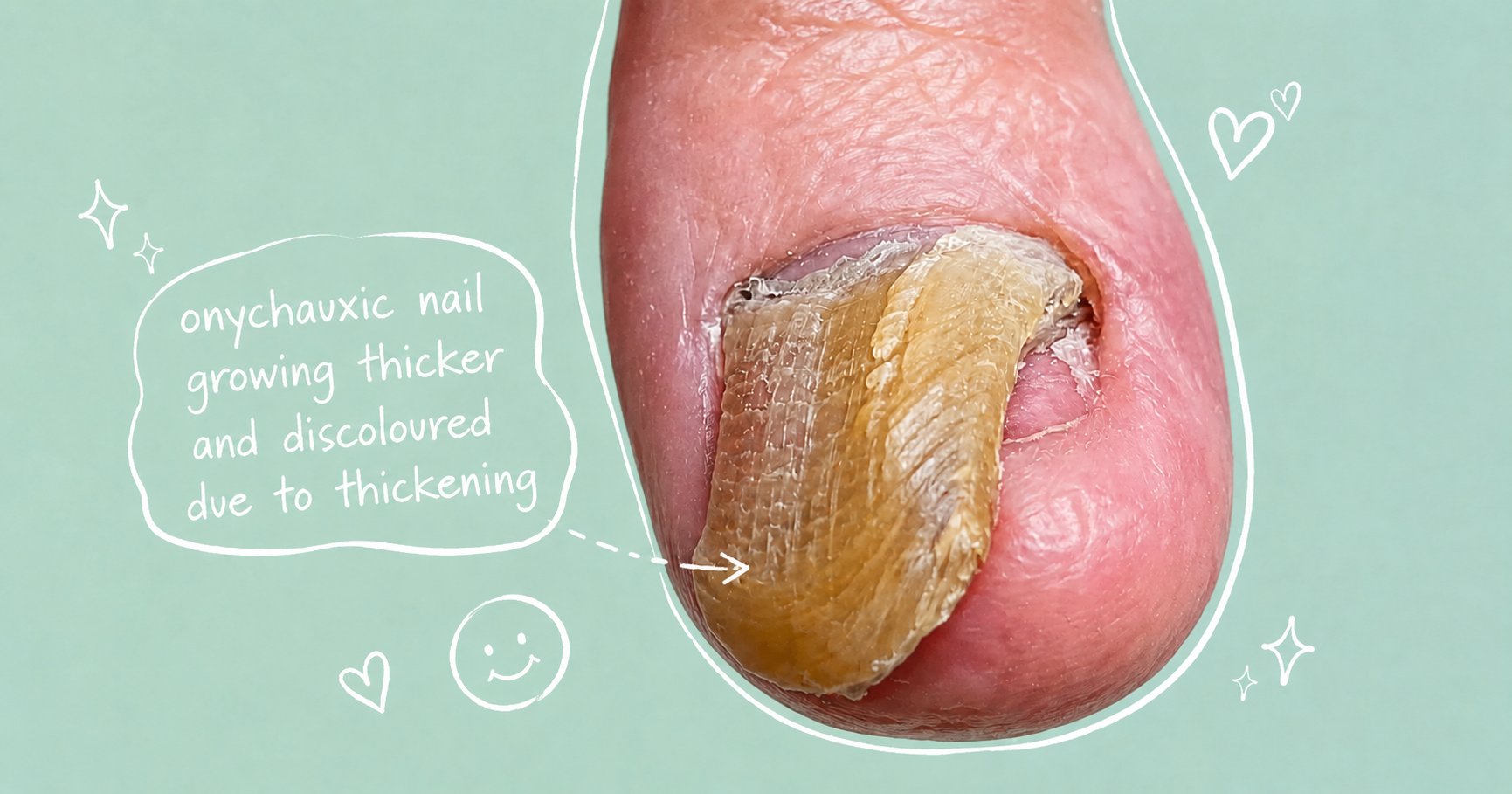
A thick toenail is one of the most common nail problems seen in podiatry. Patients often describe the nail as “too thick to cut”, “yellow”, “hard”, “curved”, “ugly”, “dead”, “fungal”, or “pressing in my shoe”. The medical term used for abnormal nail thickening is onychauxia or onychauxis or an onychauxic nail.
A thick toenail is one of the most common nail problems seen in podiatry. Patients often describe the nail as “too thick to cut”, “yellow”, “hard”, “curved”, “ugly”, “dead”, “fungal”, or “pressing in my shoe”. The medical term used for abnormal nail thickening is onychauxia or onychauxis or an onychauxic nail.
Strictly speaking, onychauxia/onychauxis is a description, not a final diagnosis. It means the nail plate has become abnormally thickened or hypertrophic. It does not automatically tell us why the nail became thick.
This distinction matters. Many thick toenails are assumed to be fungal. While some might be, many thick nails are caused by chronic shoe pressure, ageing, trauma, psoriasis, diabetes-related foot risk, vascular disease, toe deformity, inflammatory skin disease, or previous nail-matrix injury. Occasionally, a chronic abnormal nail may reflect a less common but more serious nail-unit condition.
Book An Appointment
Book An Appointment
1. Nail anatomy: why the nail can thicken
The nail is not just a hard plate of keratin. It is a specialised anatomical unit made up of the nail plate, nail matrix, nail bed, nail folds, cuticle, hyponychium and the surrounding soft tissues (McCarthy, 2004; de Berker, André and Baran, 2007; de Berker, 2013).
Understanding these structures helps explain why a nail can become thick, lifted, yellow, ridged or painful.
The nail plate
The nail plate is the hard visible part of the nail. It is made mainly of compact keratin and is normally translucent. The healthy nail appears pink because the nail bed underneath is vascular.
In onychauxia, the nail plate may become:
- thicker;
- harder;
- opaque;
- yellow, brown or grey;
- ridged;
- brittle;
- curved;
- painful under shoe pressure.
Sometimes the thickening is true thickening of the nail plate. Sometimes much of the apparent thickening comes from subungual hyperkeratosis, meaning compacted keratin and debris underneath the nail.
The nail matrix
The nail matrix is the nail-producing tissue at the base of the nail. The visible white crescent, when present, is the lunula, which represents the distal part of the matrix.
The matrix is crucial because damage to the matrix can permanently change nail growth. If the matrix is injured by trauma, surgery, inflammation, psoriasis or repeated pressure, it may produce a nail that grows thicker, split, ridged, distorted or irregular.
This is why a toenail that was damaged years ago may never return to a normal appearance, even if no active infection is present.
The nail bed
The nail bed lies directly under the nail plate. It helps support and guide the nail as it grows forward. Disease of the nail bed can cause lifting of the nail, thick keratin build-up, discoloration and pain.
Nail-bed disease is important in both fungal infection and psoriasis. In both conditions, the nail can lift and debris can accumulate underneath, making the nail look thick and abnormal.
The hyponychium
The hyponychium is the seal under the free edge of the nail. When the nail lifts from the nail bed, this protective seal is disrupted. This creates a space where moisture, skin debris, bacteria and fungi can collect.
The nail folds and cuticle
The skin folds around the nail protect the nail unit. The cuticle acts as a seal. Aggressive cutting, picking, pedicures, chemical irritation or chronic inflammation can damage this barrier and contribute to nail disease.
2. Toenails grow slowly, so recovery is slow
Toenails grow much more slowly than fingernails. In a study of healthy young adults, fingernails grew at an average of approximately 3.47 mm per month, while toenails grew at approximately 1.62 mm per month (Yaemsiri et al., 2010).
This explains why nail treatment is often frustrating. Even if the correct treatment starts today, the old thick nail does not instantly disappear. A great toenail may take a year or more to fully replace itself. Growth can be slower in older adults, in people with poor circulation, after trauma, and where the matrix has been damaged.
This is one reason podiatric treatment often has two goals:
- Immediate mechanical relief — reduce thickness, pressure and pain.
- Long-term correction where possible — address the cause and allow healthier nail growth over time.
3. What does onychauxia look like?
Onychauxia may present with:
- thickened nail plate;
- yellow, brown, grey or opaque colour;
- loss of normal nail translucency;
- hard or compact nail texture;
- ridges or roughness;
- pain in closed shoes;
- difficulty cutting the nail;
- nail lifting from the nail bed;
- debris under the nail;
- recurrent pressure under the nail;
- associated ingrown nail symptoms;
- progressive curvature in severe cases.
In older patients, onychauxis is commonly described as localised hypertrophy of the nail plate with discoloration, loss of translucency and sometimes subungual hyperkeratosis (Abdullah and Abbas, 2011). If the nail becomes severely thickened, elongated and curved, the condition may progress toward onychogryphosis, sometimes called “ram’s horn nail” (Ko and Lipner, 2018).
4. Onychauxia is not the same as fungal nail infection
Onychauxia means the nail is thick. Onychomycosis means the nail is infected by fungus.
A fungal nail can become thick, but not every thick nail is fungal.
Onychomycosis is a fungal infection of the nail unit caused by dermatophytes, yeasts or non-dermatophyte moulds (Lipner and Scher, 2019a; Leung et al., 2020). It commonly causes nail discoloration, thickening, crumbling, lifting and subungual debris.
However, similar appearances can occur with trauma, psoriasis, ageing, vascular disease, eczema, lichen planus, repeated shoe pressure and previous matrix injury (Wollina et al., 2016; Lee and Lipner, 2022).
This is why appearance alone can be misleading.
A nail may look fungal but test negative. A traumatically damaged nail may later develop fungal colonisation. A psoriatic nail may be mistaken for fungus. A single abnormal nail that does not respond to appropriate care may need further assessment.
For this reason, expert reviews and guidelines recommend confirming suspected fungal nail infection before prolonged antifungal treatment, especially before oral antifungal medication (Ameen et al., 2014; Lipner and Scher, 2019a; Falotico and Lipner, 2022).
5. Common causes of onychauxia
5.1 Repeated shoe pressure and microtrauma
In podiatry, chronic microtrauma is one of the most important causes of thick toenails.
The big toenail and second toenail are especially vulnerable. They may repeatedly hit the top, front or side of the shoe. Over time, the nail unit responds to this pressure by producing a thicker, harder or more distorted nail.
This is common in:
- runners;
- hikers;
- people who wear narrow shoes;
- people with shallow toe-box footwear;
- people with bunions;
- people with hammertoes;
- people with a long second toe;
- people whose foot slides forward in the shoe;
- people with altered gait mechanics;
- people with previous nail trauma.
The nail should therefore never be assessed in isolation. A podiatrist should also look at the toe shape, shoe shape, walking pattern, toe-box depth, pressure points and foot mechanics.
If mechanical pressure is the main cause, antifungal treatment alone will not solve the problem.
5.2 Age-related nail change
Nail changes are common with ageing. Older toenails may grow more slowly, become thicker, more opaque, more brittle, more ridged and more difficult to cut (Singh, Haneef and Uday, 2005; Abdullah and Abbas, 2011; Albucker, Conway and Lipner, 2024).
This does not mean thick nails in older adults should be dismissed. Thick nails can cause:
- shoe pain;
- difficulty walking;
- reduced mobility;
- difficulty with self-care;
- pressure wounds;
- secondary infection;
- embarrassment;
- loss of confidence wearing open shoes.
In older patients, onychauxia may be part of a wider picture involving reduced flexibility, poor eyesight, difficulty reaching the feet, vascular disease, diabetes, neuropathy or inappropriate footwear.
5.3 Fungal nail infection
Onychomycosis remains a very common cause of thick toenails. It commonly affects toenails more than fingernails and may present with yellow-white discoloration, nail lifting, crumbling, subungual debris and thickening (Lipner and Scher, 2019a; Leung et al., 2020).
Risk factors include:
- increasing age;
- tinea pedis;
- warm enclosed footwear;
- sweating;
- nail trauma;
- diabetes;
- immunosuppression;
- peripheral vascular disease;
- family or household exposure;
- previous fungal nail infection.
Fungal nails can also recur after treatment. Biofilms, persistent tinea pedis, reinfection from shoes or skin, incomplete treatment, and ongoing trauma may all contribute to recurrence (Gupta, Daigle and Carviel, 2016; Lipner and Scher, 2019b).
5.4 Psoriasis
Nail psoriasis is another major cause of thickened, abnormal nails. It can affect the nail matrix and nail bed. Matrix involvement may produce pitting, ridging, leukonychia and crumbling. Nail-bed involvement may cause oil-drop discoloration, onycholysis, splinter haemorrhages and subungual hyperkeratosis (Schons et al., 2014; Pasch, 2016; Haneke, 2017).
Psoriatic nails can look very similar to fungal nails. To complicate matters further, fungal infection and nail psoriasis can coexist (Chaowattanapanit et al., 2018; Kyriakou et al., 2022).
This matters because antifungal treatment will not resolve nail psoriasis unless there is also a true fungal infection. If a patient has skin psoriasis, scalp psoriasis, joint pain, morning stiffness, swollen fingers or toes, or a family history of psoriasis, the thick nail should be assessed with psoriasis in mind.
5.5 Diabetes and high-risk feet
In people with diabetes, thick nails deserve particular attention.
Diabetes can be associated with neuropathy, vascular disease, reduced immune response, skin fragility and increased risk of ulceration. A thick nail may press into the nail bed, the shoe or adjacent toes. If the patient has reduced sensation, this pressure may go unnoticed until a wound develops.
Studies have found a high prevalence of toenail onychomycosis in diabetic populations, especially in older patients and those with severe nail changes (Saunte et al., 2006; Navarro-Pérez et al., 2024). However, the important podiatric issue is broader than fungus. Thick nails in a diabetic foot can create pressure, skin breakdown and infection risk.
Patients with diabetes, poor circulation or numbness should avoid aggressive home cutting, blades, digging under the nail or “bathroom surgery”.
5.6 Poor circulation and vascular disease
Reduced blood flow can affect nail growth, tissue resilience and healing. Thickened, curved and dystrophic nails are often seen in patients with vascular compromise.
A case-control study found onychogryphosis to be associated with increased age, activity limitations, psoriasis, onychomycosis, hallux deformities, peripheral vascular disease, venous varices, ulcers and type 2 diabetes mellitus (Choo and Lipner, 2023).
This supports a practical clinical point: a severely thickened nail can be a visible marker of wider foot-health risk.
5.7 Previous nail injury
A single injury can permanently affect nail growth. Examples include:
- dropping a heavy object on the toe;
- stubbing the toe badly;
- sports trauma;
- repeated black toenails from running;
- crush injury;
- previous nail surgery;
- long-term shoe pressure;
- repeated pedicure trauma.
If the nail matrix was scarred, the nail may grow abnormally for life. In this situation, the aim is often not to make the nail perfect, but to make it thinner, safer, less painful and easier to manage.
5.8 Onychogryphosis: the severe end of thick nail disease
Onychogryphosis is a severe form of nail thickening in which the nail becomes opaque, yellow-brown, elongated, curved and grossly thickened. It is often described as “ram’s horn nail” (Chang and Meaux, 2015; Ko and Lipner, 2018).
It is more common in older adults, patients with poor self-care capacity, chronic trauma, poor footwear, vascular disease, diabetes, psoriasis or longstanding neglected nail disease (Ko and Lipner, 2018; Choo and Lipner, 2023).
The nail may become so thick that normal clippers cannot cut it. It may press into shoes, adjacent toes or the skin. In severe cases, it can contribute to pain, wounds, paronychia or infection.
5.9 Less common but important causes
Less common causes of thick, abnormal or dystrophic nails include:
- lichen planus;
- yellow nail syndrome;
- pachyonychia congenita;
- chronic paronychia;
- subungual exostosis;
- onychomatricoma;
- squamous cell carcinoma of the nail unit;
- nail-unit melanoma.
These conditions are less common than trauma or fungal infection, but they are important because delayed diagnosis can have serious consequences. A single nail that is changing, bleeding, pigmented, painful, ulcerated or associated with a lump should not be treated indefinitely as “fungus” without reassessment (Wollina et al., 2016; Darmawan et al., 2022; Jin et al., 2024).
6. Symptoms: why thick toenails hurt
Some thick nails are painless. Others become very painful.
Pain can occur because the nail becomes a hard wedge inside the shoe. It may press upward into the shoe, downward into the nail bed, or sideways into the skin. Even a few millimetres of extra nail thickness can matter if the toe box is shallow.
Symptoms may include:
- pain in closed shoes;
- pain while walking;
- pain while running;
- pressure under the nail;
- difficulty cutting the nail;
- catching on socks;
- recurrent bleeding under the nail;
- nail lifting;
- ingrown nail symptoms;
- corns beside or under the nail;
- embarrassment wearing sandals;
- fear of cutting the nail.
In high-risk feet, especially in people with diabetes, neuropathy or poor circulation, the issue is not only pain. The issue is pressure injury and ulcer risk.
7. Diagnosis: what should be assessed?
7.1 Clinical history
Important questions include:
- How long has the nail been thick?
- Did it begin after trauma?
- Is one nail affected or several?
- Is there pain?
- Does the nail hurt in shoes?
- Is there athlete’s foot?
- Has the nail changed colour?
- Is there psoriasis or eczema?
- Is there diabetes, neuropathy or vascular disease?
- What shoes does the patient wear most often?
- Does the patient run, hike or play sport?
- Has antifungal treatment been tried?
- Did it work?
- Is there bleeding, pigmentation, ulceration or a lump?
7.2 Foot and nail examination
The examination should include:
- nail thickness;
- colour;
- texture;
- degree of nail lifting;
- subungual debris;
- skin around the nail;
- interdigital skin;
- evidence of tinea pedis;
- toe deformities;
- shoe pressure points;
- foot posture;
- gait-related pressure;
- pulses when indicated;
- sensation testing in high-risk patients;
- signs of psoriasis elsewhere.
The pattern matters. One thick big toenail after years of shoe pressure is different from multiple thick nails with scaling skin. A stable traumatic nail is different from a single rapidly changing pigmented nail.
7.3 Fungal testing
If onychomycosis is suspected, testing may include:
- potassium hydroxide microscopy;
- fungal culture;
- histopathology of nail clippings with PAS stain;
- polymerase chain reaction testing;
- dermoscopy as an adjunct.
Different tests have different strengths. Culture can identify the organism but may be slow and sometimes insensitive. PAS staining is often useful for detecting fungal elements in nail clippings. PCR can be faster and more sensitive in some settings but is not always available (Velasquez-Agudelo and Cardona-Arias, 2017; Lim, Ohn and Mun, 2021; Falotico and Lipner, 2022).
The practical message is simple: if a thick nail is going to be treated as fungal, especially with oral medication, it is usually better to confirm the diagnosis.
7.4 When referral or biopsy matters
Further investigation may be needed if there is:
- a single nail changing progressively;
- dark pigment spreading into surrounding skin;
- a widening dark band;
- bleeding without clear trauma;
- ulceration;
- a lump under or around the nail;
- severe unexplained pain;
- recurrent infection;
- failure to respond to appropriate treatment;
- suspicion of melanoma or squamous cell carcinoma.
Nail-unit cancer is uncommon, but it is often diagnosed late because it can resemble benign nail disease. A persistent abnormal nail should not be dismissed forever as “fungus”.
8. Treatment: how podiatrists manage onychauxia
Treatment depends on the cause, severity, symptoms and patient risk.
8.1 Professional nail reduction
For many patients, the most immediately helpful treatment is professional reduction of the nail thickness.
This may reduce:
- shoe pressure;
- pain;
- nail-bed pressure;
- subungual debris;
- risk of pressure injury;
- difficulty with self-care.
In podiatry, this is usually done with appropriate sterile instruments and, where needed, a podiatric drill. This is different from cosmetic filing. Pathological nails can be hard, curved, brittle, painful and risky to cut incorrectly.
Professional reduction may also improve penetration of topical treatment if a fungal infection is present.
8.2 Treating fungal infection when confirmed
If fungal infection is confirmed, treatment may include:
- topical antifungal medication;
- oral antifungal medication;
- mechanical debridement;
- treatment of associated tinea pedis;
- footwear hygiene;
- relapse prevention.
Topical treatments are generally safer but require persistence and may be less effective when the nail is very thick or the matrix is involved. Oral terbinafine is commonly used for dermatophyte toenail infection, but oral antifungals require medical consideration because of drug interactions, liver considerations and patient-specific contraindications (Ameen et al., 2014; Lipner and Scher, 2019b; Falotico and Lipner, 2022).
Fungal nail treatment is slow because the nail has to grow out.
8.3 Reducing shoe pressure
If shoe trauma is the cause, treatment must address footwear.
Useful changes may include:
- a deeper toe box;
- a wider forefoot shape;
- correct shoe length;
- avoiding shoes that taper over the toes;
- reducing forward slide inside the shoe;
- appropriate socks;
- lacing adjustments;
- orthoses or insoles where foot mechanics contribute to pressure;
- treating associated toe deformities where possible.
If the shoe continues to hit the nail, the nail will continue to respond to trauma.
8.4 Managing psoriasis or inflammatory nail disease
If psoriasis is the cause, the treatment pathway is different. Nail psoriasis may require dermatological treatment, topical therapy, intralesional treatment, systemic medication or biologic therapy depending on severity and associated skin or joint disease (Pasch, 2016; Haneke, 2017).
Podiatric nail reduction may still help pain and shoe pressure, but it does not replace treatment of the underlying inflammatory disease.
8.5 High-risk foot care
Patients with diabetes, neuropathy, poor circulation, immune suppression or previous ulceration should treat thick nails as a medical foot-care issue, not just a cosmetic issue.
The aim is to:
- reduce pressure;
- avoid accidental cuts;
- prevent wounds;
- monitor skin integrity;
- reduce infection risk;
- maintain mobility.
8.6 Nail surgery
In severe recurrent cases, nail surgery may be considered. This may involve partial or total nail avulsion, with or without chemical or surgical matrix destruction.
However, nail surgery is not the first answer for every thick nail. If the nail is thick because of shoe pressure, psoriasis or fungal infection, those factors still need to be addressed. Surgery is best reserved for carefully selected cases.
9. What patients should avoid
Patients should avoid:
- digging under the nail with sharp tools;
- cutting deeply down the sides;
- using blades, knives or razors;
- applying acids or caustic chemicals without advice;
- assuming every thick nail is fungal;
- taking someone else’s antifungal medication;
- ignoring a painful single thick nail;
- ignoring dark pigment, bleeding or a lump;
- delaying care if diabetic or numb;
- repeated cosmetic covering without diagnosis.
A thick nail may look simple, but poor self-treatment can create cuts, infection, ingrown nails or delayed diagnosis.
10. Can a thick toenail become normal again?
Sometimes yes. Sometimes partially. Sometimes no.
The outcome depends on the cause.
A recently traumatised nail may improve if pressure is removed and the matrix is still healthy. A fungal nail may improve with correct treatment, but it needs months of growth. A psoriatic nail may improve when inflammation is controlled. A nail damaged by old matrix trauma may never look completely normal, but it can often be made thinner, safer and more comfortable.
The realistic goals are:
- reduce pain;
- reduce thickness;
- reduce shoe pressure;
- identify or exclude fungal infection;
- manage underlying disease;
- prevent wounds and infection;
- improve function and appearance where possible.
11. When should you see a podiatrist?
You should consider professional assessment if:
- the nail is too thick to cut safely;
- the nail hurts in shoes;
- the nail is lifting;
- there is recurring bleeding;
- there is an ingrown edge;
- there is debris or smell;
- several nails are changing;
- previous fungal treatment failed;
- you have diabetes;
- you have numbness;
- you have poor circulation;
- you have psoriasis or joint symptoms;
- one nail is changing rapidly;
- there is dark pigment, a lump, ulceration or unexplained bleeding.
A thick nail is common. But common does not always mean harmless.
Frequently asked questions
Is onychauxia the same as toenail fungus?
No. Onychauxia means abnormal thickening of the nail. Toenail fungus, or onychomycosis, is one possible cause. Thick nails may also be caused by trauma, ageing, psoriasis, poor circulation, diabetes-related foot risk, toe deformity or previous matrix injury.
Why is only one toenail thick?
A single thick toenail often suggests local trauma, shoe pressure, previous injury, toe deformity or a local nail-unit problem. Fungal infection can affect one nail, but multiple nails and associated athlete’s foot may make fungus more likely. A single nail that changes progressively should be assessed carefully.
Can cutting the nail fix onychauxia?
Cutting alone does not fix the cause. However, professional nail reduction can reduce pressure, pain and shoe irritation. If the nail is thick because of trauma, fungus, psoriasis or pressure, the underlying cause still needs to be addressed.
Should I use antifungal treatment?
Only if fungal infection is likely or confirmed. Many thick nails are treated as fungal without testing. This can lead to poor results, especially when the real cause is trauma, psoriasis or matrix damage.
Why do thick toenails keep coming back?
Because the cause often persists. Common reasons include ongoing shoe pressure, untreated fungus, reinfection from skin fungus, toe deformity, psoriasis, slow nail growth, vascular disease or permanent matrix injury.
Can shoes cause thick toenails?
Yes. Repeated shoe pressure is a major cause of traumatic nail thickening. This is especially common in runners, hikers, people with bunions, people with hammertoes and people wearing narrow or shallow shoes.
Is onychauxia dangerous?
In healthy low-risk patients, it is often mainly uncomfortable or cosmetic. In people with diabetes, neuropathy, poor circulation or immune compromise, thick nails can contribute to pressure wounds and infection. Any nail with dark pigment, bleeding, ulceration, a lump or rapid change should be assessed.
Conclusion
Onychauxia is not simply an ugly toenail. It is a visible sign that the nail unit is responding to pressure, injury, infection, inflammation, ageing or disease.
The most common mistake is assuming that every thick yellow toenail is fungal. The second mistake is treating only the nail surface while ignoring the toe, shoe, gait, skin condition, medical history and vascular status.
For many people, the solution is not dramatic. It may involve careful nail reduction, better footwear, pressure relief, fungal testing, targeted antifungal treatment, psoriasis management, or regular high-risk foot care. But the correct treatment depends on the correct diagnosis.
Book An Appointment
Disclaimer: The word "treatment" in this article refers to the care and management of a patient’s health to prevent, cure, or improve a condition. Treatment results vary and do not necessarily indicate a cure. This article is for informational and educational purposes only and does not constitute medical advice.
About the Author
Mark B. Reyneker, BTech (Podiatry), MSc (Palaeontology) is a podiatrist and Founder & Clinical Director of Family Podiatry Centre, with more than 25 years of clinical experience across South Africa, Malaysia and Singapore. His clinical interests include foot and lower-limb pain, gait and biomechanics, sports-related foot conditions, orthotic therapy and footwear.
Alongside his clinical practice, Mark conducts research into human gait and foot biomechanics. His MSc research at the University of the Witwatersrand investigated human propulsion and the structural properties of the metatarsals. He is also the inventor of A Foot Orthotic, an orthotic technology developed through an international patent family.
Book An Appointment
Disclaimer: The word "treatment" in this article refers to the care and management of a patient’s health to prevent, cure, or improve a condition. Treatment results vary and do not necessarily indicate a cure. This article is for informational and educational purposes only and does not constitute medical advice.
About the Author
Mark B. Reyneker, BTech (Podiatry), MSc (Palaeontology) is a podiatrist and Founder & Clinical Director of Family Podiatry Centre, with more than 25 years of clinical experience across South Africa, Malaysia and Singapore. His clinical interests include foot and lower-limb pain, gait and biomechanics, sports-related foot conditions, orthotic therapy and footwear.
Alongside his clinical practice, Mark conducts research into human gait and foot biomechanics. His MSc research at the University of the Witwatersrand investigated human propulsion and the structural properties of the metatarsals. He is also the inventor of A Foot Orthotic, an orthotic technology developed through an international patent family.
References
3. Ameen, M., Lear, J.T., Madan, V., Mohd Mustapa, M.F. and Richardson, M. (2014) ‘British Association of Dermatologists’ guidelines for the management of onychomycosis 2014’, British Journal of Dermatology, 171(5), pp. 937–958. doi: 10.1111/bjd.13358.
4. Baswan, S., Kasting, G.B., Li, S.K., Wickett, R., Adams, B., Eurich, S. and Schamper, R. (2017) ‘Understanding the formidable nail barrier: a review of the nail microstructure, composition and diseases’, Mycoses, 60(5), pp. 284–295. doi: 10.1111/myc.12592.
Chang, P. and Meaux, T. (2015) ‘Onychogryphosis: a report of ten cases’, SKINmed, 13(5), pp. 355–359.
5. Chaowattanapanit, S., Pattanaprichakul, P., Leeyaphan, C., Chaiwanon, O., Sitthinamsuwan, P., Kobwanthanakun, W., Hanamornroongruang, S. and Bunyaratavej, S. (2018) ‘Coexistence of fungal infections in psoriatic nails and their correlation with severity of nail psoriasis’, Indian Dermatology Online Journal, 9(5), pp. 314–317.
6. Choo, Z.N. and Lipner, S.R. (2023) ‘Onychogryphosis is associated with dermatologic and vascular disease: a case-control study of the All of Us Research Program’, Skin Appendage Disorders, 9(4), pp. 252–257. doi: 10.1159/000530096.
7. Darmawan, C.C., Ohn, J., Mun, J.H., Kim, S., Lim, Y., Jo, S.J., Kim, Y.G., Kim, B., Seong, M.W., Kim, B.J., Lee, C., Kwak, Y., Chung, H.J., Virós, A. and Lee, D.Y. (2022) ‘Diagnosis and treatment of nail melanoma: a review of the clinicopathologic, dermoscopic, and genetic characteristics’, Journal of the European Academy of Dermatology and Venereology, 36(5), pp. 651–660. doi: 10.1111/jdv.17975.
9. Falotico, J.M. and Lipner, S.R. (2022) ‘Updated perspectives on the diagnosis and management of onychomycosis’, Clinical, Cosmetic and Investigational Dermatology, 15, pp. 1933–1957. doi: 10.2147/CCID.S362635.
10. Gupta, A.K., Daigle, D. and Carviel, J.L. (2016) ‘The role of biofilms in onychomycosis’, Journal of the American Academy of Dermatology, 74(6), pp. 1241–1246. doi: 10.1016/j.jaad.2016.01.008.
11. Haneke, E. (2017) ‘Nail psoriasis: clinical features, pathogenesis, differential diagnoses, and management’, Psoriasis: Targets and Therapy, 7, pp. 51–63. doi: 10.2147/PTT.S126281.
12. Jin, A., Haynes, D., Rodriguez, O. and Rubin, A.I. (2024) ‘A review of the histopathology of nail unit tumors including selection of the optimal surgical sampling’, Skin Appendage Disorders, 10(6), pp. 1–16. doi: 10.1159/000539383.
13. Ko, D. and Lipner, S.R. (2018) ‘Onychogryphosis: case report and review of the literature’, Skin Appendage Disorders, 4(4), pp. 326–330. doi: 10.1159/000485854.
14. Kyriakou, A., Zagalioti, S.C., Trakatelli, M.G., Fotiadou, C., Apalla, Z., Lazaridou, E. and Patsatsi, A. (2022) ‘Fungal infections and nail psoriasis: an update’, Journal of Fungi, 8(2), 154. doi: 10.3390/jof8020154.
16. Leung, A.K.C., Lam, J.M., Leong, K.F., Hon, K.L. and Barankin, B. (2020) ‘Onychomycosis: an updated review’, Recent Patents on Inflammation & Allergy Drug Discovery, 14(1), pp. 32–45.
17. Lim, S.S., Ohn, J. and Mun, J.H. (2021) ‘Diagnosis of onychomycosis: from conventional techniques and dermoscopy to artificial intelligence’, Frontiers in Medicine, 8, 637216. doi: 10.3389/fmed.2021.637216.
18. Lipner, S.R. and Scher, R.K. (2019a) ‘Onychomycosis: clinical overview and diagnosis’, Journal of the American Academy of Dermatology, 80(4), pp. 835–851. doi: 10.1016/j.jaad.2018.03.062.
19. Lipner, S.R. and Scher, R.K. (2019b) ‘Onychomycosis: treatment and prevention of recurrence’, Journal of the American Academy of Dermatology, 80(4), pp. 853–867. doi: 10.1016/j.jaad.2018.05.1260.
20. McCarthy, D.J. (2004) ‘Anatomic considerations of the human nail’, Clinics in Podiatric Medicine and Surgery, 21(4), pp. 477–491. doi: 10.1016/j.cpm.2004.05.004.
21. Navarro-Pérez, D., et al. (2024) ‘Prevalence and risk factors predicting onychomycosis in patients with and without diabetes mellitus in Spain: a cross-sectional study’, Journal of Fungi, 10(11), 790.
22. Pasch, M.C. (2016) ‘Nail psoriasis: a review of treatment options’, Drugs, 76(6), pp. 675–705. doi: 10.1007/s40265-016-0564-5.
23. Piraccini, B.M., Starace, M., Rubin, A.I., Di Chiacchio, N.G., Iorizzo, M. and Rigopoulos, D. (2022) ‘Onychomycosis: recommendations for diagnosis, assessment of treatment efficacy, and specialist referral. The CONSONANCE consensus project’, Dermatology and Therapy, 12(4), pp. 885–898. doi: 10.1007/s13555-022-00698-x.
24. Saunte, D.M.L., Holgersen, J.B., Haedersdal, M., Strauss, G., Bitsch, M. and Svendsen, O.L. (2006) ‘Prevalence of toe nail onychomycosis in diabetic patients’, Acta Dermato-Venereologica, 86(5), pp. 425–428. doi: 10.2340/00015555-0113.
25. Schons, K.R.R., Knob, C.F., Murussi, N., Beber, A.A.C., Neumaier, W. and Monticielo, O.A. (2014) ‘Nail psoriasis: a review of the literature’, Anais Brasileiros de Dermatologia, 89(2), pp. 312–317. doi: 10.1590/abd1806-4841.20142633.
26. Singh, G., Haneef, N.S. and Uday, A. (2005) ‘Nail changes and disorders among the elderly’, Indian Journal of Dermatology, Venereology and Leprology, 71(6), pp. 386–392. doi: 10.4103/0378-6323.18941.
27. Velasquez-Agudelo, V. and Cardona-Arias, J.A. (2017) ‘Meta-analysis of the utility of culture, biopsy, and direct KOH examination for the diagnosis of onychomycosis’, BMC Infectious Diseases, 17, 166. doi: 10.1186/s12879-017-2258-3.
28. Wollina, U., Nenoff, P., Haroske, G. and Haenssle, H.A. (2016) ‘The diagnosis and treatment of nail disorders’, Deutsches Ärzteblatt International, 113(29–30), pp. 509–518. doi: 10.3238/arztebl.2016.0509.