Growing Pains in Children: Does Growing Really Cause Leg Pain?



11 September 2026
By Mark Reyneker, BTech (Podiatry), MSc (Palaeontology), Registered Podiatrist, Foot & Gait Specialist | Founder & Clinical Director, Family Podiatry Centre
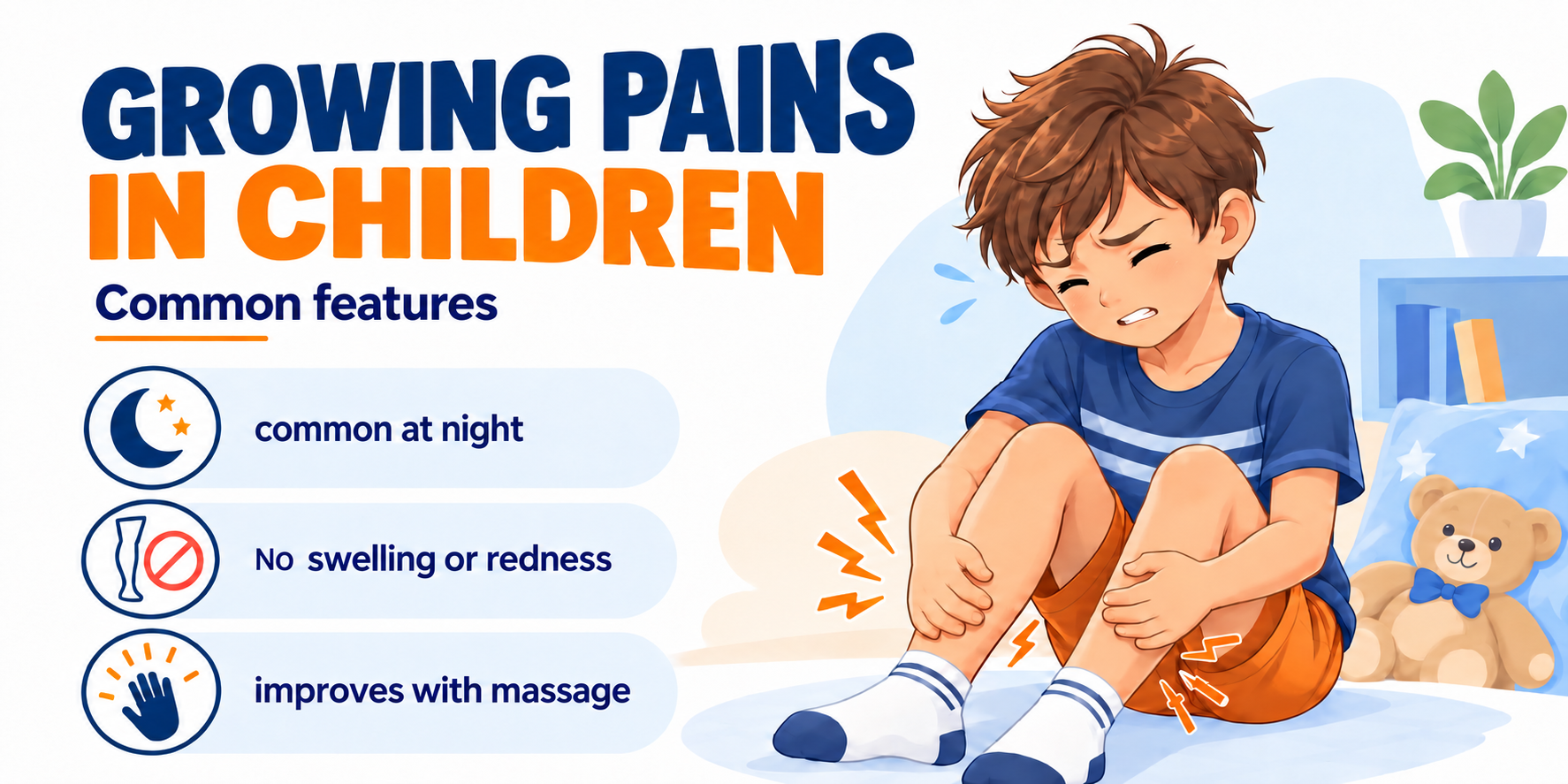
The traditional syndrome usually involves aching in the calves, shins, thighs or behind the knees, often later in the day or at night, with the child appearing normal again by morning. Research increasingly suggests that “growing pains” may represent several different causes or mechanisms rather than one disease, including physical loading, muscular fatigue, pain sensitivity, hypermobility and, in some children, sleep-related or nutritional factors. Persistent limping, swelling, morning stiffness, progressive focal pain, fever or inability to bear weight are not typical growing pains and should be medically assessed.
What Are “Growing Pains”?
- aching or throbbing pain in the calves, thighs, shins or behind the knees
- symptoms occurring later in the day or at night
- episodes that come and go
- normal activity between episodes
- no obvious joint swelling
- no persistent limp
- no significant restriction of movement
- a normal musculoskeletal examination
93% of studies defining “growing pains” did not mention growth.
Myth 1: Children's Bones Hurt Because They Are Growing
The Study That Directly Tested the Growth Theory
- absolute rapid growth, and
- relative rapid growth adjusted for the child's starting height.
- absolute rapid growth: OR 0.74, 95% CI 0.38–1.45
- relative rapid growth: OR 0.73, 95% CI 0.37–1.43
Children With Growing Pains Are Growing—but That Does Not Mean Growth Causes the Pain
- Sever's disease,
- Osgood-Schlatter disease,
- muscle fatigue,
- sports injuries,
- joint hypermobility,
- recurrent limb pain
“Their legs hurt because their bones are growing.”
We currently do not have convincing evidence that this is true.
Why, Then, Are They Called Growing Pains?
Modern researchers have proposed terms such as:
If Growth Does Not Cause the Pain, What Does?
This is where the story becomes much more interesting.
- physical activity and mechanical loading
- joint hypermobility
- altered pain sensitivity
- bone characteristics
- vitamin-D status
- neurological factors
- familial susceptibility
- sleep disorders including restless legs syndrome
Theory 1: Physical Activity and Mechanical Loading
“It seems worse after they've been running around all day.”
That observation may have more scientific merit than the growth theory.
Theory 2: Pain Sensitivity May Be Different
Another may experience considerably more discomfort from a similar mechanical load.
Theory 3: Could Bone Strength Matter?
That is fundamentally different from saying:
The issue, if confirmed, would be load relative to tissue capacity, not growth itself.
Theory 4: Vitamin D
- vitamin-D deficiency contributed to the pain
- symptoms naturally improved
- activity changed
- another deficiency or lifestyle factor changed simultaneously
- regression to the mean occurred
- treatment expectations influenced symptom reporting
Vitamin-D deficiency may be a contributing or modifiable factor in some children with recurrent musculoskeletal pain.
They are not synonymous.
Theory 5: Joint Hypermobility
- running
- jumping
- cutting
- climbing
- prolonged walking
- sport
Some observational studies have reported substantially greater rates of hypermobility among children diagnosed with growing pains.
Myth 2: Growing Pains Are Caused by Flat Feet
But What About Orthotics?
Some children who have been labelled as having “growing pains” may actually have mechanically mediated lower-limb pain.
- reproducible activity-related symptoms
- abnormal loading patterns
- symptomatic foot mechanics
- lower-limb weakness
- poor movement control
- fatigue-related discomfort
Not because the diagnosis says “growing pains.”
That is a critical difference.
Growing Pains May Not Even Be One Condition
- high sporting load.
- hypermobility and reduced muscular endurance.
Another may have:
- low vitamin D.
Another may have:
- increased pain sensitivity.
Another may actually have:
- restless legs syndrome.
Another may have:
- a mechanical lower-limb problem.
And another may simply experience benign intermittent muscular aches without any clinically important abnormality.
Growing Pains and Restless Legs Syndrome
- uncomfortable sensations in the legs
- symptoms becoming worse while resting
- symptoms predominating during the evening or night
- an urge to move the legs
- improvement when walking or moving
- disrupted sleep
Why Iron Sometimes Enters the Discussion
- restlessness
- unpleasant crawling or pulling sensations
- difficulty remaining still
- evening predominance
- relief through movement
- significant sleep disturbance
Growing Pains Are Not an Inflammatory Disease
- persistent swelling
- warmth
- redness
- joint effusion
- restricted joint movement
- prolonged morning stiffness
Myth 3: Any Leg Pain at Night Is Growing Pains
- no pain
- no limp
- no stiffness
- no weakness
- no swelling
When Should Parents Be Concerned?
Pain repeatedly occurring at exactly the same anatomical location deserves examination.
Does Unilateral Pain Automatically Rule Out Growing Pains?
What Else Can Cause Leg Pain in Children?
Mechanical and sporting conditions
- muscular fatigue
- muscle strain
- joint hypermobility
- biomechanical overload
- stress reaction or stress fracture
- symptomatic foot mechanics
Growth-plate and traction conditions
- Sever's disease
- Osgood-Schlatter disease
- other traction apophysites
Hip conditions
- transient synovitis
- Legg-Calvé-Perthes disease
- slipped capital femoral epiphysis
Inflammatory conditions
- juvenile idiopathic arthritis
- enthesitis-related arthritis
- inflammatory muscle disease
Infection
- osteomyelitis
- septic arthritis
Neurological and sleep conditions
- restless legs syndrome
- peripheral neurological disorders
Nutritional and metabolic conditions
- vitamin-D deficiency
- metabolic bone disease in selected cases
Haematological or malignant disease
- leukaemia
- osteosarcoma
- Ewing sarcoma
- other tumours
What Should a Proper Assessment Include?
1. Where exactly is the pain?
- calf
- shin
- knee
- thigh
- heel
- ankle
- hip
- muscle
- joint
- bone?
2. Is it one leg or both?
3. When does the pain occur?
- during activity?
- immediately after sport?
- several hours later?
- before bed?
- during sleep?
- first thing in the morning?
4. What happened that day?
- football
- gymnastics
- dance
- running
- playground activity
- school sport
- long walks
- new sporting programmes
5. Is there morning stiffness?
6. Is the child limping?
7. Are the joints hypermobile?
8. How strong is the child?
- calf strength
- quadriceps
- hamstrings
- hip abductors
- hip extensors
- balance and lower-limb control
9. What do the feet and legs do during walking and running?
- asymmetry
- movement control
- abnormal loading
- instability
- fatigue
- functional weakness
10. Does moving the legs make the symptoms better?
Do Children With Growing Pains Need Blood Tests or X-Rays?
- radiographs
- blood count
- inflammatory markers
- iron studies
- vitamin-D testing
- metabolic investigations
- ultrasound
- MRI
What Actually Helps?
Stretching
- quadriceps
- hamstrings
- calf musculature
Massage and Heat
Strengthening May Matter Just as Much as Stretching
- hypermobility
- poor muscular endurance
- poor lower-limb control
- high sporting load
- repeated fatigue-related symptoms
- calf capacity
- hip strength
- lower-limb control
- balance
- sport-specific conditioning
Activity Modification Does Not Mean Stopping Sport
- number of sports sessions
- running or jumping volume
- recovery between training days
- sudden increases in activity
- footwear
- training surface
Orthotics: Treat the Child, Not the Label
- symptomatic mechanical overload
- reproducible pain with activity
- excessive movement associated with symptoms
- fatigue
- instability
- a clear response to mechanical modification
Vitamin D: Test and Treat When Clinically Appropriate
What We Assess at Family Podiatry Centre
- detailed pain history
- joint range of motion
- hypermobility assessment
- muscle strength
- balance
- foot posture
- lower-limb alignment
- walking and running gait analysis
- activity and sporting load
- footwear
- localisation of painful structures
So Are Growing Pains a Myth?
- physical loading
- muscular fatigue
- hypermobility
- pain sensitivity
- skeletal loading capacity
- vitamin-D status
- neurological factors
- sleep-related disorders
- individual biomechanics
The Bottom Line
“The pain is probably benign, but let's understand why your legs are hurting.”
Frequently Asked Questions
Are growing pains really caused by growing?
At what age do growing pains occur?
Where do growing pains normally hurt?
Do growing pains occur in both legs?
Can growing pains wake a child at night?
Should a child limp with growing pains?
Can flat feet cause growing pains?
Do orthotics treat growing pains?
Does vitamin-D deficiency cause growing pains?
Should children with growing pains stop playing sport?
When should I worry about my child's leg pain?
Book An Appointment
Disclaimer: The word "treatment" in this article refers to the care and management of a patient’s health to prevent, cure, or improve a condition. Treatment results vary and do not necessarily indicate a cure. This article is for informational and educational purposes only and does not constitute medical advice.
About the Author
Mark B. Reyneker, BTech (Podiatry), MSc (Palaeontology) is a podiatrist and Founder & Clinical Director of Family Podiatry Centre, with more than 25 years of clinical experience across South Africa, Malaysia and Singapore. His clinical interests include foot and lower-limb pain, gait and biomechanics, sports-related foot conditions, orthotic therapy and footwear.
Alongside his clinical practice, Mark conducts research into human gait and foot biomechanics. His MSc research at the University of the Witwatersrand investigated human propulsion and the structural properties of the metatarsals. He is also the inventor of A Foot Orthotic, an orthotic technology developed through an international patent family.
References
- Baxter, M.P. and Dulberg, C. (1988). ‘Growing pains’ in childhood—a proposal for treatment. Journal of Pediatric Orthopaedics, 8(4), 402–406.
Original article: https://www.ovid.com/jnls/pedorthopaedics/abstract/01241398-198807000-00004~growing-pains-in-childhood-a-proposal-for-treatmentt - Evans, A.M. (2003). Relationship between ‘growing pains’ and foot posture in children: single-case experimental designs in clinical practice. Journal of the American Podiatric Medical Association, 93(2), 111–117.
Original article: https://www.mdpi.com/1930-8264/93/2/111 - Evans, A.M. and Scutter, S.D. (2007). Are foot posture and functional health different in children with growing pains? Pediatrics International, 49(6), 991–996.
Original article: https://onlinelibrary.wiley.com/doi/abs/10.1111/j.1442-200X.2007.02493.x - Evans, A.M. (2008). Growing pains: contemporary knowledge and recommended practice. Journal of Foot and Ankle Research, 1, 4.
Original article: https://pmc.ncbi.nlm.nih.gov/articles/PMC2553776/ - Hashkes, P.J. et al. (2004). Decreased pain threshold in children with growing pains. Journal of Rheumatology, 31(3), 610–613.
Original article: https://www.jrheum.org/content/31/3/610.short - Hestbæk, L., Lücking, A. and Jensen, S.T. (2024). Growing pains in Danish preschool children: a descriptive study. Scientific Reports, 14, 3956.
Original article: https://www.nature.com/articles/s41598-024-54570-3 - Lehman, P.J. and Carl, R.L. (2017). Growing Pains: When to Be Concerned. Sports Health, 9(2), 132–138.
Original article: https://pmc.ncbi.nlm.nih.gov/articles/PMC5349398/ - Luo, T., Huang, Y., Guo, Y. and Lian, X. (2026). Risk factors associated with growth pain disorder in children: a systematic review and meta-analysis. Frontiers in Pediatrics, 14, 1806380.
Original article: https://www.frontiersin.org/journals/pediatrics/articles/10.3389/fped.2026.1806380/full - O'Keeffe, M. et al. (2022). Defining Growing Pains: A Scoping Review. Pediatrics, 150(2), e2021052578.
Original article: https://publications.aap.org/pediatrics/article-abstract/150/2/e2021052578/188581/Defining-Growing-Pains-A-Scoping-Review?redirectedFrom=fulltext&utm_source=TrendMD&utm_campaign=Pediatrics_TrendMD_0&utm_medium=TrendMD - Rosen, A.E.V. et al. (2025). Restless legs syndrome and growing pains in childhood: understanding the link. Frontiers in Neurology, 16, 1603694.
Original article: https://www.frontiersin.org/journals/neurology/articles/10.3389/fneur.2025.1603694/full - Smith, M. et al. (2025). Assessments, diagnostic criteria and outcome measures for growing pains and persistent pain in the presence of restless leg syndrome in children: a scoping review. BMJ Open.
Original article: https://europepmc.org/article/med/41338633 - Uziel, Y. and Hashkes, P.J. (2007). Growing pains in children. Pediatric Rheumatology, 5, 5.
Original article: https://link.springer.com/article/10.1186/1546-0096-5-5 - Uziel, Y. et al. (2010). Five-year outcome of children with ‘growing pains’: correlations with pain threshold. Journal of Pediatrics, 156(5), 838–840.
Original article: https://d1wqtxts1xzle7.cloudfront.net/54253429/Five-Year_Outcome_of_Children_With_Growing_Pains
Frequently Asked Questions
Historically, growing pains refer to recurrent, aching lower-limb pain in healthy children. However, the medical community actually lacks a clear definition. Reference: A 2022 scoping review published in Pediatrics examined 145 studies and found remarkably poor agreement on a definition, with lower-limb pain mentioned in only 50% of the definitions.
The classical description includes an aching or throbbing pain in the calves, thighs, shins, or behind the knees that occurs later in the day or at night. The physical examination is entirely normal, there is no joint swelling, and the child does not have a persistent limp.
No. Reference: The 2022 Pediatrics scoping review concluded that there is currently no clear consensus in the medical literature about what defines the condition, advising clinicians to be cautious about using the label.
Current evidence does not support normal childhood growth as the cause of growing pains. The traditional theory that rapidly lengthening bones create painful tension in muscles and tendons has not been demonstrated, and a 2024 longitudinal study found no association between rapid growth and episodes of growing pains.
Yes. Reference: A 2024 study published in Scientific Reports followed a cohort of 777 Danish preschool children. It measured both absolute and relative rapid growth and found that neither measure was associated with growing pains, concluding the name is a misnomer.
Because growth is rarely factored into the actual medical diagnosis. Reference: The 2022 scoping review in Pediatrics revealed a remarkable finding: 93% of studies that defined "growing pains" did not even mention growth.
Because the traditional name implies a false cause, modern researchers have proposed more accurate terms, such as "benign nocturnal limb pains of childhood" or "recurrent paediatric limb pain."
It is likely a combination of several factors. Reference: A 2026 systematic review and meta-analysis of 37 studies (involving 16,086 participants) points to the condition being a "multifactorial syndrome" rather than a single disease with one cause.
Yes, it is highly plausible that the pain is a form of musculoskeletal load intolerance or fatigue. Reference: The 2026 systematic review found that children with these pains were approximately 34% more likely to have greater physical-activity exposure.
Children who experience these pains may process physical fatigue differently. Reference: Pain neuroscience researchers have measured "pressure-pain thresholds" in children diagnosed with growing pains and found that they demonstrate lower pain thresholds compared to healthy controls.
Reference: The 2026 systematic review and meta-analysis identified 17 proposed risk factors. Among the most notable potential contributors are joint hypermobility, altered pain sensitivity, bone characteristics, vitamin-D status, neurological factors, familial susceptibility, and sleep disorders.
Yes. Reference: The 2026 meta-analysis lists sleep disorders, specifically including restless legs syndrome (RLS), as a potential contributing factor or overlapping condition to what is traditionally called growing pains.
Children who develop conditions like Sever's disease, Osgood-Schlatter disease, or joint hypermobility are also actively growing, but growth itself is not the biological mechanism causing their symptoms. This highlights the flaw in assuming growth causes pain.
As noted in the article, labeling unexplained childhood leg pain as "growing pains" can prematurely stop the diagnostic process. It prevents parents and clinicians from asking the more important question: Why does this particular child’s leg hurt?
Unlikely. Reference: The classical definition (and 48% of the definitions in the 2022 Pediatrics review) notes that the pain specifically occurs in the evening or at night, with normal, pain-free activity between episodes.
Yes, though this is heavily debated in literature. Reference: The 2022 Pediatrics scoping review found that a "normal physical examination" was only required in 35% of the study definitions, further proving how inconsistent the diagnosis is.
Typically, yes. Reference: Bilateral pain (pain in both legs) is a standard clinical feature, though the 2022 Pediatrics review noted it was explicitly mentioned in only 31% of formal study definitions.
Children accumulate enormous amounts of running, jumping, and climbing during the day. By the evening, their muscles and tissues have absorbed thousands of loading cycles, which can manifest as aching or throbbing once the body rests.
The terminology is largely historical, with descriptions resembling growing pains dating back roughly two centuries—long before modern biomechanics and pain neuroscience were understood.
Parents should retire the myth that "bones hurt because they are growing." Instead, they should view the pain as a real physical response (often to daytime mechanical loading and fatigue) and consult a professional to rule out specific, treatable biomechanical issues.
Night-time leg pain in children has several possible causes. The common pattern traditionally called “growing pains” typically produces intermittent aching in the calves, shins or thighs after an otherwise normal day, with symptoms resolving by morning. However, night pain alone does not establish the diagnosis. Persistent pain in one specific location, swelling, limping, morning stiffness, weakness, fever or worsening symptoms should prompt clinical assessment because other musculoskeletal, inflammatory, neurological or, rarely, more serious conditions can also cause night-time leg pain.