Does Icing an Injury Actually Work? The Science Behind Ice, Inflammation and Healing



8 September 2026
By Mark Reyneker, BTech (Podiatry), MSc (Palaeontology), Registered Podiatrist, Foot & Gait Specialist | Founder & Clinical Director, Family Podiatry Centre
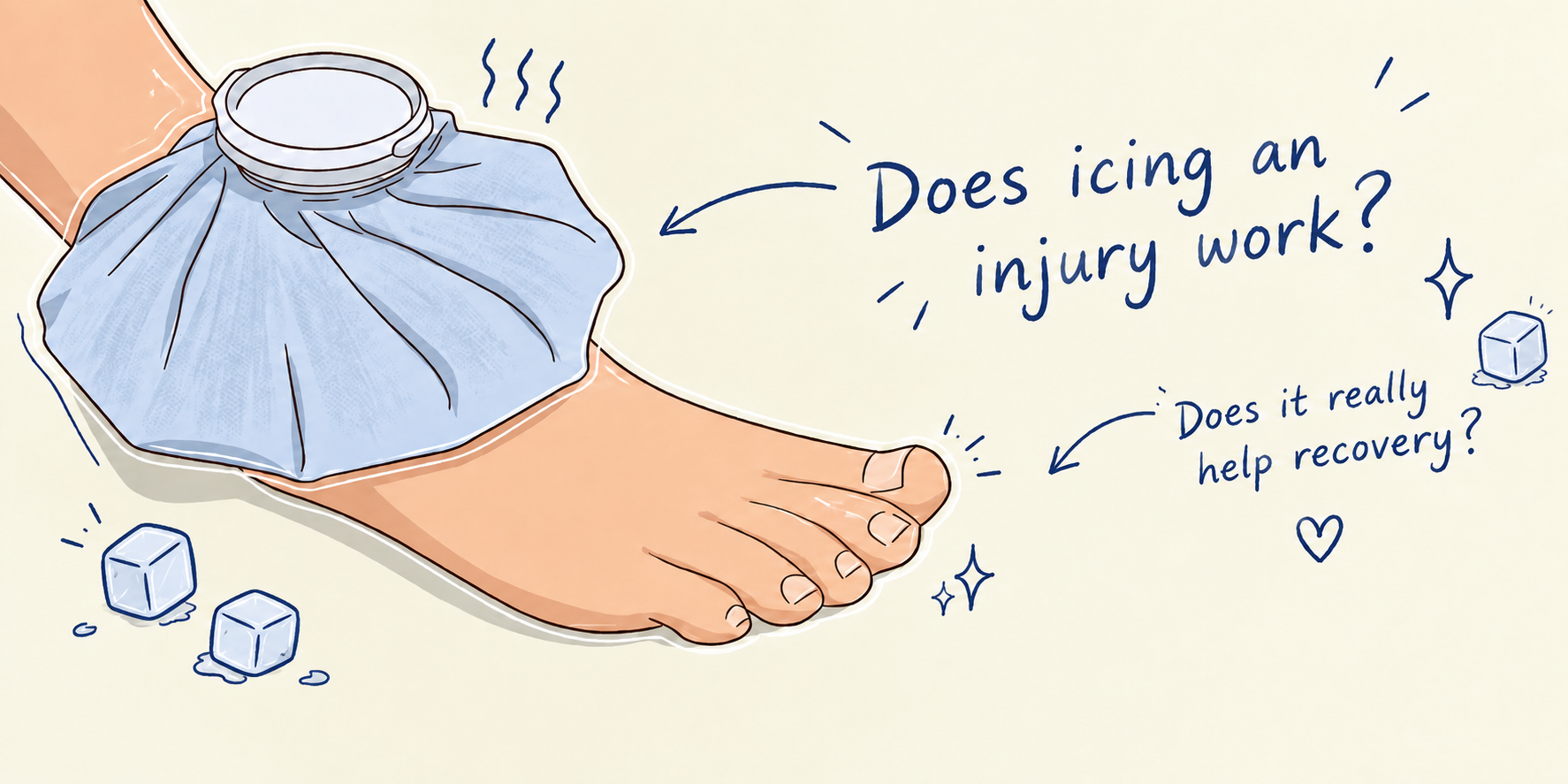
Does icing an injury actually work?
- Put some ice on it.
- Twist your ankle? Ice.
- Pull a muscle? Ice.
- Bang your knee? Ice.
- Finish a hard training session? Get into an ice bath.
If the goal is to make an injured ligament, muscle or tendon heal faster, however, the scientific evidence becomes considerably less convincing.
“Does ice work?”
It is:
“What does ice actually do — and when is that effect useful?”
Ice can temporarily reduce pain following an injury.
- Speeds ligament healing
- Accelerates muscle regeneration
- Improves tendon repair
- Prevents so-called secondary tissue damage
- Substantially improves long-term swelling
- Gets people back to sport faster
That does not mean ice is useless.
It means we may have been using it for the wrong reason.
How Did Icing Become So Popular?
The reasoning appeared perfectly logical.
Injury creates inflammation.
↓
Inflammation creates swelling and pain.
↓
Inflammation Is Not the Enemy
Within minutes to hours of injury, damaged tissue releases molecular signals that recruit immune cells to the area.
Monocytes subsequently enter the tissue and differentiate into macrophages.
- Removing damaged cellular material
- Signalling satellite cells involved in muscle regeneration
- Coordinating vascular repair
- Regulating extracellular matrix remodelling
- Transitioning the injured tissue from inflammation towards reconstruction
What Actually Happens When You Put Ice on an Injury?
1. Tissue temperature decreases
- Duration
- Type of ice or cold pack
- Tissue depth
- Subcutaneous fat thickness
- Compression
- The temperature difference between the skin and cooling medium
2. Nerve conduction slows
Cooling reduces peripheral nerve conduction velocity and alters nociceptive signaling.
A randomised trial of acute musculoskeletal injuries in an emergency department found meaningful short-term analgesia following intensive local cryotherapy. The analgesic effect of ice is therefore real.
Less pain does not automatically mean faster healing.
That distinction is fundamental.
3. Blood flow decreases
There may indeed be circumstances — particularly immediately after significant trauma — where reducing bleeding or haematoma formation is potentially useful. But swelling is more complicated than simply “too much blood entering the area”.
4. Cellular metabolism decreases
The idea was that cells surrounding the original injury might die because reduced circulation leaves them relatively hypoxic.
Does Ice Actually Reduce Swelling?
A systematic review examining cryotherapy for acute ankle sprains found only two eligible randomised trials, both at high risk of bias.
- Swelling
- Pain
- Range of motion
- Function
And that distinction matters.
Could Icing Actually Slow Healing?
These were animal studies.
“Ice blocks inflammation and therefore prevents healing.”
That statement goes beyond the evidence.
What Does the Best Recent Review Say?
- Analgesia is well supported
- Human evidence that cryotherapy prevents secondary tissue damage is lacking
- Human evidence that cryotherapy improves tissue regeneration is lacking
- Animal research raises legitimate concerns about interference with regeneration
- Prolonged routine cooling therefore cannot automatically be assumed to promote healing
“Ice for 20 minutes every few hours for the next three days.”
But What About Surgery?
- 0.77 points immediately
- 0.84 points short term
- 0.41 points medium term
What About Tendon Injuries?
A 2026 systematic review examined cryotherapy and human tendon health. From more than 1,000 records screened, only 12 studies met the inclusion criteria. Some reported short-term improvements in pain or microcirculation. But the authors concluded that the evidence does not support cryotherapy as a standalone or standard treatment for tendinopathy.
A chronic tendon problem generally requires some combination of:
- Appropriate loading
- Progressive strengthening
- Management of training volume
- Correction of relevant mechanical stressors
- Time for tissue adaptation
But that is not the same thing as rebuilding tendon capacity.
And What About Ice Baths After Training?
Cold-water immersion after strenuous exercise can reduce delayed-onset muscle soreness and improve how recovered an athlete feels.
- Competition recovery
Cold exposure may be useful when rapid recovery is the priority. - Training adaptation
Routine immediate post-training cooling may be undesirable when maximising muscle growth is the priority.
Sometimes the soreness you are trying to suppress is occurring alongside the biological signalling responsible for adaptation.
So Why Did Sports Medicine Move Away From RICE?
PEACE & LOVE
Immediately after injury: PEACE
Protection does not mean complete immobilisation unless the injury specifically requires it.
Then Give the Injury LOVE
L — Load
Through mechanotransduction, cells convert mechanical loading into biochemical signals that influence tissue remodelling.
- Muscle needs load.
- Tendon needs load.
- Bone needs load.
- Ligament eventually needs load.
O — Optimism
V — Vascularisation
E — Exercise
- Strength
- Mobility
- Balance
- Proprioception
- Tissue capacity
- Confidence
Does That Mean PEACE & LOVE Has Been Proven Superior?
This is another area where internet discussions sometimes move faster than the science.
Both groups improved.
That does not invalidate PEACE & LOVE. It simply reminds us that medicine rarely progresses by replacing one catchy acronym with another.
Move away from passive symptom suppression and towards appropriate protection followed by progressive rehabilitation.
Should You Ever Ice an Injury?
But we should be clear about why we are doing it.
Ice makes sense when:
- Pain is significant
If an ankle sprain is sufficiently painful that the patient cannot comfortably begin gentle movement or weight-bearing, temporary analgesia from ice may be useful. - There has been very recent significant trauma
During the first few hours following a substantial contusion or muscle injury, cooling may potentially help control pain and possibly haematoma formation. - Pain is preventing sleep
Short-term symptom control has value. Being comfortable enough to sleep is not trivial. - Ice allows appropriate rehabilitation
If ten minutes of cooling makes a painful ankle comfortable enough to begin sensible movement or exercise, ice may indirectly help the rehabilitation process. - Rapid recovery between competitions matters more than long-term adaptation
Tournament athletes occasionally need to perform again within hours.
When Would I Be Less Enthusiastic About Ice?
“I ice it every night because it has hurt for six months.”
This is unlikely to address the cause of a chronic musculoskeletal problem.
“I need to get the inflammation out.”
Inflammation is not a substance trapped inside the injury that needs removing. It is part of a biological signaling process.
The important questions are whether the swelling is excessive, worsening, associated with significant structural injury, compromising movement or circulation, or persisting unexpectedly.
How Long Should You Ice?
Traditional recommendations of 15–20 minutes were often passed from textbook to textbook long before strong clinical evidence existed.
For someone using ice purely for short-term analgesia, a pragmatic approach is therefore:
More Ice Is Not Better
- Cold injury
- Skin damage
- Temporary sensory impairment
- Nerve injury
- Excessive tissue cooling
- Impaired sensation
- Peripheral neuropathy
- Poor circulation
- Vascular disease
- Cold hypersensitivity
- Conditions affecting temperature perception
A Practical Example: The Sprained Ankle
Within minutes:
- The lateral ankle becomes painful
- Swelling begins
- Walking hurts
- The person assumes they need ice immediately
1. First few hours
- Fracture
- Significant ligament rupture
- Syndesmotic injury
- Dislocation
- Inability to bear weight
- Substantial instability
- Another injury requiring medical assessment
If pain is substantial, a short application of ice can be used for comfort.
2. Next several days
- Tolerable weight-bearing
- Ankle movement
- Calf function
- Strength
- Proprioception
- Balance
Therapeutic exercise becomes considerably more important than the ice pack.
The Important Difference Between Pain Relief and Healing
Imagine taking a painkiller for a headache. The medication may reduce the headache. That does not necessarily mean it has corrected whatever produced the headache.
So: Does Icing an Injured Area Work?
For swelling?
For inflammation?
For faster tissue healing?
Could excessive icing interfere with healing?
Should everyone stop using ice?
The change is in how we should think about it.
The Family Podiatry Centre Perspective
The Bottom Line
A treatment can become standard practice long before we fully understand whether it changes the outcome that matters most.
Ice is good at making an injury feel better.It has not been convincingly shown to make most soft-tissue injuries heal faster.
So if you have just twisted an ankle and an ice pack makes it considerably more comfortable, there is nothing irrational about using it briefly. Just don't mistake numbness for healing. The rehabilitation begins when the ice comes off.
Key Takeaways
- Ice reliably provides short-term pain relief.
- Evidence that ice substantially reduces swelling is weak.
- Human evidence that icing accelerates soft-tissue regeneration is lacking.
- Inflammation forms an important part of normal tissue repair.
- Animal studies show that aggressive early cooling can alter macrophage activity and regeneration, although the relevance to human injury is uncertain.
- Brief ice use immediately after an injury can still be reasonable when pain control is needed.
- Repeated icing for days simply because an injury remains inflamed has little evidence behind it.
- Chronic tendon problems generally require progressive loading rather than repeated cooling.
- Cold-water immersion can help soreness after exercise but habitual immediate use after resistance training may modestly reduce muscle hypertrophy.
- Ultimately, appropriate loading and rehabilitation matter substantially more than icing.
Book An Appointment
Disclaimer: The word "treatment" in this article refers to the care and management of a patient’s health to prevent, cure, or improve a condition. Treatment results vary and do not necessarily indicate a cure. This article is for informational and educational purposes only and does not constitute medical advice.
About the Author
Mark B. Reyneker, BTech (Podiatry), MSc (Palaeontology) is a podiatrist and Founder & Clinical Director of Family Podiatry Centre, with more than 25 years of clinical experience across South Africa, Malaysia and Singapore. His clinical interests include foot and lower-limb pain, gait and biomechanics, sports-related foot conditions, orthotic therapy and footwear.
Alongside his clinical practice, Mark conducts research into human gait and foot biomechanics. His MSc research at the University of the Witwatersrand investigated human propulsion and the structural properties of the metatarsals. He is also the inventor of A Foot Orthotic, an orthotic technology developed through an international patent family.
References
- Bleakley, C.M., McDonough, S. and MacAuley, D.C. (2004) ‘The use of ice in the treatment of acute soft-tissue injury: a systematic review of randomized controlled trials’, The American Journal of Sports Medicine, 32(1), pp. 251–261.
Original article: https://doi.org/10.1177/0363546503260757 - Bleakley, C.M., McDonough, S.M. and MacAuley, D.C. (2006) ‘Cryotherapy for acute ankle sprains: a randomised controlled study of two different icing protocols’, British Journal of Sports Medicine, 40(8), pp. 700–705.
Original article: https://doi.org/10.1136/bjsm.2006.025932 - Chen, R., Ma, X., Ma, X. and Cui, C. (2024) ‘The effects of hydrotherapy and cryotherapy on recovery from acute post-exercise induced muscle damage—a network meta-analysis’, BMC Musculoskeletal Disorders, 25, 749.
Original article: https://doi.org/10.1186/s12891-024-07315-2 - Dubois, B. and Esculier, J-F. (2020) ‘Soft-tissue injuries simply need PEACE and LOVE’, British Journal of Sports Medicine, 54(2), pp. 72–73.
Original article: https://doi.org/10.1136/bjsports-2019-101253 - Lima, T.A. and Rocha, T.S. (2026) ‘Is cryotherapy effective for tendon health? A systematic review of evidence and methodological limitations’, Journal of Bodywork and Movement Therapies, 46, pp. 346–355.
Original article: https://doi.org/10.1016/j.jbmt.2025.11.015 - MacAuley, D.C. (2001) ‘Ice therapy: how good is the evidence?’, International Journal of Sports Medicine, 22(5), pp. 379–384.
Original article: https://doi.org/10.1055/s-2001-15656 - Martin, R.L., Davenport, T.E., Fraser, J.J., Sawdon-Bea, J., Carcia, C.R., Carroll, L.A., Kivlan, B.R. and Carreira, D. (2021) ‘Ankle stability and movement coordination impairments: lateral ankle ligament sprains revision 2021’, Journal of Orthopaedic & Sports Physical Therapy, 51(4), pp. CPG1–CPG80.
Original article: https://doi.org/10.2519/jospt.2021.0302 - Meškauskas, M. et al. (2026) ‘PRICE (Protection, Rest, Ice, Compression, Elevation) vs. PEACE and LOVE (Protection, Elevation, Avoid anti-inflammatories, Compression, Education and Load, Optimism, Vascularization, Exercise) in adolescent lateral ankle sprain rehabilitation: a randomized prospective comparative study of muscle strength and dynamic balance’, BMC Sports Science, Medicine and Rehabilitation.
Original article:https://doi.org/10.1186/s13102-026-01651-7 - Miranda, J.P., Silva, W.T., Silva, H.J., Mascarenhas, R.O. and Oliveira, V.C. (2021) ‘Effectiveness of cryotherapy on pain intensity, swelling, range of motion, function and recurrence in acute ankle sprain: a systematic review of randomized controlled trials’, Physical Therapy in Sport, 49, pp. 243–249.
Original article: https://doi.org/10.1016/j.ptsp.2021.03.011 - Miranda, J.P. de, Figueiredo, R.C.C., Saragiotto, B. and Oliveira, V.C. (2026) ‘Effectiveness of cryotherapy on pain intensity, range of motion, swelling and function in the postoperative care of musculoskeletal disorders: a systematic review and meta-analysis of randomised controlled trials’, British Journal of Sports Medicine, 60(6), pp. 440–449.
Original article: https://doi.org/10.1136/bjsports-2024-109497 - Piñero, A., Burke, R., Augustin, F. et al. (2024) ‘Throwing cold water on muscle growth: a systematic review with meta-analysis of the effects of postexercise cold water immersion on resistance training-induced hypertrophy’, European Journal of Sport Science, 24(2), pp. 177–189.
Original article: https://doi.org/10.1002/ejsc.12074 - Racinais, S., Dablainville, V., Rousse, Y., Ihsan, M., Grant, M-E., Schobersberger, W., Budgett, R. and Engebretsen, L. (2024) ‘Cryotherapy for treating soft tissue injuries in sport medicine: a critical review’, British Journal of Sports Medicine, 58(20), pp. 1215–1223.
Original article: https://doi.org/10.1136/bjsports-2024-108304 - Tamari, A., Nitta, E., Terada, E., Nagata, I., Kawashima, M., Sakuraya, T., Sonomura, T., Maeshige, N., Nitta, R. and Arakawa, T. (2026) ‘Immediate icing disrupts the very early MCP-1/CCR2 recruitment window and delays muscle regeneration in rats’, American Journal of Physiology-Cell Physiology, 331(1), pp. C222–C235.
Original article: https://doi.org/10.1152/ajpcell.00190.2026
Frequently Asked Questions
If the goal is to temporarily reduce pain, icing works very well. However, if the goal is to make an injured ligament, muscle, or tendon heal faster, the scientific evidence is much less convincing. Ice helps with pain management, not necessarily with accelerated tissue healing.
Cooling the tissue triggers several physiological changes. It decreases the tissue temperature, slows nerve conduction (which reduces pain), decreases local blood flow (vasoconstriction), and reduces cellular metabolic activity.
No. According to a major 2024 critical review published in the British Journal of Sports Medicine, there is currently no human evidence demonstrating that routine icing speeds up tissue regeneration, ligament healing, or muscle repair.
Ice is highly effective as an analgesic, meaning it provides temporary pain relief. By cooling the tissue, nerve conduction velocity slows down, making the injured area less sensitive to pain.
Probably less than most people assume. While cold causes vasoconstriction (reduced blood flow), swelling is a complex process involving capillary permeability and lymphatic drainage. Clinical studies have struggled to demonstrate substantial reductions in swelling from ice alone. The RICE Method & Medical History
RICE stands for Rest, Ice, Compression, and Elevation. It has been a standard protocol for acute injury management for decades.
The RICE acronym was popularized by sports physician Dr. Gabe Mirkin in his 1978 Sportsmedicine Book.
Not entirely. Dr. Gabe Mirkin, who popularized RICE, has since argued that excessive rest and icing may potentially delay rather than accelerate aspects of tissue healing, given modern understandings of inflammation.
Over time, the acronym has evolved to PRICE (Protection, Rest, Ice, Compression, Elevation) and later to POLICE (Protection, Optimal Loading, Ice, Compression, Elevation), reflecting a shift away from complete rest toward appropriate movement. Understanding Inflammation
No, inflammation is not simply an unwanted side effect; it is a highly coordinated biological repair process. When tissue is injured, inflammation recruits immune cells (like neutrophils and macrophages) to clear damaged cells and begin the regeneration process.
Ice can reduce metabolic activity and blood flow, which may theoretically suppress some inflammatory signaling. However, modern research increasingly describes inflammation and regeneration as interconnected processes, suggesting that suppressing inflammation completely isn't ideal.
No. While excessive or prolonged inflammation can become a problem, the primary objective of recovery should be the appropriate regulation of inflammation, rather than maximal suppression. Scientific Evidence & Studies
The 2024 critical review concluded that, beyond temporary pain relief (analgesia), there is no human evidence demonstrating that cryotherapy limits "secondary injury" or improves tissue regeneration.
The theory of "secondary hypoxic injury" suggested that cooling reduces cellular metabolic needs, protecting surrounding cells from dying due to a lack of oxygen. However, the 2024 British Journal of Sports Medicine review found no human evidence proving that cryotherapy meaningfully prevents this.
A systematic review examining cryotherapy for acute ankle sprains found uncertain evidence that adding ice improved swelling, pain, range of motion, or function, concluding there wasn't sufficient evidence supporting ice alone for management.
According to a 2021 clinical practice guideline for lateral ankle sprains, while ice alone doesn't improve function, intermittent ice combined with therapeutic exercise may improve symptoms and allow patients to tolerate weight-bearing exercises more comfortably. Practical Advice for Using Ice
Yes, if your primary goal is to reduce pain. The analgesic effect of ice is real, and reducing pain can make it easier to begin rehabilitation and gentle movement, which does aid recovery.
No. That is a fundamental distinction in modern sports medicine: Less pain does not automatically mean faster healing.
How much cooling occurs depends on several factors: the duration of icing, the type of cold pack used, tissue depth, the thickness of subcutaneous fat, whether compression is applied, and the temperature difference between the skin and the ice.
While ice is great for short-term pain relief, the modern scientific consensus—reflected in the shift from RICE to POLICE (Optimal Loading)—suggests that appropriately loading and exercising the tissue is much more vital for actual recovery than simply resting and icing.