Adidas Adizero Dropset Pro: EnergyRods, Foot Stiffness and the Biomechanics of Hybrid Racing



17 August 2026
By Mark Reyneker, BTech (Podiatry), MSc (Palaeontology), Registered Podiatrist, Foot & Gait Specialist | Founder & Clinical Director, Family Podiatry Centre
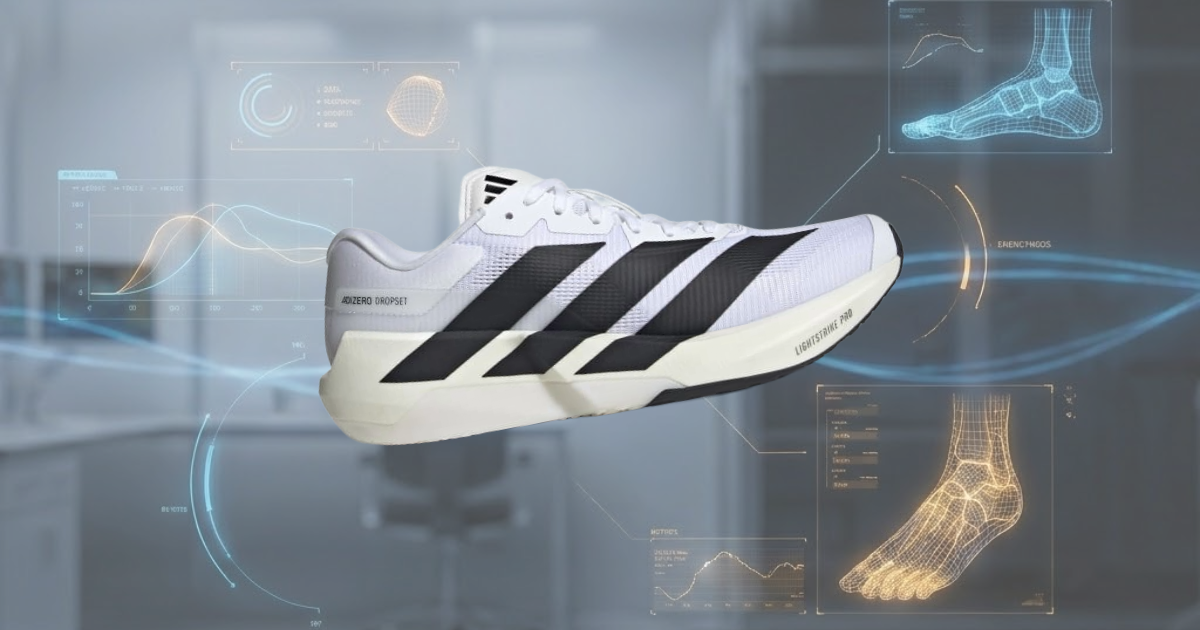
How EnergyRods and Lightstrike Pro foam interact with the natural mechanics of the human foot to balance running speed and lifting stability
These are not necessarily compatible requirements. A highly cushioned running shoe can feel comfortable and responsive when moving forwards but less stable when large forces are being applied through the foot during strength-based movements. A conventional strength-training shoe provides stability, but that same rigidity and weight may make repeated running sections considerably less pleasant.
The foot is not simply a flexible shock absorber
It can deform under load, store elastic energy and then become relatively stiffer as the body progresses towards push-off. This changing stiffness is produced by several interacting mechanisms rather than by one anatomical structure alone.
The plantar fascia is important. So are the intrinsic muscles of the foot, the geometry of the longitudinal and transverse arches, the metatarsals and the numerous joints connecting the rearfoot, midfoot and forefoot. This ability to alter stiffness is one of the remarkable mechanical characteristics of the human foot.
The longitudinal arch behaves partly like a spring
Classic work by Ker and colleagues demonstrated that the human arch can store and return elastic energy, allowing the foot to function partly as a spring during locomotion (Ker et al., 1987).
More recent research has reinforced this concept. The arch compresses under load and recoils later in stance, with passive tissues and the muscles of the foot contributing to this behaviour (Kelly et al., 2014; Kelly et al., 2015). The foot therefore should not be thought of simply as either flexible or rigid.
The windlass mechanism
The classic windlass model proposes that this tension assists in raising the longitudinal arch and bringing the rearfoot and forefoot into a mechanically more stable relationship as the body progresses over the foot (Hicks, 1954; Fuller, 2000).
Fuller's mechanical analysis of the windlass remains particularly useful clinically because it demonstrates how tension within the plantar fascia can influence forces and moments throughout the foot rather than acting only beneath the arch (Fuller, 2000).
Finite-element modelling has subsequently demonstrated that plantar fascial tension increases considerably during late stance, with peak loading occurring around pre-swing when the toes are dorsiflexed (Chen et al., 2015). In other words, the upward bending of the toes is connected mechanically to what happens farther back within the foot.
The big toe has an important role
At the same time, the centre of pressure moves forwards beneath the foot. The forefoot therefore becomes the final major interface through which force is transferred into the ground. This is one reason why disorders affecting the first MTP joint, such as hallux rigidus, can substantially change gait. Restricting movement or producing pain at this joint can alter the way a person progresses over the forefoot.
However, the first MTP joint should not be considered in isolation. The human forefoot has five metatarsals, and force is distributed across these structures in different proportions depending on speed, anatomy, footwear and movement. That becomes particularly relevant when considering a shoe containing several longitudinal stiffening elements rather than one continuous plate.
The windlass is only part of the story
Kelly and colleagues demonstrated that activation of muscles including abductor hallucis, flexor digitorum brevis and quadratus plantae could resist deformation of the longitudinal arch under load. Increasing muscular activation effectively buttressed the arch, indicating that foot stiffness is actively regulated rather than being purely passive (Kelly et al., 2014).
The transverse arch also contributes to foot stiffness
Curve the same sheet slightly across its width and it becomes much harder to bend along its length. No additional material has been added. Its geometry has changed its stiffness. Something conceptually similar contributes to the architecture of the human foot.
Why does the foot need stiffness during propulsion?
The mechanical behaviour of the foot therefore influences how this force is transferred. A structure that bends will behave differently from one that resists bending. This does not mean that a completely rigid foot would be better.
Something interesting happens at the toes during running
A classic study by Stefanyshyn and Nigg measured MTP joint mechanics during running and sprinting and found substantial negative mechanical work at the MTP joint complex (Stefanyshyn and Nigg, 1997). Negative work means that the joint is absorbing mechanical energy.
The researchers reported approximately 20.9 joules during running and 47.8 joules during sprinting at the MTP joint complex. It is tempting to describe all of this as "energy loss", but that requires some caution.
Some mechanical energy can indeed be dissipated through deformation of biological tissues and footwear. However, the foot is also capable of storing elastic energy in the plantar fascia, muscles and other tissues and returning a portion of that energy later.
For example, the extensibility of the plantar fascia influences longitudinal arch deformation, and plantar fascia shortening during the latter stages of stance appears to contribute to arch recoil during push-off (Welte et al., 2021). Therefore, negative MTP joint work does not mean that every joule absorbed at the forefoot is permanently lost.
What happens when we make the shoe harder to bend?
Take a very flexible trainer in your hands and bend the toe upwards. Now compare that with a racing shoe containing a stiff carbon structure. The second shoe generally requires considerably more force to bend. Increasing longitudinal bending stiffness changes the mechanical environment in which the foot operates. This has been studied for more than two decades.
Stiffer shoes can reduce MTP joint bending and negative work
Subsequent work has demonstrated that stiffening the shoe can reduce dorsiflexion and negative work at the MTP joint. Willwacher and colleagues examined carbon-fibre structures of different stiffness and found that changing shoe stiffness altered the mechanics of the forefoot and the effective lever arms through which the ground reaction force acted (Willwacher et al., 2013; Willwacher et al., 2014).
That does not mean the shoe is adding energy to the human body. It means it is changing the conditions under which the body produces and absorbs mechanical work.
What modern carbon-plated shoes have taught us
In the Nike Vaporfly condition, MTP dorsiflexion and negative MTP work were reduced. Interestingly, the researchers found that considerable mechanical energy was stored and returned by compression of the midsole foam, whereas relatively little energy was stored and returned through bending of the carbon-fibre plate itself (Hoogkamer et al., 2019).
That distinction is important. It suggests that the stiff structure does not necessarily work primarily as a spring. The plate changes the mechanics of the foot-shoe system, while the compliant foam can perform much of the mechanical energy storage and return.
Another revealing experiment modified the Nike Vaporfly by cutting the carbon plate, thereby reducing its ability to provide longitudinal stiffness. This resulted in increased MTP dorsiflexion, angular velocity and negative MTP power.
However, running economy was not significantly worse in the cut-plate condition (Healey and Hoogkamer, 2022). This helps prevent an overly simple conclusion. Reducing negative work at the MTP joint does not automatically translate into better running economy.
There appears to be an optimum rather than "the stiffer the better"
A 2026 study in elite marathon runners again demonstrated that increasing longitudinal bending stiffness reduced late-stance MTP dorsiflexion and negative MTP work. Negative work declined from approximately 0.21 J/kg in the lower-stiffness shoe to 0.13 J/kg in the highest-stiffness condition (Gao et al., 2026). Yet the wider literature does not support the idea that increasing shoe stiffness always improves performance.
A contemporary review concluded that footwear longitudinal bending stiffness has its largest biomechanical effects around the MTP and ankle joints, but the effect on running economy varies between studies and individuals (Ortega et al., 2021). The relationship between footwear stiffness and human performance is therefore more nuanced than simply making a shoe harder to bend.
This brings us back to the Adidas EnergyRods
Viewed through the biomechanics described above, the combination is interesting. The foam and rods are performing different mechanical roles. The Lightstrike Pro can deform under load. The EnergyRod structure can resist and regulate bending.
The foot inside the shoe is simultaneously changing its own stiffness using the plantar fascia, muscles, arches and joints. We therefore have several structures interacting:
- The foot
- The EnergyRods
- The foam
- The outsole
- The ground
Do the EnergyRods copy the natural function of the foot?
Nevertheless, there is an interesting mechanical parallel. The biological foot changes stiffness during locomotion. The shoe also contains structures intended to manipulate stiffness.
Both therefore influence how readily the foot-shoe system bends under load. This may be a more useful way to understand EnergyRods than imagining them simply acting like springs that fire the athlete forwards.
Why multiple rods are particularly interesting
From an anatomical perspective, this is intriguing because the human forefoot is itself not a single rigid plate. It contains five metatarsal rays with interconnecting soft tissues and different loading patterns. The transverse arch literature further demonstrates that interactions between the metatarsals contribute substantially to the longitudinal stiffness of the entire foot (Venkadesan et al., 2020).
Why the concept becomes particularly relevant to hybrid racing
- Burpee broad jumps
- Rowing
- Farmers carries
- Weighted lunges
- Wall balls
Running: allowing progression without excessive forefoot deformation
The Lightstrike Pro foam simultaneously provides the compliant component of the system. This combination — compliant foam constrained by a stiffer internal structure — has already proved mechanically important in advanced running footwear. The Dropset Pro applies a related concept to a very different sporting environment.
Sled push: a different mechanical problem
- Traction
- Stability
- Effective force transmission
An excessively compliant platform may deform under the athlete rather than providing the stable sensation usually associated with strength footwear.
A stiffening structure within a compliant midsole could theoretically help limit some of this deformation. However, the EnergyRods should not be viewed independently of the outsole. During a sled push, traction between the shoe and floor may become just as important as the internal stiffness of the shoe.
The Dropset Pro therefore uses both its structural components and outsole traction system as parts of the same performance package. Adidas uses Lighttraxion and Continental rubber specifically to address grip while attempting to minimise weight (Adidas, 2026).
Lunges and wall balls: where too much running-shoe softness can become noticeable
The challenge is that simply making the entire shoe firm would compromise the running experience. This may be one of the more interesting aspects of the Dropset Pro design. Rather than relying exclusively on firm foam, Adidas can use the geometry and EnergyRod structure to help control deformation while retaining a more responsive foam.
Burpee broad jumps introduce another requirement
There needs to be enough compliance to tolerate repeated impact, sufficient grip to prevent slipping and enough structural control to make propulsion predictable. This is an example of why evaluating a hybrid shoe solely by running in it provides an incomplete picture.
My experience testing the Dropset Pro
During treadmill running, I am looking at how easily the shoe progresses through the forefoot and how noticeable its longitudinal stiffness becomes at different speeds.
- Forefoot stability
- Heel stability
- How much the midsole visibly deforms
- Whether the shoe feels predictable under load
- Traction
- How easily the foot can change direction
- Whether the stiffening structure interferes with movements that are not simply straight-line running
What the science allows us to say — and what it does not
- MTP dorsiflexion
- Negative MTP joint work
- Ground-reaction-force lever arms
- Ankle and forefoot mechanics
- The distribution of mechanical work within the lower limb
Could stiffness also matter for foot pain?
A useful way to understand the Dropset Pro
The human foot already performs its own version of this task, such as:
- It deforms under load
- The arch stores elastic energy
- The plantar fascia becomes tensioned as the toes dorsiflex
- The intrinsic muscles regulate arch deformation
- The geometry of the transverse arch contributes substantially to longitudinal stiffness
- The forefoot becomes the final major interface between the athlete and the ground during propulsion.
The shoe is then placed underneath that already sophisticated biological system. For an example:
- Its foam can deform
- Its rods can resist bending
- Its rocker and geometry can influence progression
- Its outsole determines how effectively force can be transferred to the surface.
My assessment of the EnergyRod concept
Their potentially more interesting role may be in controlling deformation and modifying the effective stiffness of the foot-shoe system, while Lightstrike Pro provides the compliant and resilient component underneath the athlete.
That is what makes the Dropset Pro interesting. The technology is not simply sitting underneath the foot. It is interacting with a biological structure that already has its own sophisticated mechanisms for storing energy, changing stiffness and producing propulsion. And that is ultimately how I think performance footwear should be assessed:
Book An Appointment
Disclaimer: The word "treatment" in this article refers to the care and management of a patient’s health to prevent, cure, or improve a condition. Treatment results vary and do not necessarily indicate a cure. This article is for informational and educational purposes only and does not constitute medical advice.
About the Author
Mark B. Reyneker, BTech (Podiatry), MSc (Palaeontology) is a podiatrist and Founder & Clinical Director of Family Podiatry Centre, with more than 25 years of clinical experience across South Africa, Malaysia and Singapore. His clinical interests include foot and lower-limb pain, gait and biomechanics, sports-related foot conditions, orthotic therapy and footwear.
Alongside his clinical practice, Mark conducts research into human gait and foot biomechanics. His MSc research at the University of the Witwatersrand investigated human propulsion and the structural properties of the metatarsals. He is also the inventor of A Foot Orthotic, an orthotic technology developed through an international patent family.
References
- Adidas (2026) Adidas expands hybrid training offer with the Adizero Dropset Pro, built for the full demands of the hybrid athlete, from training through to race day. Adidas News, 17 June 2026. Available at: Adidas News.
- Chen, Y.N., Chang, C.W., Li, C.T., Chang, C.H. and Lin, C.F. (2015) ‘Finite element analysis of plantar fascia during walking: a quasi-static simulation’, Foot & Ankle International. Available at: PubMed.
- Day, E.M., Hahn, M.E. and Kelly, L.A. (2019) ‘Dynamic angular stiffness about the metatarsophalangeal joint increases with running speed’, Human Movement Science. Available at: PubMed.
- Day, E.M. et al. (2021) ‘Does running speed affect the response of joint level mechanics to footwear longitudinal bending stiffness?’, Gait & Posture. Available at: PubMed.
- Fuller, E.A. (2000) ‘The windlass mechanism of the foot: a mechanical model to explain pathology’, Journal of the American Podiatric Medical Association, 90(1), pp. 35–46. Available at: PubMed.
- Gao, S. et al. (2025) ‘The impact of running experience and shoe longitudinal bending stiffness on lower limb joint mechanics’, Journal of Sports Sciences. Available at: PubMed.
- Gao, S. et al. (2026) ‘Effects of varying longitudinal bending stiffness in running shoes on lower limb biomechanics of elite marathon runners’. Available at: PubMed.
- Healey, L.A. and Hoogkamer, W. (2022) ‘Longitudinal bending stiffness does not affect running economy in Nike Vaporfly shoes’, Journal of Sport and Health Science. Available at: PubMed.
- Hicks, J.H. (1954) ‘The mechanics of the foot. II. The plantar aponeurosis and the arch’, Journal of Anatomy, 88, pp. 25–30. Available at: PubMed/PMC.
- Hoogkamer, W., Kipp, S., Frank, J.H., Farina, E.M., Luo, G. and Kram, R. (2019) ‘A comparison of the energetic cost of running in marathon racing shoes’, Sports Medicine. See related biomechanical analysis: The biomechanics of competitive male runners in three marathon racing shoes. Available at: PubMed.
- Kelly, L.A., Cresswell, A.G., Racinais, S., Whiteley, R. and Lichtwark, G. (2014) ‘Intrinsic foot muscles have the capacity to control deformation of the longitudinal arch’, Journal of the Royal Society Interface, 11, 20131188. Available at: PubMed.
- Kelly, L.A., Lichtwark, G. and Cresswell, A.G. (2015) ‘Active regulation of longitudinal arch compression and recoil during walking and running’, Journal of the Royal Society Interface, 12. Available at: PubMed.
- Kelly, L.A. et al. (2019) ‘Intrinsic foot muscles contribute to elastic energy storage and return in the human foot’, Journal of Applied Physiology. Available at: PubMed.
- Ker, R.F., Bennett, M.B., Bibby, S.R., Kester, R.C. and Alexander, R.M. (1987) ‘The spring in the arch of the human foot’, Nature, 325, pp.147–149. Available at: PubMed.
- Ortega, J.A., Healey, L.A., Swinnen, W. and Hoogkamer, W. (2021) ‘Energetics and biomechanics of running footwear with increased longitudinal bending stiffness: a narrative review’, Sports Medicine. Available at: PubMed.
- Roy, J.P.R. and Stefanyshyn, D.J. (2006) ‘Shoe midsole longitudinal bending stiffness and running economy, joint energy, and EMG’, Medicine & Science in Sports & Exercise, 38(3), pp.562–569. Available at: PubMed.
- Song, Y. et al. (2023) ‘The influence of running shoe with different carbon-fiber plate design on internal foot mechanics’, Journal of Biomechanics. Available at: PubMed.
- Stefanyshyn, D.J. and Nigg, B.M. (1997) ‘Mechanical energy contribution of the metatarsophalangeal joint to running and sprinting’, Journal of Biomechanics, 30(11–12), pp.1081–1085. Available at: PubMed.
- Venkadesan, M., Yawar, A., Eng, C.M., Dias, M.A., Singh, D.K., Tommasini, S.M., Haims, A.H., Bandi, M.M. and Mandre, S. (2020) ‘Stiffness of the human foot and evolution of the transverse arch’, Nature, 579, pp.97–100. Available at: PubMed.
- Welte, L., Kelly, L.A., Kessler, S.E., Lieberman, D.E., D’Andrea, S.E. and Rainbow, M.J. (2021) ‘The extensibility of the plantar fascia influences the windlass mechanism during human running’, Proceedings of the Royal Society B. Available at: PubMed.
- Willwacher, S., König, M., Braunstein, B., Goldmann, J.P. and Brüggemann, G.P. (2013) ‘Does specific footwear facilitate energy storage and return at the metatarsophalangeal joint in running?’, Journal of Applied Biomechanics. Available at: PubMed.
- Willwacher, S., König, M., Potthast, W. and Brüggemann, G.P. (2014) ‘The gearing function of running shoe longitudinal bending stiffness’, Gait & Posture, 40(3), pp.386–390. Available at: PubMed.
Frequently Asked Questions
The Adidas Adizero Dropset Pro is designed to bridge the gap between highly cushioned running shoes and rigid strength-training shoes [3]. It is engineered specifically for the multi-directional demands of hybrid training and racing, targeting activities like treadmill intervals, sled pushes, weighted lunges, farmer's carries, and wall balls rather than straight-line running alone [33].
Hybrid racing (such as HYROX) combines high-speed running intervals with heavy strength movements [2]. Traditional running shoes lack the stability needed for pushing sleds or carrying heavy weights, while stiff lifting shoes are too heavy and rigid for running [3]. A specialized hybrid shoe must dynamically balance lightweight responsiveness during running with stability and effective force transmission during loaded exercises [2, 35].
The shoe combines Adidas' Lightstrike Pro midsole foam with an integrated EnergyRod structure [3, 28]. The Lightstrike Pro foam provides lightweight cushioning and resilient energy return under load, while the EnergyRods provide "tuned stiffness" to regulate bending and support heel-to-toe transition [3, 28, 47].
While traditional marathon shoes typically use a single, continuous, solid carbon-fibre plate, the EnergyRod design distributes the stiffening elements longitudinally across the forefoot [31]. This aligns more closely with the natural anatomy of the human foot, which has five distinct metatarsal rays with interconnecting soft tissues [31].
Not primarily. It is a common misconception that stiff rods or plates act as mechanical springs that "fire" an athlete forward [25, 30]. Scientific findings suggest that the stiff structures alter the mechanics of the foot-shoe system and control deformation, while the compliant midsole foam performs the majority of the energy storage and return [24, 25, 47].
Longitudinal bending stiffness (LBS) refers to the amount of mechanical resistance a shoe offers when you try to bend it from the heel to the toe [21]. Stiff carbon-plated racing shoes have high LBS, requiring significant force to bend, whereas minimalist or flexible trainers have very low LBS [21].
Increasing the longitudinal bending stiffness of a shoe reduces dorsiflexion (upward bending) at the metatarsophalangeal (MTP) joint, which is the joint at the base of the toes [22, 27]. This reduces the negative mechanical work (energy absorbed or dissipated) at the MTP joint, altering the lever arms through which ground reaction forces act [22, 23].
During running, the forefoot absorbs mechanical energy as the heel rises and the toes bend [18, 19]. This is measured as negative work [19]. Research shows that running and sprinting absorb significant energy at the MTP joint complex—approximately 20.9 joules during running and 47.8 joules during sprinting [19].
The human foot is not a simple, static shock absorber [4]. It behaves dynamically: it deforms under load when first contacting the ground to absorb shock and store elastic energy, and then actively stiffens as the heel rises to create a solid lever for propulsion [4, 5].
The windlass mechanism is a key foot-stiffening process [8]. The plantar fascia (a strong band of connective tissue) runs from the heel to the toes [8]. As the heel rises and the toes bend upward (dorsiflex), the plantar fascia winds around the heads of the metatarsals [8, 9]. This shortens the distance between the heel and the forefoot, raising the arch and stabilizing the foot's structure [9].
Yes. Foot stiffness is actively regulated rather than purely passive [13]. The intrinsic muscles inside the foot (such as the abductor hallucis, flexor digitorum brevis, and quadratus plantae) contract to "buttress" the arch, actively resisting excessive deformation under load and contributing directly to elastic energy storage and return [13, 14].
The transverse arch refers to the side-to-side curved geometry of the metatarsal bones across the width of the foot [15]. Research shows that this transverse curvature contributes more than 40% of the foot's longitudinal stiffness [15]. Like a flat sheet of paper that becomes rigid when curved slightly, this three-dimensional geometry prevents the foot from bending too easily [16].
No. There is no "the stiffer the better" rule in footwear biomechanics [26]. Increasing stiffness indefinitely does not guarantee better running economy [26]. Biomechanical responses to stiffness are highly individual and depend on factors such as running speed, footwear geometry, and an athlete's unique biomechanical characteristics [26, 27].
During a sled push, the athlete leans forward to generate horizontal force [35]. An overly soft or compliant running shoe would collapse and deform under this load [35]. The Dropset Pro's EnergyRod structure helps limit this deformation, while its high-traction outsole—utilizing Lighttraxion and Continental™ rubber—provides the grip necessary for horizontal force transmission [36, 38].
Soft, highly cushioned running shoes undergo large and unpredictable deformations during heavy, single-limb movements like lunges, or rapid squat-to-press movements like wall balls [37]. This causes instability [3] and compromises balance [37]. The Dropset Pro uses its specific geometry and EnergyRod stiffness to control midsole deformation, retaining responsiveness without sacrificing stability [38].
Burpee broad jumps require a shoe to handle rapid landing impact, stabilize a quick transitions, and provide immediate traction and structural control for explosive forward propulsion [38, 39]. This movement demands a delicate compromise: enough cushioning to absorb impact, superb grip to avoid slipping, and sufficient stiffness to prevent energy loss during push-off [39].
No. While stiff-soled shoes can redistribute pressure and are sometimes used clinically to treat conditions like hallux rigidus or plantar fasciitis, a high-performance training shoe is not a medical treatment [43]. Changing shoe stiffness alters plantar pressure, internal strain, and metatarsal stress, which can redistribute forces to other areas rather than eliminating them entirely [43, 44].
Yes. Biomechanical studies indicate that experienced and novice runners respond differently to increased longitudinal bending stiffness, exhibiting variations in joint reaction forces at the MTP joint [44]. Footwear performance and safety depend heavily on individual experience and running mechanics [44].
While the EnergyRod configuration mimics the five-ray structure of the human metatarsals, there are currently no peer-reviewed studies proving that individual EnergyRods mechanically reproduce individual metatarsal function, nor is there peer-reviewed data showing they outperform continuous plates in hybrid racing [32]. It remains a biomechanical hypothesis [32].
Performance should not be evaluated by focusing on individual components like "energy-returning foam" or "stiff plates" in isolation [46]. Instead, athletes should evaluate the shoe as an integrated system—observing how the foam, rods, rocker geometry, and outsole interact with their unique foot mechanics across both running speeds and strength-based hybrid movements [40, 46, 49].