Sabastian Sawe and the First Official Sub-Two-Hour Marathon



26 April 2026
By Mark Reyneker, BTech (Podiatry), MSc (Palaeontology), Registered Podiatrist, Foot & Gait Specialist | Founder & Clinical Director, Family Podiatry Centre
Written by Mark Reyneker, B.T. Pod (SA), MSc (SA)
Registered Podiatrist & Human Gait Specialist
Founder / Clinical Director, Family Podiatry Centre
Published: 24 April 2026 | Last reviewed: 5 June 2026
On 26 April 2026, Kenyan distance runner Sabastian Sawe made marathon history at the London Marathon, becoming the first athlete to run an officially recognised marathon in under two hours. His winning time of 1:59:30 broke the previous official world record of 2:00:35, set by Kelvin Kiptum in Chicago in 2023, by 65 seconds. Ethiopia’s Yomif Kejelcha also finished under two hours in 1:59:41, with Uganda’s Jacob Kiplimo third in 2:00:28, making it one of the most remarkable elite marathon races ever recorded.
Registered Podiatrist & Human Gait Specialist
Founder / Clinical Director, Family Podiatry Centre
Published: 24 April 2026 | Last reviewed: 5 June 2026
On 26 April 2026, Kenyan distance runner Sabastian Sawe made marathon history at the London Marathon, becoming the first athlete to run an officially recognised marathon in under two hours. His winning time of 1:59:30 broke the previous official world record of 2:00:35, set by Kelvin Kiptum in Chicago in 2023, by 65 seconds. Ethiopia’s Yomif Kejelcha also finished under two hours in 1:59:41, with Uganda’s Jacob Kiplimo third in 2:00:28, making it one of the most remarkable elite marathon races ever recorded.
This was not the first time the marathon distance had been covered in under two hours. Eliud Kipchoge famously ran 1:59:40 in the INEOS 1:59 Challenge in 2019. However, that event was not recognised as an official world record because it was run under controlled exhibition conditions rather than standard race conditions. Sawe’s London performance therefore represents a different landmark: the first official, race-legal sub-two-hour marathon.
For runners, clinicians, coaches, and footwear specialists, Sawe’s performance is fascinating not only because of the time itself, but because it sits at the intersection of running economy, biomechanics, altitude-based training, pacing strategy, and modern super-shoe technology.
The Pace: What Does 1:59:30 Actually Mean?
A marathon is 42.195 km. To complete it in 1:59:30, Sawe averaged approximately:
MeasurementApproximate ValueAverage pace per kilometre | 2:50/km
Average pace per mile | 4:33/mile
Average speed | 21.2 km/h
Average 5 km split | 14:10
Average pace per mile | 4:33/mile
Average speed | 21.2 km/h
Average 5 km split | 14:10
What makes the performance even more impressive is that Sawe reportedly ran a negative split, covering the first half in about 60:29 and the second half in 59:01. A 59-minute half marathon at the end of a full marathon is extraordinary, particularly because it was achieved after more than an hour of already world-record-level running.
From a clinical and biomechanical point of view, this tells us something important: the breakthrough was not simply about early aggression. It was about efficiency preserved under fatigue.
Sabastian Sawe’s Running Style: Controlled, Economical, and Deceptively Relaxed
Elite marathon running is not about looking powerful in the way sprinting does. It is about minimising wasted movement. Sawe’s style is a good example of this principle.
From available race footage and elite-level analysis, his running appears to show several key features:
1. Minimal vertical oscillation
Sawe does not appear to “bounce” excessively. His centre of mass seems to travel forward with very little unnecessary vertical movement. This matters because every extra centimetre of vertical displacement requires energy. Over 42.195 km, small inefficiencies accumulate.
2. Compact upper-body carriage
His shoulders remain relaxed, his arm swing is controlled, and there is no obvious excessive trunk rotation. This is important because unnecessary upper-body movement can increase metabolic cost and disturb rhythm.
3. High rhythm without visible strain
At sub-two-hour marathon pace, the runner must combine a very long stride length with a rapid cadence. However, Sawe’s style does not look forced. This is one of the hallmarks of exceptional running economy: the speed is extremely high, but the movement pattern remains smooth.
4. Strong midfoot-to-forefoot loading bias
Elite marathoners using modern carbon-plated racing shoes often appear to load through the midfoot or forefoot, particularly at faster speeds. Sawe’s footwear choice is also designed around this type of fast, forward-rolling gait pattern. The shoe’s geometry, low drop, carbon-integrated propulsion system, and high forefoot stack all appear better suited to a runner who can remain mechanically stable at very high speeds.
This does not mean recreational runners should copy Sawe’s exact foot strike. A foot strike pattern is partly determined by speed, anatomy, strength, mobility, fatigue, footwear, and training history. What matters clinically is not whether the runner lands on the heel, midfoot, or forefoot in isolation, but whether the whole gait cycle is efficient, controlled, and sustainable.
A Biomechanical Interpretation: Why Sawe Looks So Efficient
Sawe’s running style demonstrates a principle that is very relevant to podiatry and gait analysis: efficient running is not about perfect-looking movement; it is about economical movement.
At marathon world-record pace, the body must manage four major demands:
- Shock attenuation
The body must absorb repetitive ground reaction forces without excessive braking. - Elastic energy storage and return
The Achilles tendon, plantar fascia, calf complex, intrinsic foot muscles, and lower-limb tendons all contribute to elastic recoil. - Forward propulsion
The runner must convert each ground contact into forward movement with minimal energy loss. - Fatigue resistance
The gait pattern must remain stable even when the neuromuscular system is under prolonged metabolic stress.
Sawe’s performance suggests an exceptional combination of cardiovascular capacity, musculoskeletal stiffness regulation, tendon elasticity, neuromuscular rhythm, and mechanical economy. In simple terms, he appears to waste very little energy.
Training Regime: Altitude, Group Training, and Specific Marathon Preparation
Precise details of Sawe’s full weekly mileage and training sessions are not publicly available in a complete training diary format. However, reliable reporting indicates that he trains at altitude in western Kenya and is associated with the 2 Running Club in Kapsabet, a high-altitude training group founded by coach Claudio Berardelli. The group includes several world-class distance runners and marathoners.
Sawe’s preparation appears to include several characteristics common to elite Kenyan marathon systems:
1. High-altitude aerobic development
Training at altitude in Kenya allows athletes to accumulate large volumes of aerobic work in an environment that stresses oxygen transport. However, altitude alone does not create a champion. It is the combination of genetics, progressive training load, recovery, coaching, competition, nutrition, and long-term adaptation that matters.
2. Group-based intensity
Kenyan elite training groups often create a powerful training environment. Athletes do not train in isolation. They run with others who are capable of pushing world-class pace. This can raise the standard of daily work, especially for tempo runs, long runs, and marathon-specific intervals.
3. Marathon-specific long runs
One report before London 2026 noted that Sawe completed a key 30 km training session faster than he had before Berlin 2025, while reportedly doing so at lower effort and using a high carbohydrate intake strategy. This suggests that his preparation was not only about running more, but about improving the relationship between pace, heart rate, fuel use, and fatigue resistance.
4. Recovery after injury
Reuters reported that Sawe had resumed serious training in January after injury, making his London performance even more remarkable. That point should be interpreted carefully: it does not mean he had a short training history. Rather, he entered the race with years of elite conditioning behind him, then built a specific preparation block once he returned to full training.
Pacing Strategy: Why the Negative Split Matters
A common mistake among recreational marathoners is starting too fast. Sawe’s race demonstrates the opposite principle: controlled aggression.
The first half was already extremely fast, but the second half was faster. This suggests:
- excellent aerobic reserve;
- superb lactate control;
- strong carbohydrate availability;
- efficient mechanics under fatigue;
- psychological patience;
- confidence in late-race acceleration.
The reported 59:01 second half is not just fast; it shows that Sawe was able to maintain or even improve mechanical efficiency when most runners begin to deteriorate.
For everyday runners, the lesson is not to attempt elite pace. The lesson is that successful marathon running depends on preserving form and metabolic control deep into the race.
The Shoes: Adidas Adizero Adios Pro Evo 3
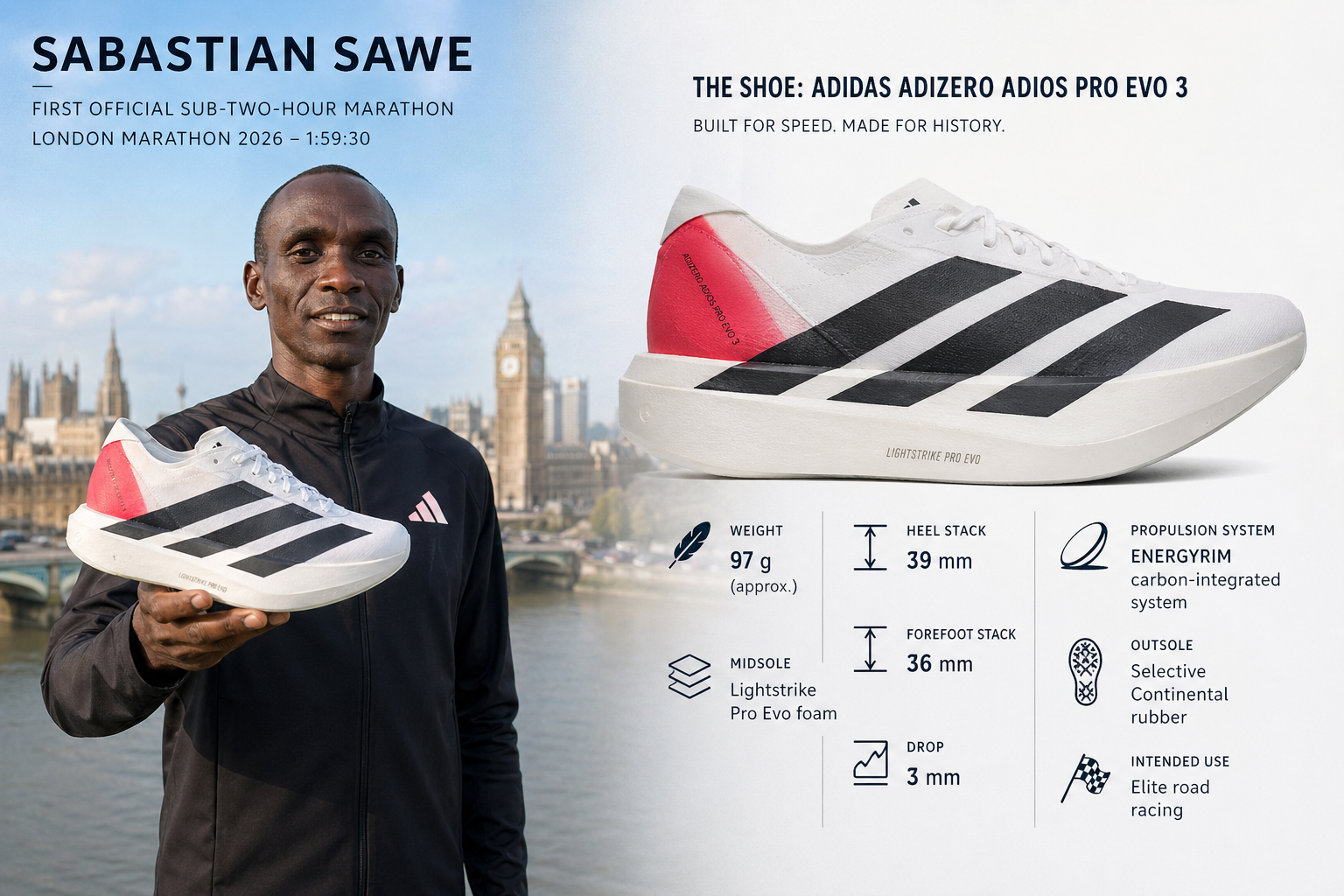
Sawe reportedly wore the Adidas Adizero Adios Pro Evo 3, Adidas’s newest ultra-light marathon racing shoe. The shoe was launched just before the 2026 London Marathon and is described by Adidas as its lightest and fastest racing shoe, with an average weight of 97 g.
Key Specifications
FeatureAdidas Adizero Adios Pro Evo 3Weight | Approx. 97 g
Heel stack | 39 mm
Forefoot stack | 36 mm
Drop | 3 mm
Midsole | Lightstrike Pro Evo foam
Propulsion system | ENERGYRIM carbon-integrated system
Outsole | Selective Continental rubber
Intended use | Elite road racing
Price at launch | Around US$500
Heel stack | 39 mm
Forefoot stack | 36 mm
Drop | 3 mm
Midsole | Lightstrike Pro Evo foam
Propulsion system | ENERGYRIM carbon-integrated system
Outsole | Selective Continental rubber
Intended use | Elite road racing
Price at launch | Around US$500
Adidas states that the Evo 3 is about 30% lighter than its predecessor, uses a new version of Lightstrike Pro Evo foam, and includes the ENERGYRIM carbon-integrated system instead of the older EnergyRods structure. Adidas also claims the shoe provides a 1.6% improvement in running economy compared with the previous model.
Why the Shoe Matters Biomechanically
Modern marathon racing shoes are not simply “soft shoes with carbon plates.” They are integrated systems involving:
- High-stack compliant foam
This provides cushioning and energy return. - A stiff carbon element
This changes how the forefoot bends and may help preserve lever function during propulsion. - Rocker geometry
This assists forward roll-through, especially at faster speeds. - Very low weight
Reducing shoe mass matters because the foot is accelerated and decelerated thousands of times during a marathon. - Foam-volume placement
High forefoot stack may be especially useful for runners who load aggressively through the forefoot at high speeds.
The Evo 3’s 39 mm heel / 36 mm forefoot configuration keeps it just below the World Athletics road-racing stack-height limit of 40 mm. World Athletics rules also restrict shoes to no more than one rigid embedded plate or blade structure.
What Does the Science Say About Super Shoes?
The scientific evidence generally supports the idea that carbon-plated, high-performance racing shoes can improve running economy, although the exact benefit varies between runners.
A 2026 systematic review and meta-analysis reported that plated footwear reduced metabolic demand by approximately 2–3% across several outcomes. Earlier research on Nike’s Vaporfly-style technology showed meaningful improvements in running economy compared with traditional racing shoes, although later work has suggested that no single component — foam, plate, or geometry — explains the entire effect on its own.
This is important clinically. The shoe does not run the marathon. The athlete does. But at the elite level, where margins are tiny, a small improvement in running economy can be decisive.
For Sawe, the shoe likely complemented his physiology and running mechanics. The Adidas Evo 3 may have helped reduce the cost of maintaining sub-two-hour pace, but it only works at this level because the athlete is already capable of generating and controlling world-class speed.
A Podiatry Perspective: Should Recreational Runners Use Shoes Like This?
For elite marathoners, shoes such as the Adidas Adizero Adios Pro Evo 3 are designed for one purpose: maximum race-day performance.
For recreational runners, the answer is more nuanced.
A super shoe may help some runners run faster or feel more efficient, particularly at higher speeds. However, ultra-light racing shoes often have trade-offs:
- reduced durability;
- less outsole coverage;
- less rearfoot stability;
- narrow or aggressive geometry;
- higher cost;
- greater demand on calf, Achilles, and forefoot structures;
- less suitability for slow daily training.
A runner with Achilles tendinopathy, forefoot overload, metatarsalgia, calf weakness, poor balance, or unstable rearfoot mechanics may not automatically benefit from an aggressive elite racing shoe. Shoe selection should match the runner’s body, speed, injury history, strength, foot structure, and training goals.
In clinical practice, the question should not be, “What shoe did Sawe wear?” The better question is:
“Does this shoe match the way this runner loads, moves, trains, and tolerates stress?”
Why Sawe’s Performance Matters Beyond the Record
Sabastian Sawe’s sub-two-hour marathon represents a historic moment in sport. But it is also a reminder of how performance emerges from multiple interacting systems:
- genetics;
- training environment;
- coaching;
- altitude;
- pacing;
- nutrition;
- biomechanics;
- footwear technology;
- psychological control;
- injury management;
- race-day execution.
His performance should not be reduced to the shoe alone. Nor should it be viewed as a purely physiological miracle. It was a convergence of human talent, long-term training, mechanical efficiency, and modern sports technology.
For runners and clinicians, the lesson is clear: performance is not created by one variable. It is created when the whole system works together.
Conclusion
Sabastian Sawe’s 1:59:30 at the 2026 London Marathon changed the history of distance running. His relaxed but devastatingly efficient running style, high-altitude training background, disciplined pacing, and use of the Adidas Adizero Adios Pro Evo 3 all contributed to a performance that once seemed almost impossible.
From a podiatry and biomechanics perspective, the most important takeaway is not simply that super shoes are fast. It is that the fastest runners in the world combine efficient movement, resilient tissues, precise training, appropriate footwear, and extraordinary fatigue resistance.
Sawe’s achievement is not just a story about breaking two hours. It is a story about how far human locomotion can be refined.
Disclaimer: The attached image is an AI-generated editorial illustration created for educational commentary. It is not an official Adidas or Sabastian Sawe image.
About the Author
Mark B. Reyneker, BTech (Podiatry), MSc (Palaeontology) is a podiatrist and Founder & Clinical Director of Family Podiatry Centre, with more than 25 years of clinical experience across South Africa, Malaysia and Singapore. His clinical interests include foot and lower-limb pain, gait and biomechanics, sports-related foot conditions, orthotic therapy and footwear.
Alongside his clinical practice, Mark conducts research into human gait and foot biomechanics. His MSc research at the University of the Witwatersrand investigated human propulsion and the structural properties of the metatarsals. He is also the inventor of A Foot Orthotic, an orthotic technology developed through an international patent family.
Book An Appointment
Disclaimer: The attached image is an AI-generated editorial illustration created for educational commentary. It is not an official Adidas or Sabastian Sawe image.
About the Author
Mark B. Reyneker, BTech (Podiatry), MSc (Palaeontology) is a podiatrist and Founder & Clinical Director of Family Podiatry Centre, with more than 25 years of clinical experience across South Africa, Malaysia and Singapore. His clinical interests include foot and lower-limb pain, gait and biomechanics, sports-related foot conditions, orthotic therapy and footwear.
Alongside his clinical practice, Mark conducts research into human gait and foot biomechanics. His MSc research at the University of the Witwatersrand investigated human propulsion and the structural properties of the metatarsals. He is also the inventor of A Foot Orthotic, an orthotic technology developed through an international patent family.
Book An Appointment