
When Volcanoes Erupt and Preserve Time



10 May 2026
By Mark Reyneker, BTech (Podiatry), MSc (Palaeontology), Registered Podiatrist, Foot & Gait Specialist | Founder & Clinical Director, Family Podiatry Centre
Written by Mark Reyneker, B.T. Pod (SA), MSc (SA)
Registered Podiatrist & Human Gait Specialist
Founder / Clinical Director, Family Podiatry Centre
Published: 10 May 2026 | Last reviewed: 5 June 2026
The recent eruption of Mount Dukono in Indonesia is a sobering reminder of the destructive force of volcanoes. The event brings to mind a larger geological truth: volcanic eruptions can destroy landscapes in moments, but under rare conditions, they can also preserve them. Reuters reported that the May 2026 eruption sent ash up to around 10 km into the atmosphere and resulted in fatalities among hikers, including two Singaporeans.
Registered Podiatrist & Human Gait Specialist
Founder / Clinical Director, Family Podiatry Centre
Published: 10 May 2026 | Last reviewed: 5 June 2026
The recent eruption of Mount Dukono in Indonesia is a sobering reminder of the destructive force of volcanoes. The event brings to mind a larger geological truth: volcanic eruptions can destroy landscapes in moments, but under rare conditions, they can also preserve them. Reuters reported that the May 2026 eruption sent ash up to around 10 km into the atmosphere and resulted in fatalities among hikers, including two Singaporeans.
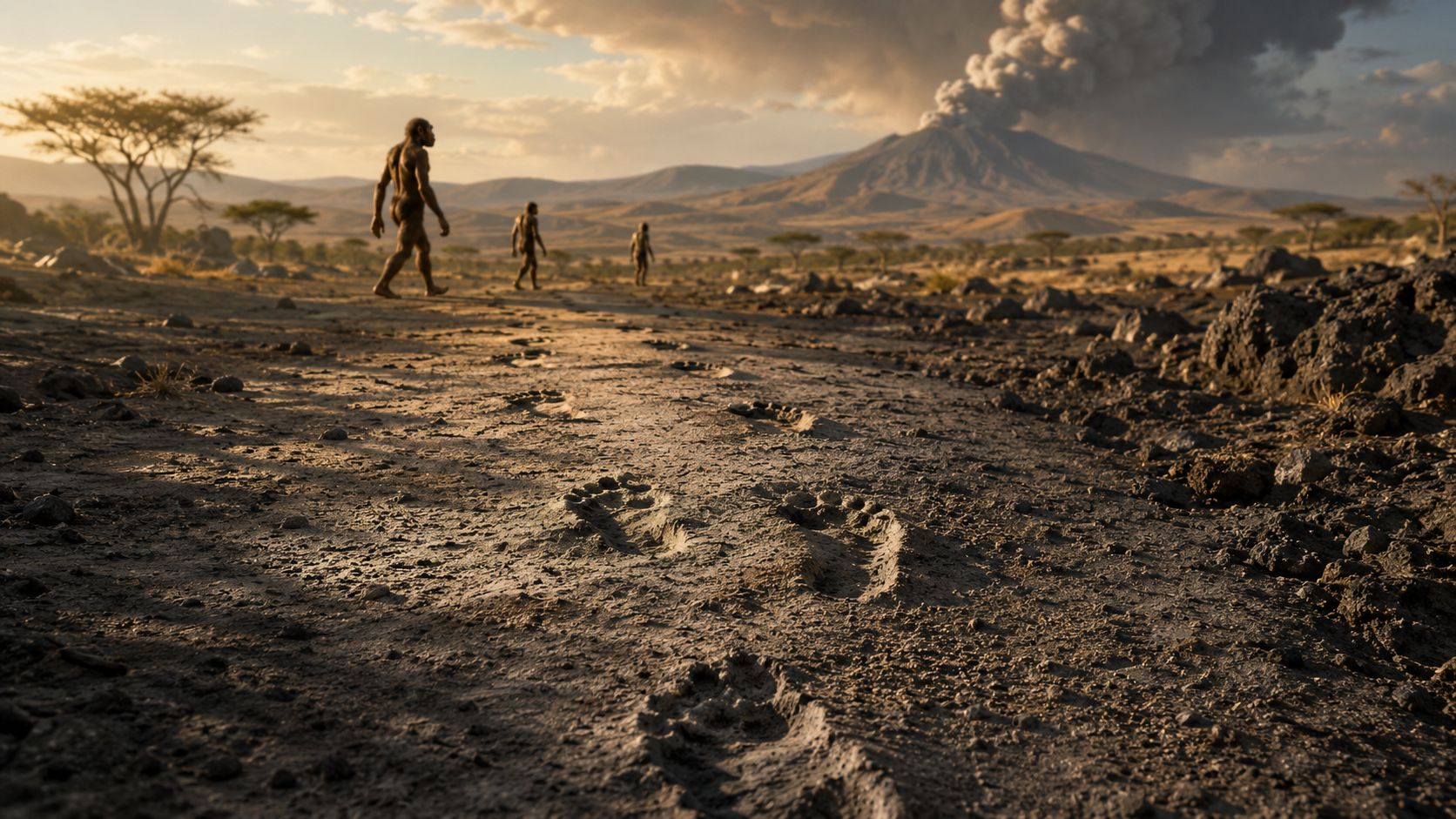
That paradox — destruction and preservation occurring through the same natural force — is central to one of the most extraordinary discoveries in human evolutionary science: the Laetoli footprints in Tanzania. These footprints were first reported scientifically by Leakey and Hay, who described a series of Pliocene animal and hominin tracks preserved in volcanic tuff at Laetoli in northern Tanzania (Leakey and Hay, 1979). Their discovery provided direct fossil evidence not merely of anatomy, but of behaviour: ancient hominins walking across a soft volcanic surface more than three million years ago.
The footprints are often popularly linked with Lucy, the famous Australopithecus afarensis skeleton discovered at Hadar in Ethiopia in 1974. However, they were not Lucy’s own footprints. Lucy is dated to approximately 3.18 million years ago, based on argon dating of volcanic ash layers associated with the Hadar Formation (Walter, 1994). The Laetoli footprints are older, around 3.66 million years old, and were discovered in Tanzania, not Ethiopia. The connection is therefore not individual, but taxonomic: the Laetoli trackmakers are commonly attributed to Australopithecus afarensis, the same species to which Lucy belonged (White and Suwa, 1987; Kimbel and Delezene, 2009).
What makes the Laetoli footprints so scientifically powerful is that they capture a moment of movement. Bones tell us what an ancient body was built like; footprints show what that body actually did. The Laetoli prints show clear evidence of bipedal walking, including a pattern of footfall consistent with upright locomotion (White and Suwa, 1987). Later biomechanical studies have suggested that the Laetoli hominins walked with a surprisingly human-like pattern, although not necessarily identical to modern humans (Raichlen et al., 2010; Crompton et al., 2012; Hatala et al., 2016).
That same principle helped clarify Lucy’s age as well. Lucy herself was not dated because someone found her footprints. Rather, scientists dated volcanic ash layers associated with the Hadar Formation. Later argon-argon dating of suitable volcanic ash samples helped establish Lucy’s age at around 3.18 million years.
That same principle helped clarify Lucy’s age as well. Lucy herself was not dated because someone found her footprints. Rather, scientists dated volcanic ash layers associated with the Hadar Formation. Later argon-argon dating of suitable volcanic ash samples helped establish Lucy’s age at around 3.18 million years.
The role of volcanic ash is central to the story. The hominins appear to have walked across damp volcanic ash, leaving impressions while the surface was still soft. Subsequent ashfall and sedimentation helped seal and preserve the tracks, eventually turning that surface into a fossilised tuff. This is why Laetoli is so remarkable: a volcanic event created both the surface on which the footprints were made and the conditions that allowed them to survive for millions of years (Leakey and Hay, 1979; White and Suwa, 1987).
This gives the story its deeper meaning. Volcanoes are usually remembered for their violence: ash clouds, falling debris, buried landscapes and sudden loss. But in the case of Laetoli, volcanic ash became a time capsule. It preserved not just bones, but a fleeting act of life — several early hominins walking across an ancient East African landscape. More than 3.6 million years later, those steps remain visible, allowing us to study the origins of upright walking with a level of immediacy that skeletal fossils alone cannot provide.
For anyone interested in the human foot, gait, and mobility, Laetoli is almost poetic. It reminds us that the foot is not simply an anatomical structure; it is an instrument of movement, adaptation and survival. The Laetoli footprints captured that movement in real time. In doing so, they transformed a moment of volcanic ash into one of the most important records of human evolutionary history.
More than three million years ago, a few individuals walked across wet ash in East Africa. They did not know they were leaving a message. They did not know that their footprints would survive continents shifting, climates changing, species disappearing, and humans eventually emerging. Yet today, those impressions remain: not as myth, not as speculation, but as physical evidence.
In a world where moments vanish instantly, the Laetoli footprints remind us that sometimes the Earth itself remembers.
More than three million years ago, a few individuals walked across wet ash in East Africa. They did not know they were leaving a message. They did not know that their footprints would survive continents shifting, climates changing, species disappearing, and humans eventually emerging. Yet today, those impressions remain: not as myth, not as speculation, but as physical evidence.
In a world where moments vanish instantly, the Laetoli footprints remind us that sometimes the Earth itself remembers.
Book An Appointment
Disclaimer: This article is for informational and educational purposes only.
About the Author
Mark B. Reyneker, BTech (Podiatry), MSc (Palaeontology) is a podiatrist and Founder & Clinical Director of Family Podiatry Centre, with more than 25 years of clinical experience across South Africa, Malaysia and Singapore. His clinical interests include foot and lower-limb pain, gait and biomechanics, sports-related foot conditions, orthotic therapy and footwear.
Alongside his clinical practice, Mark conducts research into human gait and foot biomechanics. His MSc research at the University of the Witwatersrand investigated human propulsion and the structural properties of the metatarsals. He is also the inventor of A Foot Orthotic, an orthotic technology developed through an international patent family.
References:
Recommended posts