How Does Shock Wave Therapy Work?




23 March 2026
Written by Mark Reyneker, B.T. Pod (SA), MSc (SA)
Registered Podiatrist & Human Gait Specialist
Founder / Clinical Director, Family Podiatry Centre
Published: 23 March 2026 | Last reviewed: 5 June 2026
If you have been told that you may benefit from shock wave therapy, you may be wondering what it actually is, how it works, and why podiatrists use it for stubborn tendon and heel problems.
Registered Podiatrist & Human Gait Specialist
Founder / Clinical Director, Family Podiatry Centre
Published: 23 March 2026 | Last reviewed: 5 June 2026
If you have been told that you may benefit from shock wave therapy, you may be wondering what it actually is, how it works, and why podiatrists use it for stubborn tendon and heel problems.
At Family Podiatry Centre, shock wave therapy is used as a non-surgical treatment option for selected musculoskeletal conditions, especially when pain has been present for some time and has not responded fully to rest, stretching, footwear changes, or exercise-based rehabilitation. Shock wave therapy is not “electric shock” treatment. It is a treatment that uses acoustic pressure waves delivered into injured tissue in a controlled way (Ogden, Tóth-Kischkat and Schultheiss, 2001; Speed, 2004).
What is shock wave therapy?
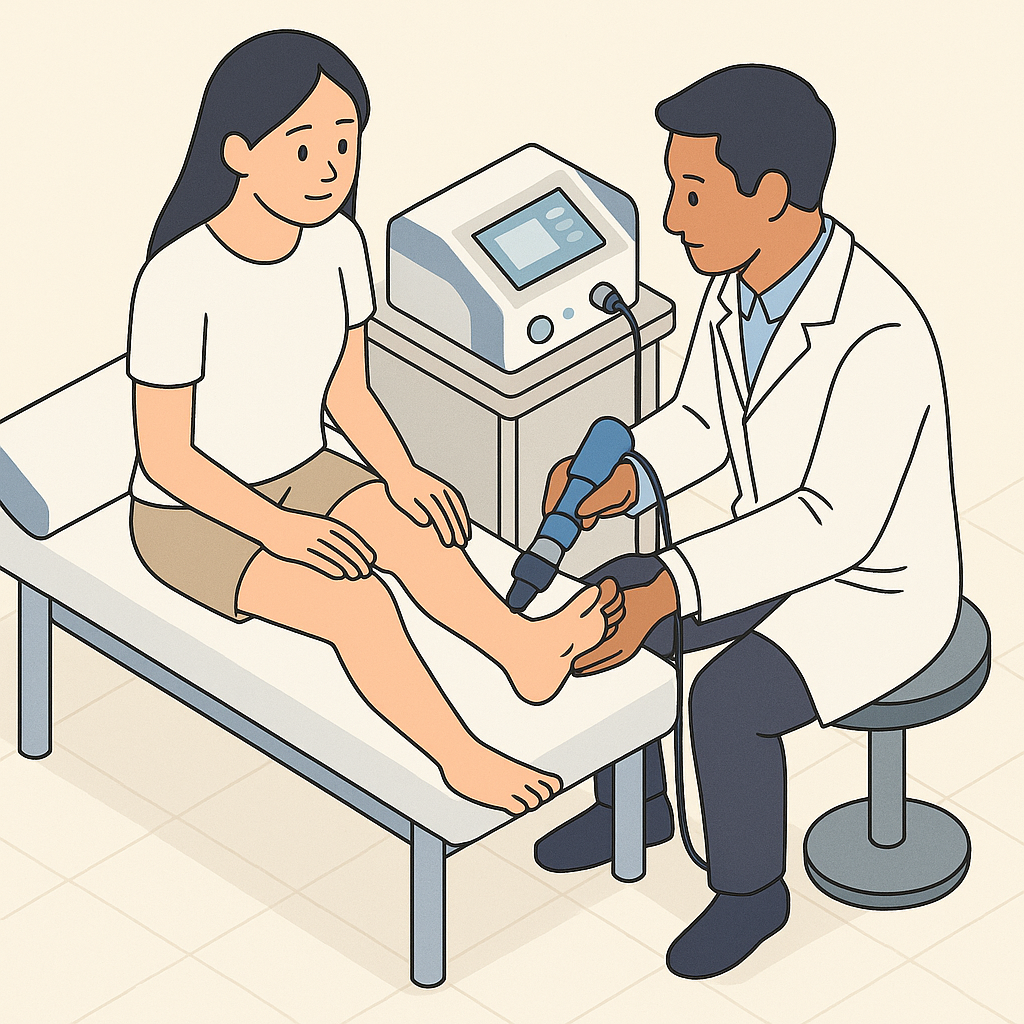
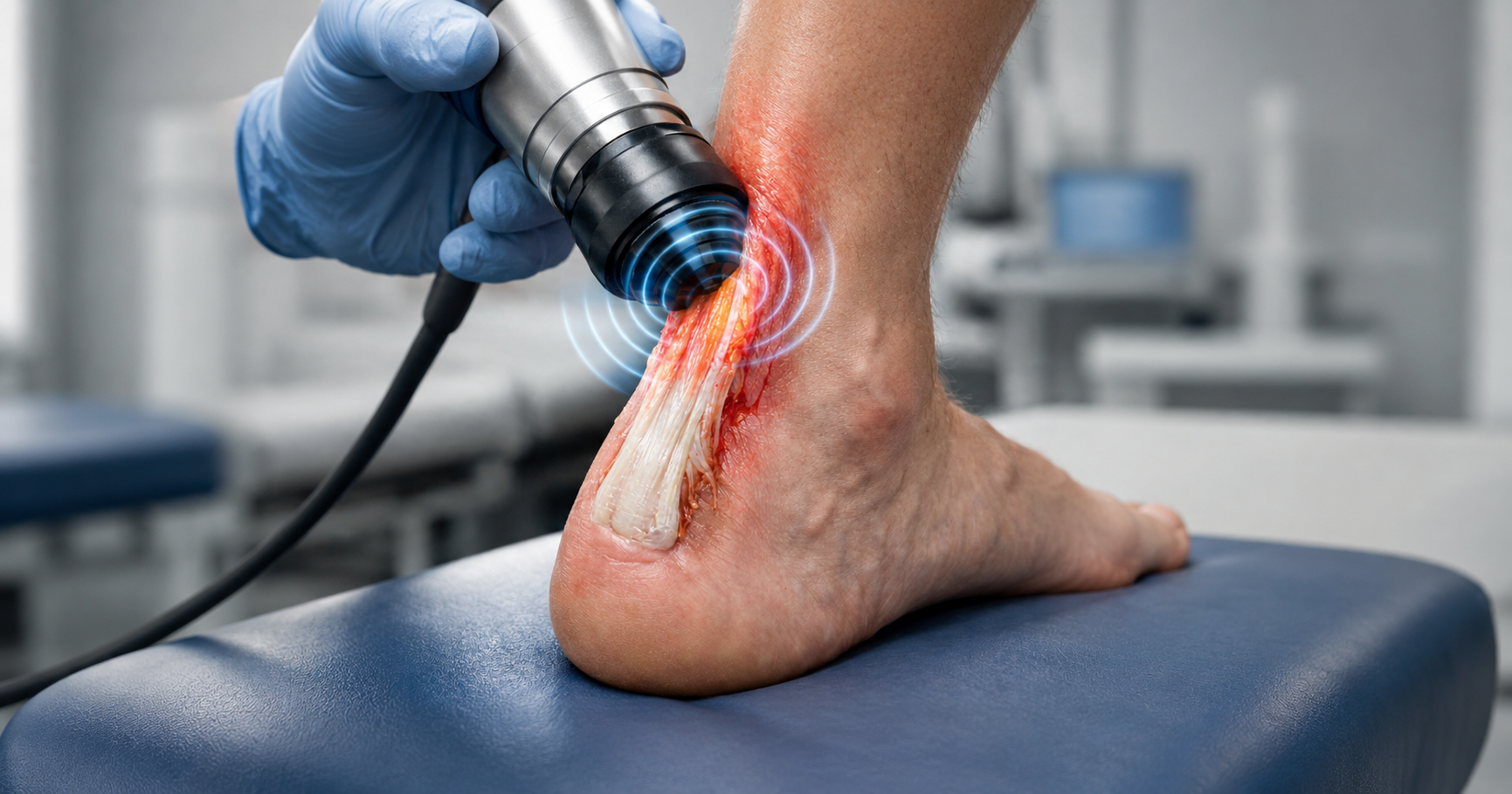
Extracorporeal shock wave therapy (ESWT) is a non-invasive treatment in which a handheld device delivers pulses of mechanical energy to a painful area from outside the body. The word extracorporeal simply means “outside the body.” Unlike surgery, there are no incisions, and unlike injections, nothing is injected into the tissue (Ogden, Tóth-Kischkat and Schultheiss, 2001; Speed, 2004).
The treatment was first developed in medicine in relation to lithotripsy, where shock waves were used to break kidney stones. Over time, the same broad technology was adapted for musculoskeletal care, where the goal is different: not to break tissue apart, but to stimulate healing responses and reduce pain in carefully selected tissues (Simplicio et al., 2020; Notarnicola and Moretti, 2012).
What exactly is a shock wave?
A shock wave is not just any sound wave. It is a high-pressure acoustic wave with a very rapid rise in pressure, followed by a lower-pressure phase. This rapid change in pressure is one of the features that makes shock waves biologically active in tissue. Foundational papers on ESWT describe shock waves as transient pressure disturbances that propagate rapidly through tissue and may also produce effects related to cavitation, especially during the negative-pressure phase (Ogden, Tóth-Kischkat and Schultheiss, 2001; Gerdesmeyer et al., 2002).
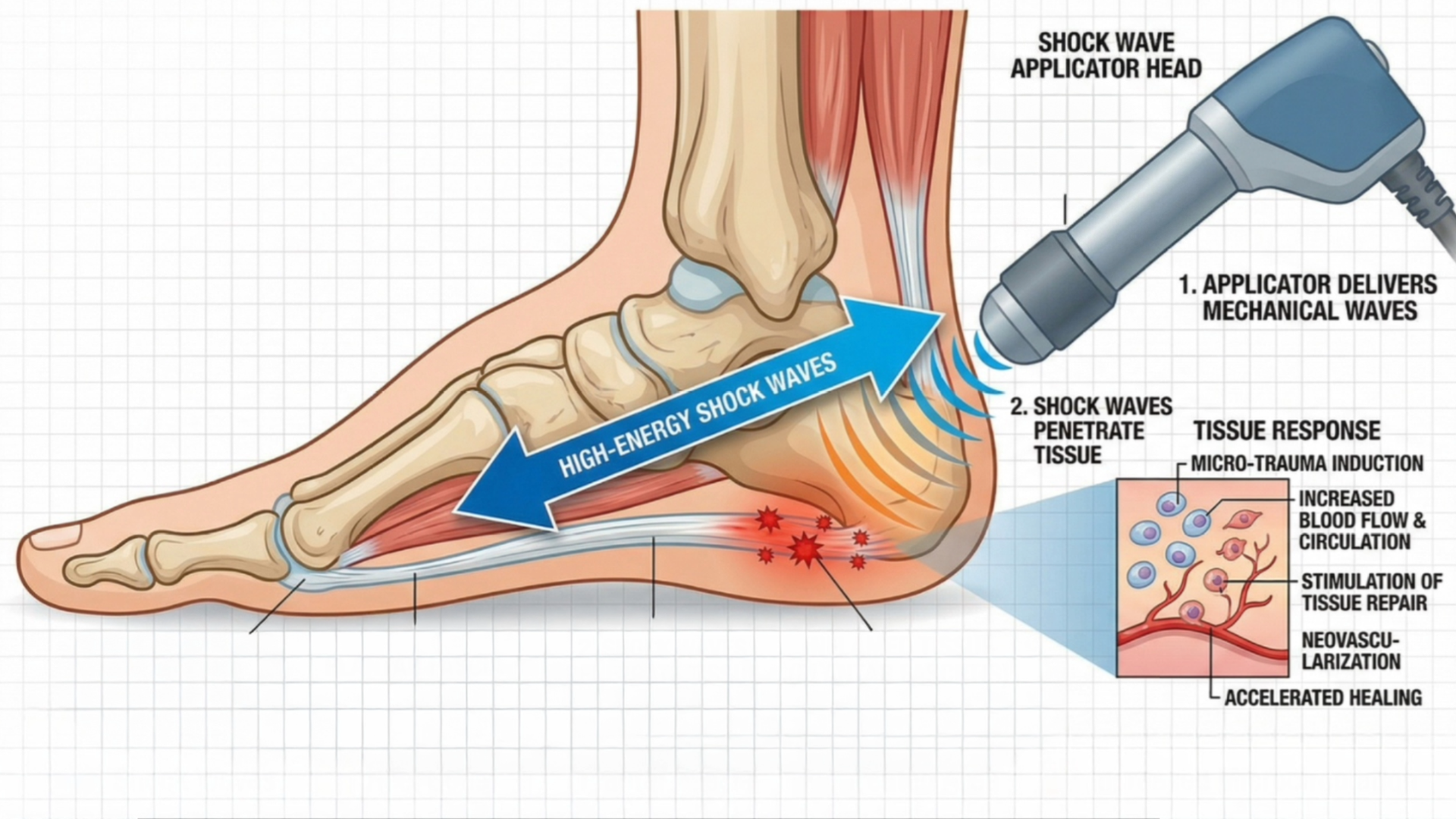
In practical terms, this means the treatment head delivers a series of controlled pressure pulses into the painful area. These pulses transfer energy into the tissue, and that mechanical stimulus appears to trigger a range of biological responses rather than acting as a simple “massage” or warming treatment (Gerdesmeyer et al., 2002; Simplicio et al., 2020).
How does shock wave therapy work?
This is the key question. The short answer is that shock wave therapy appears to work through a combination of mechanical stimulation, biological signaling, and pain modulation.
The older view of shock wave therapy was too simplistic. In musculoskeletal medicine, ESWT is now generally understood not as a destructive treatment, but as one that may stimulate repair and remodeling processes in chronically irritated tissue (Notarnicola and Moretti, 2012; Simplicio et al., 2020).
The proposed mechanisms can be grouped into several areas.
1. It mechanically stimulates the tissue
When shock waves pass through tissue, they deliver a physical stimulus that cells can detect. Tendon cells and surrounding tissues respond to mechanical loading, and ESWT appears to act as a form of controlled mechanical stimulation. Review papers describe this as a trigger for downstream cellular and biochemical activity rather than a purely local physical effect (Gerdesmeyer et al., 2002; Simplicio et al., 2020).
2. It may help stimulate blood vessel formation
One of the most commonly discussed mechanisms is neovascularisation, meaning the formation of new small blood vessels. Chronically painful tendon tissue often has poor healing capacity. Reviews of ESWT suggest that shock wave exposure may promote angiogenic signaling and support improved local blood supply, which may help tissue repair over time (Notarnicola and Moretti, 2012; Poenaru, Săndulescu and Cinteza, 2023).
This does not mean the tendon heals overnight. Rather, it supports the idea that ESWT may help create a more favorable healing environment in tissue that has become stalled in a chronic pain state.
3. It may alter inflammatory and biochemical signaling
Modern tendon science has moved away from viewing chronic tendon pain as simple acute inflammation. ESWT papers suggest that shock wave treatment may influence molecules involved in tissue turnover and pain signaling, including cytokines, metalloproteinases, and other regulators of extracellular matrix remodeling (Notarnicola and Moretti, 2012; Poenaru, Săndulescu and Cinteza, 2023).
This is important because tendon pain often persists when tissue remodeling becomes disorganized. By influencing biochemical pathways, shock wave therapy may help push tissue toward a more regenerative pattern rather than a chronically degenerated one.
4. It may encourage tendon remodeling
Tendons are made up largely of collagen and extracellular matrix. Several reviews suggest that ESWT may influence tendon-cell activity, matrix organization, and the balance between breakdown and repair. Poenaru, Săndulescu and Cinteza (2023) describe effects involving cellularity, extracellular matrix changes, lubricin production, and improvements in the biomechanical behavior of remodeled tendon tissue. Notarnicola and Moretti (2012) similarly describe regenerative and tissue-repair effects rather than purely mechanical disruption.
This is one reason why shock wave therapy is often used in chronic tendon problems that have not fully responded to simpler care alone.
5. It may reduce pain in its own right
Shock wave therapy may also have a direct effect on pain. Clinical and mechanistic reviews suggest that ESWT may alter pain transmission and local nociceptive activity, which may partly explain why some patients report symptom improvement even before long-term tissue remodeling would be expected to occur (Speed, 2004; Simplicio et al., 2020).
In other words, part of the benefit may come from improved tissue biology, and part may come from changes in how pain is processed locally.
Focused and radial shock wave therapy
Patients sometimes hear the terms focused and radial shock wave therapy. These refer to different ways of generating and delivering energy. Technical reviews explain that ESWT devices differ in how waves are produced, how pressure is distributed, and how energy reaches the target tissue (Gerdesmeyer et al., 2002; Ogden, Tóth-Kischkat and Schultheiss, 2001).
Although the physics differ, the practical aim is similar: to deliver mechanical energy to a selected area in a way that is clinically useful. The best choice depends on the condition being treated, the depth of the tissue, the treatment protocol, and the clinician’s assessment.
Why is shock wave therapy often used for stubborn problems?
Many foot and ankle conditions become difficult not because they are dramatic injuries, but because they become chronic. Once pain has been present for months, tissue often does not respond well to rest alone. Clinical reviews describe ESWT as particularly relevant for chronic soft-tissue conditions where standard conservative care has not been enough (Speed, 2004).
That is why shock wave therapy is often discussed in relation to conditions such as:
- Achilles tendinopathy
- plantar heel pain / plantar fasciopathy
- other chronic tendon or insertional pain conditions
The treatment is usually best understood as part of a broader plan rather than a stand-alone miracle cure.
Is shock wave therapy meant to replace rehabilitation?
No. One of the most important messages for patients is that shock wave therapy is usually an adjunct, not a substitute for proper rehabilitation.
The biological effects described in the literature help explain why ESWT can be useful, but tissue recovery still depends on appropriate loading, footwear advice, activity modification where needed, and condition-specific rehabilitation. The treatment may help “restart” a stalled healing response, but the tendon or fascia still needs the right mechanical environment afterward (Speed, 2004; Simplicio et al., 2020).
What does this mean for patients?
The main takeaway is that shock wave therapy works by delivering controlled acoustic energy into painful tissue, where it appears to stimulate a cascade of mechanical and biological responses. These include effects on blood vessel formation, cellular activity, matrix remodeling, inflammatory mediators, and pain signaling (Notarnicola and Moretti, 2012; Poenaru, Săndulescu and Cinteza, 2023; Simplicio et al., 2020).
It is not simply a treatment that “breaks up scar tissue,” and it is not best explained as a quick fix. A more accurate explanation is that it provides a controlled mechanical stimulus that may help chronically painful tissue move toward recovery.
Final thoughts from Family Podiatry Centre
If you have persistent heel pain, Achilles pain, or another chronic foot or ankle problem, shock wave therapy may be one of the options worth considering. The science suggests that its effects are not based on one single mechanism, but on a combination of physical, cellular, vascular, and pain-modulating processes.
At Family Podiatry Centre, any decision to use shock wave therapy should be based on a proper assessment, a clear diagnosis, and a treatment plan that fits the tissue involved and your activity goals.
Book An Appointment
Disclaimer: The word "treatment" in this article refers to the care and management of a patient’s health to prevent, cure, or improve a condition. Treatment results vary and do not necessarily indicate a cure. This article is for informational and educational purposes only and does not constitute medical advice.
About the author
Mark Reyneker is a podiatrist and human gait specialist with 8 years of training and over 25 years of clinical experience. He is the Founder and Clinical Director of Family Podiatry Centre and has a Bachelors degree in Podiatric Medicine and a Master’s degree in paleoanthropology, with research focused on human foot function and metatarsal loading.
Book An Appointment
Disclaimer: The word "treatment" in this article refers to the care and management of a patient’s health to prevent, cure, or improve a condition. Treatment results vary and do not necessarily indicate a cure. This article is for informational and educational purposes only and does not constitute medical advice.
About the author
Mark Reyneker is a podiatrist and human gait specialist with 8 years of training and over 25 years of clinical experience. He is the Founder and Clinical Director of Family Podiatry Centre and has a Bachelors degree in Podiatric Medicine and a Master’s degree in paleoanthropology, with research focused on human foot function and metatarsal loading.
References