Foot Fat Pad Atrophy and Fat Pad Migration




3 January 2026
Explainer video
If you have been experiencing discomfort in the ball of your foot (the front bottom) that is especially worse when walking barefooted then you may be experiencing a condition known as metatarsalgia.
What is Metatarsalgia?
If you have been experiencing discomfort in the ball of your foot (the front bottom) that is especially worse when walking barefooted then you may be experiencing a condition known as metatarsalgia.
What is Metatarsalgia?
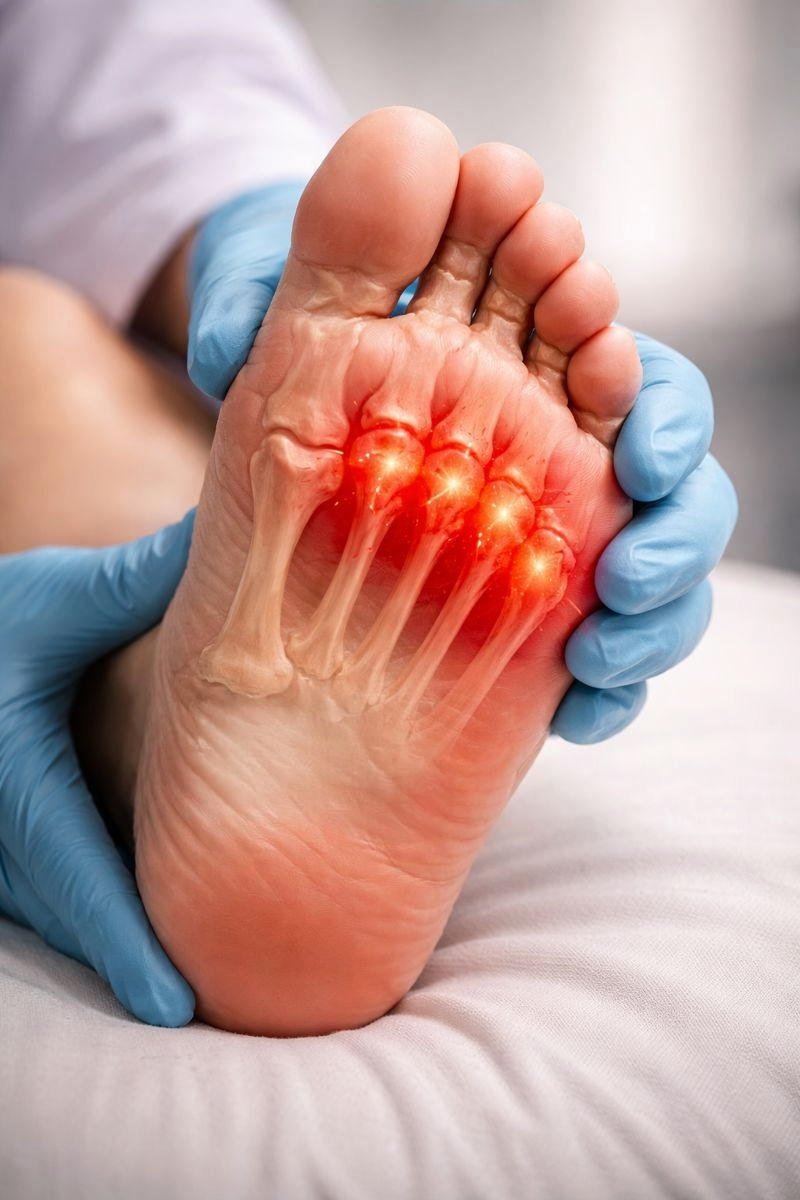
Metatarsalgia is an umbrella term for pain occurring under one or more of the metatarsal heads. The metatarsal heads are the rounded ends of the long bones that are found in the front half of the foot illustrated in the image. It is primarily caused by repetitive mechanical overload that exceeds the tolerance of the local focal tissue, leading to inflammation and pain. Under normal conditions, the plantar fat pad acts as a specialized shock absorber, protecting the skin and bone from these forces during gait. When this "cushion" either thins (atrophy) or moves out of place (migration), the metatarsal heads become vulnerable.
How and Why Does the Fat Pad Atrophy?
Atrophy refers to the loss of tissue volume or functional integrity. This occurs through several biological and mechanical pathways:
• Natural Aging and Senescence: As we age, adipose tissue undergoes cellular senescence, which promotes dysfunction through the dysregulation of extracellular remodeling and inflammation. This leads to a loss of water content and elastic fibrous tissue.
• Biological/Metabolic Changes: In conditions like diabetes, microangiopathy (damaged small blood vessels) can lead to low perfusion of the fat pad. Additionally, high blood glucose leads to the formation of Advanced Glycation End products (AGEs), which cause abnormal cross-linking of collagen. Instead of a regular, parallel arrangement, the collagen fibrils in the septal walls become distorted and fragmented, reducing the pad's ability to absorb pressure.
• Mechanical Microtrauma: Repetitive microtrauma from daily walking or obesity can cause the fibrous septa within the fat pad to thicken and become fibrotic. While this may make the pad feel "stiffer," it actually decreases its shock-absorbing capacity.
• External and Iatrogenic Factors: Atrophy is a known complication of corticosteroid injections (often used for neuromas or plantar fasciitis). It can also result from high-heeled shoes, which increase pressure on the forefoot, or surgical consequences, such as aggressive neuroma excision that inadvertently removes too much fat.
The Mechanism of Fat Pad Migration
Migration is a structural shift where the fat pad moves away from its protective position under the metatarsal heads.
• The Role of Toe Deformity: The sub-metatarsal fat pads are anchored to the proximal phalanges of the toes. In deformities like claw toe or hammer toe, the metatarsophalangeal (MTP) joint is hyperextended.
• The Distal "Pull": Because of this anatomical connection, when the toe bends upward (hyperextension), it pulls the fat pad distally (forward) toward the toes.
• Exposure of the Bone: This migration results in a thinning of the fat directly under the metatarsal head while causing the fat pad under the toe (sub-phalangeal) to become thicker. In severe cases, the fat pad can even rupture or separate, leaving the metatarsal head completely unprotected. This creates a sensation often described by patients as "walking on bone".
Summary of Causes
Diabetes/AGEs: Fragmentation of collagen and reduced perfusion (Atrophy).
Aging: Cellular senescence and loss of elasticity (Atrophy).
Claw/Hammer Toe: Mechanical "pull" of the pad toward the toes (Migration).
Steroid Injections: Chemical destruction of adipose tissue (Atrophy).
Aging: Cellular senescence and loss of elasticity (Atrophy).
Claw/Hammer Toe: Mechanical "pull" of the pad toward the toes (Migration).
Steroid Injections: Chemical destruction of adipose tissue (Atrophy).
Analogy
Think of the plantar fat pad as a thick, gel-filled insole glued inside your shoe. Atrophy is like the gel leaking out or drying up over time until the insole is paper-thin and useless. Migration is like the insole sliding forward toward the toes; even if the insole is still thick and "healthy," your heel and the ball of your foot are now hitting the hard plastic of the shoe because the cushion is no longer where the impact actually happens.
Think of the plantar fat pad as a thick, gel-filled insole glued inside your shoe. Atrophy is like the gel leaking out or drying up over time until the insole is paper-thin and useless. Migration is like the insole sliding forward toward the toes; even if the insole is still thick and "healthy," your heel and the ball of your foot are now hitting the hard plastic of the shoe because the cushion is no longer where the impact actually happens.
6. Payen, E., Acien, M., Isabelle, P.L., Turcot, K., Begon, M., Abboud, J. and Moisan, G. (2025) ‘Impact of different foot orthoses on gait biomechanics in individuals with chronic metatarsalgia’, Gait & Posture, 118, pp. 17–24. doi: 10.1016/j.gaitpost.2025.01.022.
Disclaimer: The word "treatment" in this article refers to the care and management of a patient’s health to prevent, cure, or improve a condition. Treatment results vary and do not necessarily indicate a cure.
Mark Reyneker
Disclaimer: The word "treatment" in this article refers to the care and management of a patient’s health to prevent, cure, or improve a condition. Treatment results vary and do not necessarily indicate a cure.
Mark Reyneker
B.T. Pod (SA), MSc (SA)
Podiatrist and Human Gait Specialist
Registered with the Podiatry Association of Singapore
Founder and Director:
Family Podiatry Centre Pte Ltd
Family Podiatry Centre Sdn Bhd
Solescape Orthotics Laboratory
Solescape Shoes brand