Why Do My High Heels Wear Down on the Outside?



24 May 2026
By Mark Reyneker, BTech (Podiatry), MSc (Palaeontology), Registered Podiatrist, Foot & Gait Specialist | Founder & Clinical Director, Family Podiatry Centre
Written by Mark Reyneker, B.T. Pod (SA), MSc (SA)
Registered Podiatrist & Human Gait Specialist
Founder / Clinical Director, Family Podiatry Centre
Published: 24 May 2026 | Last reviewed: 5 June 2026
High heels can look elegant, polished and professional. For many women, they are part of workwear, evening wear or personal style. But sometimes the shoe tells a story before the foot starts to hurt.
Registered Podiatrist & Human Gait Specialist
Founder / Clinical Director, Family Podiatry Centre
Published: 24 May 2026 | Last reviewed: 5 June 2026
High heels can look elegant, polished and professional. For many women, they are part of workwear, evening wear or personal style. But sometimes the shoe tells a story before the foot starts to hurt.
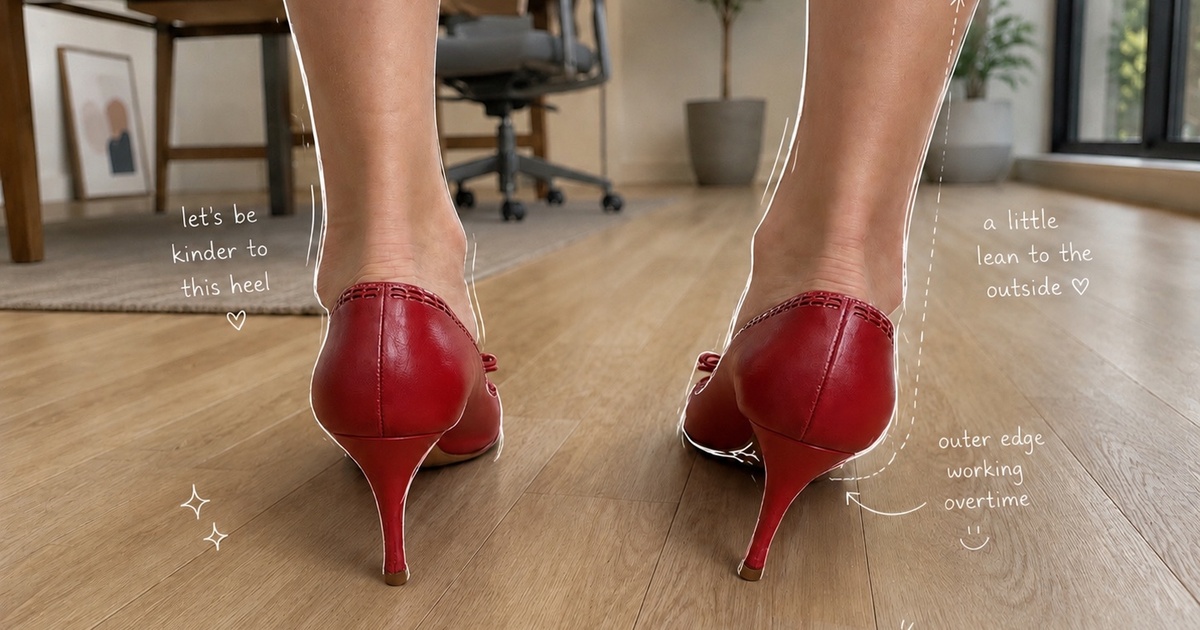
One warning sign is a high heel that begins to wear down more on the outside edge. When this happens, the heel may no longer sit flat on the ground. Instead, it starts to tilt outward. From behind, the shoe may look as though it is leaning to one side. The person wearing it may also appear to walk slightly on the outer border of the foot.
This outward tilt is often linked to a movement pattern called supination or inversion. In simple terms, the foot rolls outward and places more pressure on the outside edge. In high heels, this matters because the foot is already placed in a less stable position: the heel is lifted, the ankle is pointed downward, and the base of support is smaller. Research has shown that high heels increase ankle plantarflexion and inversion, which may increase the risk of lateral ankle strain or sprain (Foster et al., 2012).
This article is not about telling women never to wear heels. It is about helping you recognise an early sign of poor loading before pain, injury or deformity begins.
A small amount of outside heel wear can be normal
Before we panic, it is important to be fair. A little wear on the outside-back corner of the heel is common. During normal walking, many people contact the ground first on the outer part of the heel before the foot rolls inward slightly to absorb shock.
The problem is not mild wear. The concern is excessive, rapid or uneven lateral heel wear, especially when the heel itself becomes slanted. At that point, the shoe is no longer simply reflecting your walking pattern. It may start to change it.
Studies on shoe wear show that outsole wear is influenced by walking forces and gait mechanics, meaning that the pattern of wear can provide useful clues, although it should not be used as a diagnosis on its own (Hemler et al., 2021).
A practical way to think about it is this:
Normal wear: a small worn patch on the outside-back heel.
Concerning wear: the heel block or heel tip becomes angled, causing the shoe to lean outward when placed on a flat surface.
Concerning wear: the heel block or heel tip becomes angled, causing the shoe to lean outward when placed on a flat surface.
Once the heel is slanted, every step may encourage the foot to tilt further outward. The shoe can become a small mechanical trap.
What is excessive supination?
Supination is the movement where the foot rolls outward. In moderate amounts, it is part of normal foot function. Your foot needs to move in and out of different positions as you walk. The issue is when the movement is excessive, poorly controlled or repeatedly reinforced by footwear.
In a high heel, excessive supination may look like:
The heel of the shoe wearing down quickly on the outside edge.
The shoe leaning outward when viewed from behind.
The ankle looking as though it may “roll out.”
More pressure under the outer forefoot.
Callus or irritation near the little toe joint.
Feeling unstable, especially on uneven ground.
Repeated ankle twisting or near-misses.
Pain on the outside of the foot, heel or ankle.
Some women may also notice irritation around the tailor’s bunion area, which is the bony area near the little toe joint. This does not mean the shoe caused the tailor’s bunion, but an outward-loading pattern and narrow high-heeled shoe can irritate that region.
Book An Appointment
Book An Appointment
Why high heels make this more important
High heels change the position of the foot and ankle. The higher the heel, the more the ankle is placed into plantarflexion, meaning the foot points downward. This reduces the amount of stable contact with the ground and shifts loading through the foot.
Foster et al. (2012) found that higher heels increased ankle plantarflexion and inversion during walking. The authors concluded that the plantarflexed and inverted position associated with high heels may increase the risk of lateral ankle sprain (Foster et al., 2012).
Another study using advanced imaging found that high heels altered the movement and position of the ankle complex, including the talocrural and subtalar joints. The ankle was placed in a more abnormal rotational position when walking in high heels (Wang et al., 2016).
This is why a worn, tilted heel matters more in high heels than it might in a flat shoe. The high heel already challenges balance. A laterally worn heel can make that challenge worse.
The “built-in wedge” effect
When the outside of a high heel wears down, the heel no longer meets the ground evenly. The shoe may start to act like a tiny wedge under the foot.
If the lateral side of the heel is lower, the foot may be encouraged to fall outward. With every step, the shoe may reinforce the same movement that created the wear pattern in the first place.
This creates a cycle:
The foot loads more on the outside.
The heel wears down more laterally.
The shoe starts to tilt outward.
The outward tilt encourages more lateral loading.
The foot and ankle work harder to stay stable.
Over time, this may contribute to pain, fatigue, instability or irritation.
This is one reason why simply saying “my heels always wear like that” may not be enough. The important question is whether the shoe is now making the movement worse.
What problems can this lead to?
Excessive outward tilt in high heels may contribute to several issues. Not every person will develop symptoms, but the pattern is worth noticing early.
1. Heel pain
A tilted heel can alter how impact travels through the heel and rearfoot. If pressure becomes concentrated on one side, the heel may become irritated, especially during prolonged standing or walking.
2. Lateral ankle strain
High heels place the ankle in a position that is less forgiving if the foot suddenly rolls outward. The combination of plantarflexion and inversion is biomechanically relevant because lateral ankle sprains commonly occur when the foot rolls outward excessively. Foster et al. (2012) specifically linked the high-heel posture to increased lateral ankle sprain risk.
3. Outer forefoot pressure
High heels are known to shift pressure toward the front of the foot. Research has shown that increasing heel height increases forefoot pressure, impact force and perceived discomfort (Lee and Hong, 2005).
If the wearer also loads more laterally, pressure may become more noticeable around the outer forefoot and little toe joint.
4. Instability and balance problems
A systematic review and meta-analysis found that high-heeled shoes affect lower-limb biomechanics and are associated with poorer static and dynamic balance (Zeng et al., 2023).
This is particularly relevant if the heel is narrow, high, or already worn unevenly.
5. Shoe-related worsening of the original problem
The foot may have started the problem, but the shoe can continue it. A worn-down heel is not neutral. It becomes part of the mechanical environment around the foot.
Why narrow heels are worse
The narrower the heel, the smaller the base of support. A stiletto heel gives much less contact with the ground than a block heel or wedge. This means the ankle and foot have less margin for error.
Luximon et al. (2015) studied heel base size and found that heel base size affects centre-of-pressure movement and perceived stability when wearing high-heeled shoes. Smaller heel bases are associated with greater instability demands (Luximon et al., 2015).
This does not mean every woman must avoid elegant heels completely. But if your heels already wear down on the outside, a very narrow heel is usually less forgiving.
A broader heel base gives the shoe more surface area to resist tilting.
What to check at home
You can do a simple shoe check today.
Place your high heels on a flat table or floor and look at them from behind.
Ask yourself:
Does one heel lean outward?
Is the outside of the heel tip more worn than the inside?
Does one shoe tilt more than the other?
Is the heel cap uneven or flattened on one side?
Do you feel less stable in one pair of heels than another?
Do you see more callus under the outside of the forefoot?
Has the shoe become noisier, less balanced or more wobbly?
Now compare an older pair with a newer pair. If the older pair is visibly tilted, it may be time to repair or replace it.
This is especially important if you already have heel pain, ankle instability, outer foot pain, tailor’s bunion irritation or recurring corns and calluses.
What can you do if you still want to wear heels?
The answer does not have to be “stop wearing heels forever.” The more realistic answer is to make heels safer, more stable and less mechanically aggressive.
1. Repair worn heel tips early
Do not wait until the heel is badly slanted. A worn heel tip is much easier to fix early. Once the heel block is angled, the shoe may encourage further outward tilt.
For frequent heel-wearers, heel tips should be checked regularly. If the shoe no longer sits flat, it should not be used for long walking or prolonged standing.
2. Choose a wider heel base
A block heel, wedge or broader heel is usually more stable than a thin stiletto. This is especially important if you already notice outward heel wear or ankle instability.
The research on heel base size supports the idea that heel geometry affects stability and centre-of-pressure movement in high-heeled shoes (Luximon et al., 2015).
3. Reduce heel height when possible
Higher heels increase the mechanical challenge. They place the ankle in more plantarflexion and can increase inversion at heel strike (Foster et al., 2012; Hong et al., 2013).
A lower heel may still give the desired look while reducing the outward-tilting tendency.
4. Look for a shoe that holds the rearfoot
A high heel with a secure heel counter, ankle strap or better rearfoot hold may feel more stable than a loose slip-on style. If the back of the foot is sliding around, the ankle has to work harder to control the shoe.
5. Avoid very soft, unstable heels
A shoe that feels soft under the heel may feel comfortable at first, but if it compresses unevenly, it may worsen tilt. For someone with lateral heel wear, the shoe needs to be stable, not just cushioned.
6. Consider a slim dress orthotic or in-shoe support
Several studies suggest that inserts can improve comfort and stability in high-heeled shoes. Hong et al. (2013) found that total-contact inserts reduced rearfoot inversion angle and improved comfort rating in high-heeled shoes.
Lee and Hong (2005) also found that shoe inserts, including heel cup and arch support mechanisms, could reduce heel pressure, medial forefoot pressure and impact force while improving comfort in high heels.
The key is that the insert must fit the shoe properly. A bulky orthotic placed into a narrow high heel may make the shoe tighter and more unstable. Dress orthotics need to be designed specifically for low-volume footwear.
7. Strengthen ankle control
The muscles on the outside of the lower leg, especially the peroneal muscles, help resist excessive outward rolling of the ankle. Ludwig et al. (2016) described the peroneus longus as a foot evertor and pronator that helps curb inversion movement of the rearfoot. Their study also showed that specific insole stimulation could increase peroneus longus activity during gait (Ludwig et al., 2016).
For patients with instability, strengthening and balance work may be helpful. This may include controlled calf raises, balance exercises, resistance-band eversion exercises and gait retraining, ideally guided by a podiatrist or physiotherapist.
8. Do not randomly add padding to the outside of the shoe
This is important. If your foot is already tilting outward, adding the wrong pad or wedge may make things worse. The correction depends on whether the problem is coming from the shoe, the heel, the rearfoot, the forefoot, the ankle, or a combination of these.
A proper assessment can determine whether you need shoe repair, a different heel shape, a dress orthotic, ankle rehabilitation, or a change in footwear habits.
When should you seek help?
You should consider a professional foot and ankle assessment if:
Your high heels consistently wear down on the outside.
The shoe visibly tilts outward.
You feel unstable in heels.
You often twist or nearly twist your ankle.
You have pain on the outside of the foot or ankle.
You have heel pain after wearing heels.
You have callus under the outer forefoot.
You have tailor’s bunion irritation.
One shoe wears differently from the other.
You are changing the way you walk to stay balanced.
A podiatrist can assess your foot posture, ankle stability, gait, shoe wear pattern, pressure distribution and footwear. In some cases, a simple shoe modification or early heel repair may be enough. In other cases, a slim custom orthotic, strengthening programme or change in shoe type may be more appropriate.
The main message
If your high heels wear down on the outside, do not ignore it.
A little outside heel wear can be normal, but a visibly tilted heel is different. Once the heel becomes slanted, the shoe may start to push the foot further outward. In high heels, where the ankle is already placed in a more unstable position, this can increase strain on the heel, ankle and outer forefoot.
You do not necessarily have to give up heels. But you may need to wear better heels, repair worn heels earlier, choose a broader heel base, use appropriate support, or have your walking pattern assessed.
The best time to correct the problem is before pain starts.
Book An Appointment
Disclaimer: The word "treatment" in this article refers to the care and management of a patient’s health to prevent, cure, or improve a condition. Treatment results vary and do not necessarily indicate a cure. This article is for informational and educational purposes only and does not constitute medical advice.
About the Author
Mark B. Reyneker, BTech (Podiatry), MSc (Palaeontology) is a podiatrist and Founder & Clinical Director of Family Podiatry Centre, with more than 25 years of clinical experience across South Africa, Malaysia and Singapore. His clinical interests include foot and lower-limb pain, gait and biomechanics, sports-related foot conditions, orthotic therapy and footwear.
Alongside his clinical practice, Mark conducts research into human gait and foot biomechanics. His MSc research at the University of the Witwatersrand investigated human propulsion and the structural properties of the metatarsals. He is also the inventor of A Foot Orthotic, an orthotic technology developed through an international patent family.
Book An Appointment
Disclaimer: The word "treatment" in this article refers to the care and management of a patient’s health to prevent, cure, or improve a condition. Treatment results vary and do not necessarily indicate a cure. This article is for informational and educational purposes only and does not constitute medical advice.
About the Author
Mark B. Reyneker, BTech (Podiatry), MSc (Palaeontology) is a podiatrist and Founder & Clinical Director of Family Podiatry Centre, with more than 25 years of clinical experience across South Africa, Malaysia and Singapore. His clinical interests include foot and lower-limb pain, gait and biomechanics, sports-related foot conditions, orthotic therapy and footwear.
Alongside his clinical practice, Mark conducts research into human gait and foot biomechanics. His MSc research at the University of the Witwatersrand investigated human propulsion and the structural properties of the metatarsals. He is also the inventor of A Foot Orthotic, an orthotic technology developed through an international patent family.
References
4. Ludwig, O., Kelm, J. and Fröhlich, M. (2016) ‘The influence of insoles with a peroneal pressure point on the electromyographic activity of tibialis anterior and peroneus longus during gait’, Journal of Foot and Ankle Research, 9, Article 33.
5. Luximon, Y., Cong, Y., Luximon, A. and Zhang, M. (2015) ‘Effects of heel base size, walking speed, and slope angle on center of pressure trajectory and plantar pressure when wearing high-heeled shoes’, Human Movement Science, 41, pp. 307–319.
6. Shang, J., Geng, X., Wang, C., Chen, L., Zhang, C., Huang, J., Wang, X., Yan, A. and Ma, X. (2020) ‘Influences of high-heeled shoe parameters on gait cycle, center of pressure trajectory, and plantar pressure in young females during treadmill walking’, Journal of Orthopaedic Surgery, 28(2).
7. Wang, C., Geng, X., Wang, S., Ma, X., Wang, X., Huang, J. and Zhang, C. (2016) ‘The impact of high-heeled shoes on ankle complex during walking in young women: in vivo kinematic study based on 3D to 2D registration technique’, Journal of Electromyography and Kinesiology, 28, pp. 7–16.
Recommended posts